Meta launches cloud business for excess AI compute
TECH

Meta launches cloud business for excess AI compute

50+
Signals

Strategic Overview

  • 01.
    Bloomberg reported on July 1, 2026 that Meta is building a cloud infrastructure business, internally called 'Meta Compute,' to sell access to its excess AI computing capacity to outside customers - putting it in direct competition with AWS, Microsoft Azure, and Google Cloud.
  • 02.
    Meta is weighing two service models: selling API access to hosted AI models (including its closed-weight Muse Spark models, in the mold of AWS Bedrock), and selling raw computing capacity - the neocloud model that CoreWeave built its business on. The plans are early and could still change.
  • 03.
    The market split its verdict instantly: Meta jumped nearly 9% while neocloud suppliers cratered - CoreWeave fell about 14%, Nebius about 17%, and IREN about 6.5% - as investors reweighed Meta from customer to potential competitor.

Deep Analysis

Meta is turning on the suppliers it just paid tens of billions to lease

The most striking thing about Meta Compute is the position it puts Meta in relative to its own vendors. Meta is not a bystander in the neocloud market - it is one of its largest customers. In April it signed a roughly $21 billion capacity deal with CoreWeave running through December 2032 [4], and it holds a deal worth up to $27 billion over five years with Nebius, with that capacity slated to begin in 2027 [4]. Those two contracts are precisely why a report that Meta might resell its own surplus landed like a shock: the company that was propping up neocloud backlogs is now signaling it could become a rival supplier. The market treated the shift as existential for the neoclouds, with CoreWeave down about 14% and Nebius down about 17% on the day [5]. The deeper worry, as one framing put it, is that Meta could remove demand and add supply to the same market at once - if it builds enough internal capacity to serve itself and sells the remainder, it simultaneously subtracts a buyer and adds a seller, pressuring GPU-rental pricing across the board [4]. On Reddit, the concentration risk got sharper still, with commenters noting how much of CoreWeave's backlog is tied to Meta specifically.
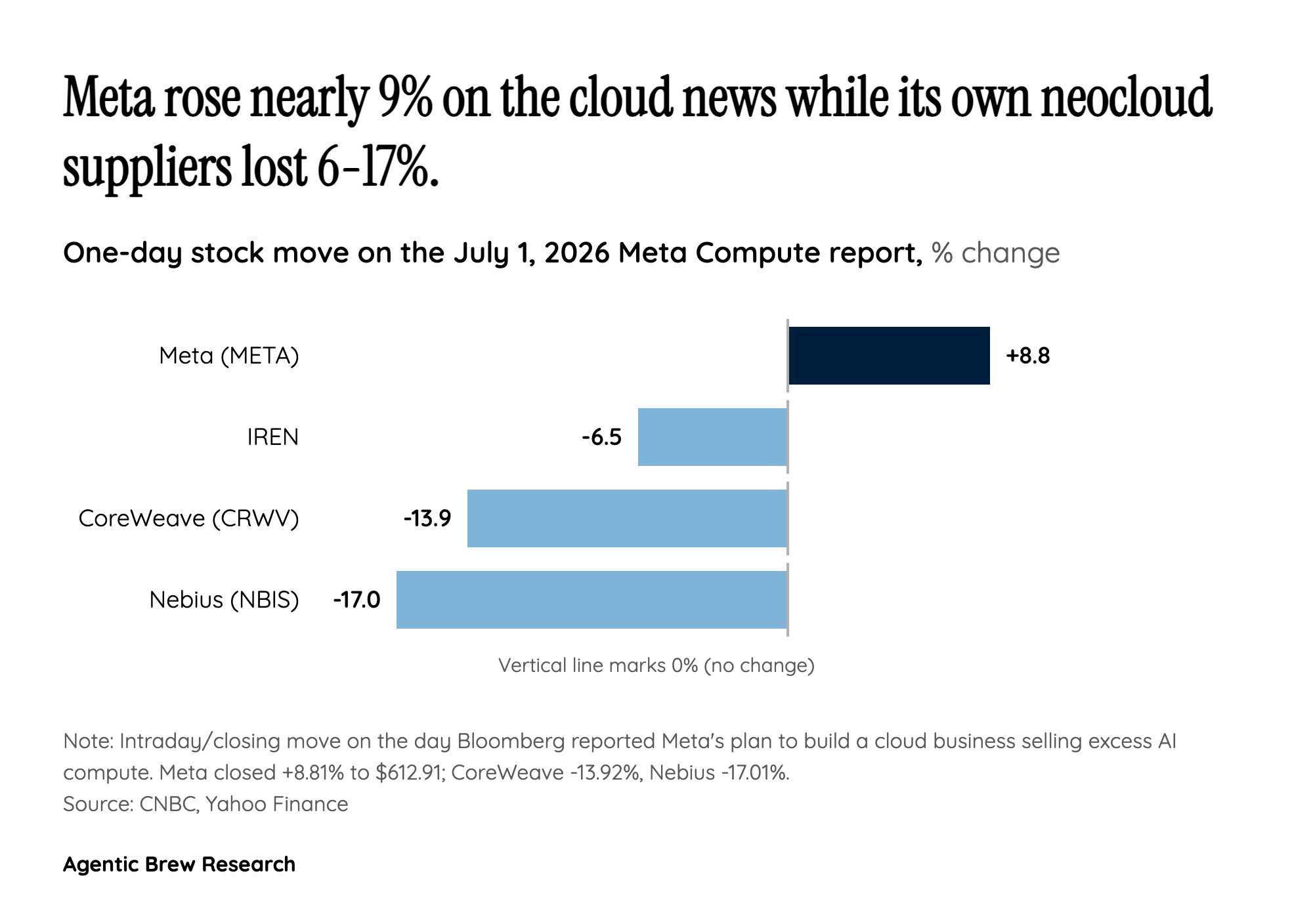
The market split its verdict: Meta up, its own suppliers down

The market split its verdict: Meta up, its own suppliers down
Meta closed up 8.81% on the July 1, 2026 cloud report while neocloud suppliers CoreWeave, Nebius, and IREN fell 6-17% the same day.

The reaction was a clean bifurcation. Meta closed up nearly 9% - specifically +8.81% to $612.91 - adding roughly $149 billion in market value on the report [3]. Its suppliers moved the opposite direction and hard: CoreWeave fell 13.92% to $85.69, Nebius dropped 17.01% to $229.18, and IREN slid about 6.5% [5]. The tremor did not stop at the neoclouds. Chip names including Micron, Nvidia, Broadcom, AMD, Marvell, Intel, ASML, and TSMC traded lower as some investors read 'excess compute' as an early tell that Meta's enormous capex - $72.2 billion in 2025, guided to $125-145 billion for 2026 - might eventually get trimmed [7][9]. That is the paradox in a single trading session: the same words that told equity investors Meta had found a new revenue lever told supplier and chip investors that a wall of future spending might soften.

Capex recovery narrative, or a rationalization of overbuilding?

Underneath the price action sits a genuine disagreement about what 'excess compute' actually means. The bull framing, articulated by Wells Fargo's Ken Gawrelski, is that market confidence is improving in companies that monetize their compute investments directly through a cloud business - idle capacity from a massive buildout becomes revenue instead of a sunk cost [6]. It is the AWS origin story retold: sell the surplus you built for yourself [2]. The skeptic framing, loudest on Reddit across r/wallstreetbets, r/stocks, and r/BetterOffline, inverts the logic - 'excess' is not a strategic asset but an admission that Meta built more than it can use and is now scrambling to justify the spend. The most-repeated question there was simply 'who is actually buying?' If every hyperscaler and SpaceX builds surplus capacity to sell to one another, where does real end-demand come from? A contrarian strand within the skeptics noted that much AI capacity is not even built yet, reading the move less as a demand peak and more as Meta's own AI lag plus a hunger for faster ROI. Notably, one thread the two camps share: Meta's continued willingness to spend billions is itself evidence that compute demand remains massive, which is why some analysts called the selloff a reset of expectations rather than the end of the neocloud story [5][6].

Buying chips is easy; running a cloud is the hard part

Even granting Meta the capacity, the execution bar is high and the timing is unforgiving. Meta is evaluating two distinct products: an API layer offering access to hosted models - including its closed-weight Muse Spark models, in the mold of AWS Bedrock - and a raw-capacity offering in the neocloud vein that CoreWeave built a whole business on [1]. Both are more than a rack of GPUs. A real cloud demands billing, provisioning, support, SLAs, and enterprise tooling that AWS, Azure, and Google Cloud have spent well over a decade compounding. That gap is exactly what Jefferies analyst Brent Thill pressed on in broadcast commentary, warning that the core downside for Meta is that it is really late - entering a market whose incumbents already own the enterprise relationships and the tooling moat. The plans are also early and could still change per the report [8], and the three-person leadership group Meta reportedly assigned to the effort reads as a serious enterprise entry rather than an experiment [1]. But seriousness does not erase the lateness, and it is the one point on which the bulls' cloud optimism and the skeptics' 'who is buying' both have to reckon with the same incumbents.

Historical Context

2025-12-31
Meta spent $72.2 billion on capex in 2025, with 2026 guidance set to nearly double that figure.
2026-04-09
CoreWeave signed a roughly $21 billion capacity agreement with Meta running through December 2032, cementing Meta as a marquee neocloud customer.
2026-04-29
Meta raised its 2026 capex guidance from $115-135B to $125-145B, citing higher component and data center costs.
2026-05
SpaceX signed a deal with Anthropic to buy out compute at its Colossus 1 data center, followed by similar leases with Google and Reflection AI - the template Meta is now echoing.
2026-07-01
Bloomberg published the Meta Compute report; Meta stock surged about 9% while neocloud stocks cratered.

Power Map

Key Players
Subject

Meta launches cloud business for excess AI compute

ME

Meta Compute (new unit)

The internal division running the cloud effort, reportedly led by a three-person group of Santosh Janardhan, Daniel Gross, and Dina Powell McCormick - a lineup signaling a deliberate enterprise push, not a side project.

AW

AWS, Microsoft Azure, Google Cloud

Incumbent hyperscalers that Meta Compute would compete against directly for enterprise cloud and hosted-model workloads.

CO

CoreWeave (CRWV)

Neocloud provider and current Meta supplier via a roughly $21B capacity deal announced April 9 running through December 2032; its stock fell about 14% on the news.

NE

Nebius (NBIS)

Neocloud provider holding a deal worth up to $27B over five years with Meta, with capacity beginning in 2027; its stock fell about 17%.

SP

SpaceX / xAI

Precedent-setter that announced similar excess-compute monetization weeks earlier, inking deals reportedly worth $1.25B per month with Anthropic and $920M per month with Google.

MA

Mark Zuckerberg

Meta CEO who signaled in late May 2026 that an enterprise cloud venture was 'definitely on the table,' foreshadowing the July report.

Fact Check

9 cited
  1. [1] Meta Plans AI Cloud Business to Challenge AWS, Azure, Google Cloud: Report
  2. [2] Meta, like SpaceX, looks to turn excess AI compute into cash
  3. [3] Meta stock rises on report of new AI cloud compute business
  4. [4] Nebius, CoreWeave, IREN tumble on Meta cloud report
  5. [5] CoreWeave, Nebius shares slide as Meta plans its own cloud
  6. [6] Wells Fargo Maintains Overweight Rating on Meta Platforms (META)
  7. [7] Meta surges on report of entering cloud business with excess compute
  8. [8] Meta Is Building a Cloud Business to Sell Excess AI Compute
  9. [9] Meta estimates 2026 capex to be between $115-135bn

Source Articles

Top 5

THE SIGNAL.

Analysts

"Maintained an 'Overweight' rating on Meta, arguing broader market confidence is improving in companies that monetize their compute investments directly through a cloud business - a bull-case read of the excess-compute pivot."

Ken Gawrelski
Analyst, Wells Fargo

"Voiced the sharpest skeptic take on execution and timing, framing the risk bluntly: for Meta, the downside is that they are really late to a market the hyperscalers already own."

Brent Thill
Analyst, Jefferies

"Read the neocloud selloff as a reset of expectations rather than the end of the neocloud story - Meta's willingness to keep spending billions on compute validates that end-demand remains massive even as it turns competitor."

Market analysis (The Next Web / Yahoo Finance)
Market commentary
The Crowd

"$META is reportedly developing a cloud business to sell access to excess AI compute, per Bloomberg. The internal initiative is called Meta Compute. The plans being considered: AI model access hosted on Meta infrastructure, similar to AWS Bedrock Raw AI compute capacity,"

@@wallstengine523

"🚨 BREAKING🚨 $META DEVELOPING PLANS FOR A CLOUD INFRASTRUCTURE BUSINESS THAT WILL SELL ACCESS TO AI COMPUTING POWER AND MODEL $META Just joined the neocloud compute race + $AMZN AWS, $MSFT AZURE, and $GOOGL Cloud."

@@TheTechInvest76

""I think the downside for $META is they're really late," says Jefferies analyst Brent Thill of the company getting into the cloud business."

@@SquawkCNBC22

"Meta Is Building a Cloud Business to Sell Excess AI Compute"

@u/jsg24fps715
Broadcast
Meta to build cloud infrastructure business to sell AI compute

Meta to build cloud infrastructure business to sell AI compute

Meta Platforms Getting Into Cloud Infrastructure Business | Closing Bell

Meta Platforms Getting Into Cloud Infrastructure Business | Closing Bell

Meta to Build Cloud Business to Sell Excess AI Compute | Bloomberg Tech 7/01/2026

Meta to Build Cloud Business to Sell Excess AI Compute | Bloomberg Tech 7/01/2026