LingBot-World 2.0 open-source real-time world model
TECH

LingBot-World 2.0 open-source real-time world model

21+
Signals

Strategic Overview

  • 01.
    Robbyant, an embodied-AI company within Ant Group, open-sourced LingBot-World 2.0 (also called LingBot-World-Infinity), an interactive world model, in early July 2026.
  • 02.
    The model targets real-time 720p output at 60fps and up to an hour of continuous generation without perceptible quality decay, using a causal pretraining approach plus a MoBA mechanism to prevent long-horizon drift.
  • 03.
    The released checkpoint is a 14B-parameter model (lingbot-world-v2-14b-causal-fast) built on the Wan2.2 foundation, with a 1.3B variant for a single consumer GPU, distributed under a non-commercial CC BY-NC-SA 4.0 license via GitHub, Hugging Face, and ModelScope.
  • 04.
    It launched alongside Robbyant's broader embodied-AI stack, including LingBot-VA 2.0, a causal video-action model for physical robot control unveiled on July 11, 2026.

Fixing the Bug That Melts Every Long Video World

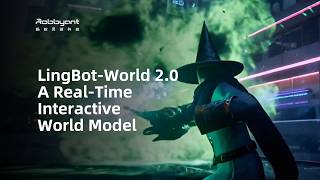
World models generate each new frame from the frames that came before, so a single small error compounds - textures smear, geometry bends, and the scene eventually collapses. That failure mode is why most interactive world models start breaking apart after seconds or minutes. LingBot-World 2.0 attacks it at the training level: Robbyant pretrains the model causally, so it learns how a world evolves strictly in chronological order, and adds a mechanism the team calls MoBA to keep long-horizon generation from accumulating those errors [3]. Reporting on the release describes the result as hour-long continuous generation with no perceptible quality decay [2].

The model is only half the system. Robbyant wraps it in an agentic harness where a vision-language model plans events and the video generator renders them. Two agents run the loop: a pilot agent that plans and executes the character's behavior, and a director agent that keeps injecting fresh environmental events so the world does not simply run dry as you explore [1]. The comparison the team draws is to coding agents: a strong base model only becomes useful once it sits inside a scaffold that lets it inspect state, act, and chase a goal across many turns.

An Hour Is a Demo, Not a Benchmark

The headline numbers deserve a skeptical read. A technical breakdown by MarkTechPost notes that the 720p/60fps figure depends on deployment infrastructure Robbyant did not release, and that the public reference implementation actually runs at 480x832 resolution across eight GPUs [1]. The hour-long stability claim rests on a single qualitative 60-minute rollout, with no standard world-model benchmarks - no VBench, no FVD - to back it up [1].

There is also a licensing catch that limits who can build on it. The weights are open, but they ship under a non-commercial CC BY-NC-SA 4.0 license, and Robbyant explicitly declined to release its deployment code [5]. So the model that hits 720p/60fps in the marketing is not the same artifact a developer can download and reproduce today. That gap between the demo reel and the downloadable checkpoint is the single most important thing to understand about this release.

What Happened When People Actually Downloaded It

The open weights collided with reality fast. Although the released checkpoint is a 14B-parameter model, it lands as roughly 74GB of weights plus a separate multi-gigabyte text encoder, and the developer community immediately zeroed in on whether it can run on anything short of a server rack. The prevailing conclusion was that consumer use waits on aggressive quantization - shrinking the weights to 8-bit or 4-bit - and that no ready-to-run tooling such as GGUF files or ComfyUI nodes existed yet at launch.

The sharper debate was philosophical: is this a persistent world or just steerable video? Skeptics pointed out that the model forgets what is behind you when you turn around, arguing there is no underlying 3D state, only frames generated in reaction to your inputs. The release itself is candid about this limitation: it does not claim true long-term memory, and areas outside the current view can be regenerated rather than recalled exactly. Yet the hands-on reactions were still striking - one builder rigged up a playable scene where a chicken behaves like a weapon and reported that objects stayed coherent across scenes and that mouse-driven camera control felt closer to a real game than anything they had used before. The tension between 'it is only video' and 'it already feels like a game' is exactly where this technology sits right now.

Why Ant Group Shipped a Whole Stack at Once

LingBot-World 2.0 did not arrive alone. It is one piece of a six-model embodied-AI stack Robbyant has been rolling out, which also includes LingBot-Depth 2.0, LingBot-Vision, LingBot-VLA 2.0, LingBot-Video, and - two days after the world model - LingBot-VA 2.0, a causal video-action model built from scratch for controlling physical robots rather than adapted from a digital video generator [4]. Read together, these are not one-off research demos; they are the layers of a full-stack bet on Physical AI, backed by Ant Group's balance sheet.

The move also reads as a fast-follower play. Open-sourcing a real-time, interactive world model and giving the weights away - even under a non-commercial license - is a classic way to win developer mindshare and set the open baseline before rivals lock it down [5]. The strategy trades near-term commercial control for ecosystem gravity: if researchers and builders standardize on LingBot as the open world-model stack, Robbyant sets the terms for what comes next. That is the actual prize here, not the hour-long demo, but the platform position underneath it.

Historical Context

2026-01-28
Robbyant first open-sourced LingBot-World (v1), a world model built for millisecond-level real-time interaction.
2026-07-09
Robbyant unveiled LingBot-World 2.0 (Infinity), extending the horizon from minutes to hour-long continuous generation with a native agentic framework.
2026-07-11
Robbyant unveiled LingBot-VA 2.0, a causal video-action model for Physical AI, completing its six-model embodied-AI stack.

Power Map

Key Players
Subject

LingBot-World 2.0 open-source real-time world model

RO

Robbyant

Embodied-AI company within Ant Group; developer and open-source publisher of LingBot-World 2.0 and the surrounding LingBot stack. It sets the release cadence and the licensing terms that decide who can build on the model.

AN

Ant Group

Parent company bankrolling Robbyant's push into world models and Physical AI, providing the corporate and financial platform behind an unusually fast six-model release cadence.

SG

SGLang

Inference framework given day-0 support for LingBot-World 2.0, lowering the barrier for third parties to serve the model even though Robbyant withheld its own deployment code.

GI

GitHub, Hugging Face, and ModelScope

Distribution platforms hosting the open weights and code, and the practical channel through which researchers and developers can actually obtain and run the model.

Fact Check

5 cited
  1. [1] Meet LingBot-World-Infinity, an Open Causal World Model with an Agentic Harness
  2. [2] Robbyant open-sources LingBot-World 2.0 for live video
  3. [3] Robbyant Unveils LingBot-World 2.0, Pioneering Hour-Long Real-Time Generation in World Models
  4. [4] Ant Group's Robbyant Unveils LingBot-VA 2.0: A Causal Video-Action Model Built Natively for Physical AI
  5. [5] Robbyant/lingbot-world-v2

Source Articles

Top 4

THE SIGNAL.

Analysts

"The 720p/60fps claim depends on deployment infrastructure Robbyant did not release; the public reference runs at 480x832 across eight GPUs, and the hour-long stability rests on a single qualitative rollout with no VBench or FVD benchmarks."

MarkTechPost
AI/ML technical publication

"The model's core contribution is sustaining consistent output quality over an effectively unbounded interaction horizon, achieved through causal factorization and self-rollout distillation rather than higher resolution."

MarkTechPost
AI/ML technical publication
The Crowd

"Robbyant released LingBot-World 2.0 (Infinity), a new open-source World model capable of generating hour-long experiences. > No quality decay, stable 720p / 60 fps real-time output. > Users can interact with the world via Actions. > The world is dynamic, with built-in agents"

@@testingcatalog104

"LingBot World 2.0 made me think about how quickly world models are evolving. The most interesting part isn't the hour long generation. It's the idea of AI worlds that keep responding, changing, and creating new experiences as you explore. That feels like a meaningful step"

@@manishkumar_dev48

"LingBot-World is unveiled as an open-source, real-time interactive world model built on Alibaba's Wan2.2, capable of generating. But heres the catch: nearly 10 minutes of stable, continuous generation - even after the camera looks away for 60 seconds, objects remain intact when"

@@kimmonismus523

"lingbot world. A new open weights world model."

@u/AffectionateSwim6614392
Broadcast
Introducing LingBot-World 2.0: The First Hour-Long Interactive World Model | Open Source

Introducing LingBot-World 2.0: The First Hour-Long Interactive World Model | Open Source

China's Answer to Google Genie 3 is Here (LingBot-World)

China's Answer to Google Genie 3 is Here (LingBot-World)

Lingbot-World Real-Time World Model and MOVA's Video-Audio AI Video Release

Lingbot-World Real-Time World Model and MOVA's Video-Audio AI Video Release