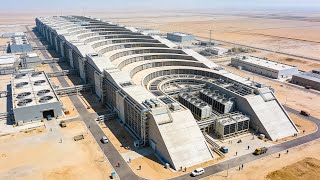
China's $295B national AI data center buildout
TECH

China's $295B national AI data center buildout

34+
Signals

Strategic Overview

  • 01.
    China is preparing to invest roughly 2 trillion yuan ($295 billion) over five years to build a nationwide network of AI data centers, with the NDRC drafting a blueprint to link computing hubs into a single interconnected national network by 2028.
  • 02.
    At least 80% of the technology used, including AI chips, would have to come from domestic suppliers such as Huawei, effectively shutting Nvidia and AMD out of the state-directed buildout.
  • 03.
    State telecom giants China Mobile and China Telecom would operate the bulk of the data centers and ensure interconnection, funded mainly through ultra-long-term government bonds and state investment funds, supplemented by bank loans and private capital.
  • 04.
    The plan is part of China's 'Six Networks' infrastructure program announced earlier in 2026, which treats computing power as national infrastructure alongside the power grid, water, communications, urban pipelines, and logistics.

Deep Analysis

The 80% rule is the real story: a forced de-Americanization of compute

The headline number is $295 billion, but the consequential clause is the requirement that at least 80% of the technology — chips included — come from domestic suppliers like Huawei [1]. That threshold is engineered to be unmeetable with imported silicon, which is why coverage frames it as effectively locking out Nvidia and AMD [2]. The timing is not accidental: just two weeks before the plan surfaced, China certified nine domestic AI chips for state procurement — Huawei's Ascend line alongside Alibaba's T-Head, Biren, Hygon, Iluvatar, MetaX, and Moore Threads [3]. That certification list is what makes an 80% domestic mandate operationally credible rather than aspirational; it pre-loads the approved supplier roster the buildout will draw from. The bullish read circulating in tech communities compresses this into a simple line — the state is spending to replace Nvidia with Huawei — and on the procurement mechanics, that framing is directionally correct: Beijing is using its own checkbook to manufacture demand for domestic accelerators at national scale.

Follow the money: debt-funded and state-operated, not private capex

Follow the money: debt-funded and state-operated, not private capex
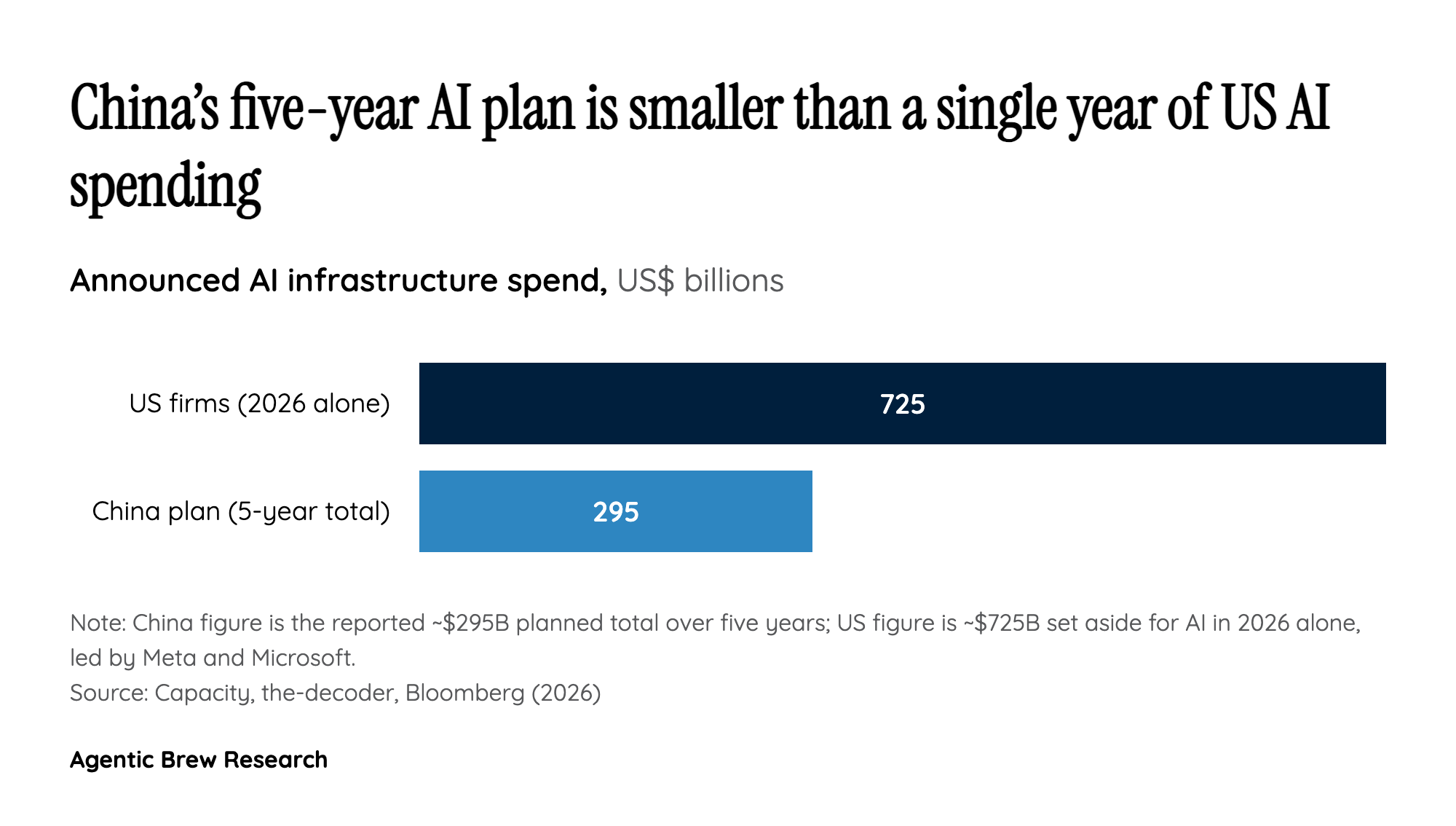
China's reported $295B five-year AI buildout against the ~$725B US firms are setting aside for AI in 2026 alone.

The financing structure tells you this is industrial policy, not a market. Funding comes mainly from ultra-long-term government bonds and state investment funds, supplemented by bank loans and private capital [1], and the data centers themselves would be operated largely by state telecoms China Mobile and China Telecom [2]. That is structurally the opposite of the US model, where hyperscalers like Meta and Microsoft are deploying private balance sheets. The scale gap is real: $295 billion over five years sits against roughly $725 billion that US firms are setting aside for AI in 2026 alone [2], though Chinese builds cost meaningfully less per unit of capacity. The buildout also slots into the broader 'Six Networks' program, where the NDRC projects total infrastructure investment to exceed 7 trillion yuan (~$1 trillion) this year [4]— the AI data center plan is one tributary of a much larger state capital flow that treats compute as national infrastructure on par with the power grid.

The overcapacity ghost: China already built hundreds of idle data centers

The strongest case against the plan is China's own recent history. The 2022 Eastern Data Western Computing push triggered hundreds of large-scale builds, and by early 2025 MIT Technology Review reported that many stood unused — up to 80% of newly built compute idle, utilization at 20-30%, and H100 server rentals collapsing from ~180,000 to 75,000 yuan/month as oversupply met weak deployment [5]. RAND's Jimmy Goodrich attributes that to inexperienced corporations and local governments chasing hype rather than planning deployment [5], and SMIC's own chief has warned that utilizing ballooning capacity 'has not been fully thought through' [6]. The skeptical reception in technical communities sharpens this: the most-shared contrarian thread argues China's best all-domestic cluster remains a fraction of the size of a top US facility, so the dollars don't yet translate into competitive compute. A centrally-coordinated, standardized national grid is partly an attempt to fix that fragmentation, but it does not by itself solve the demand problem that left the last wave dark.

Why now: export controls plus a unification problem Beijing hasn't solved

Two pressures converge to explain the timing. First, US export controls and the drive for self-sufficiency make the 80% domestic mandate a strategic necessity, not just a preference [1]. Second, the prior buildout left a technically fractured landscape: data centers running Nvidia's CUDA stack cannot be seamlessly pooled with those running Huawei's CANN, and remote western siting compromises latency for sensitive workloads [7]. Standardizing and interconnecting public computing power nationwide by 2028 is the explicit goal, but fusing incompatible hardware stacks into a single coherent cloud is a hard systems problem that money alone does not resolve [7]. The deeper signal — echoed in community discussion that frames AI as shifting from a tech-industry project to national infrastructure judged on security rather than ROI — is that Beijing is willing to absorb idle-capacity risk and inefficiency as the price of building a sovereign, US-independent compute base.

Historical Context

2022
China launched a national strategy to route eastern data demand to cheaper western data centers, triggering hundreds of large-scale builds.
2025-03-26
Reported that hundreds of AI data centers built during the boom now stand unused, with up to 80% of newly built compute idle and H100 server rentals falling from ~180,000 to 75,000 yuan/month.
2025-07-24
China began developing a nation-spanning network to resell surplus compute, with latency and Nvidia-CUDA-vs-Huawei-CANN fragmentation flagged as key hurdles; target to standardize interconnection by 2028.
2026-05-27
Nine domestic AI chips (including Huawei Ascend, Alibaba T-Head, Biren, Hygon, Iluvatar, MetaX, Moore Threads) certified for state procurement; Cambricon and Kunlunxin notably absent.
2026-06-09
Bloomberg first reported the $295 billion five-year nationwide AI data center plan with its 80% domestic-component requirement.

Power Map

Key Players
Subject

China's $295B national AI data center buildout

NA

National Development and Reform Commission (NDRC)

Lead state planning agency drafting the blueprint for the interconnected national computing network; controls the policy and capital direction of the buildout.

CH

China Mobile and China Telecom

State telecom operators that will run the bulk of the data centers and provide the interconnection backbone, placing them at the center of national AI infrastructure.

HU

Huawei Technologies

Primary domestic chip supplier (Ascend accelerators) expected to fill much of the 80% domestic-component requirement.

NV

Nvidia and AMD

US chipmakers effectively excluded; the 80% domestic threshold leaves them little room to participate in the state buildout.

DO

Domestic chipmakers (Alibaba T-Head, Biren, Hygon, Iluvatar CoreX, MetaX, Moore Threads)

Beneficiaries; nine of their chips were certified for state procurement, qualifying them as suppliers to the buildout alongside Huawei.

Fact Check

7 cited
  1. [1] Beijing's $295 billion AI buildout would require 80 percent domestic chips, locking out US suppliers
  2. [2] China plans $295bn AI investment
  3. [3] China certifies nine domestic AI chips for government procurement
  4. [4] China ramps up building national computing power network as AI token demand surges
  5. [5] China built hundreds of AI data centers to catch the AI boom. Now many stand unused.
  6. [6] China's top chipmaker warns that rushed AI data center capacity could remain idle
  7. [7] China is developing a nation-spanning network to sell surplus data center compute power

Source Articles

Top 5

THE SIGNAL.

Analysts

"Argues China's data-center overbuild stems from inexperienced corporations and local governments chasing hype rather than sound deployment planning."

Jimmy Goodrich
Senior advisor, RAND Corporation

"Contends the bottleneck is no longer infrastructure but concrete plans to actually deploy AI: 'What stands between now and a future where AI is actually everywhere...is not infrastructure anymore, but solid plans to deploy the technology.'"

Fang Cunbao
Data center project manager (quoted in MIT Technology Review)

"Notes the paradox of high Nvidia chip acquisition costs in China coexisting with collapsing GPU leasing prices driven by oversupply: 'It's paradoxical—China faces the highest acquisition costs for Nvidia chips, yet GPU leasing prices are extraordinarily low.'"

Xiao Li
Data center project manager (quoted in MIT Technology Review)
The Crowd

"BREAKING: China is spending $295 billion to replace Nvidia with Huawei across its entire AI infrastructure. China announced today it will build a nationwide AI data center network over the next 5 years operated by state firms China Mobile and China Telecom. At least 80% of all"

@@BullTheoryio936

"The Shenzhen gov says it built China's largest datacenter that has only Chinese AI chips, using 10,000 Huawei Ascend 910Cs. This is TINY - equal to what OpenAI trained GPT4 on in 2022, and 1% of the biggest U.S. datacenter today. China's AI data centers are a full four years"

@@ChrisRMcGuire290

"CHINA EYES MASSIVE $295 BILLION AI DATA CENTER EXPANSION ACROSS THE COUNTRY: BBG"

@@REDBOXINDIA252

"China Preps $295 Billion Plan to Fund Nationwide AI Buildout"

@u/Logical_Welder3467116
Broadcast
Why China Is Building an AI Megaplex in the Desert

Why China Is Building an AI Megaplex in the Desert

China builds underwater AI data centers at less than half price

China builds underwater AI data centers at less than half price

How China Built the World's Largest AI Mega Data Center

How China Built the World's Largest AI Mega Data Center