
Amazon Q2 2026 earnings: AWS revenue grew 37% year-over-year to $42.2 billion, its fastest pace since 2021, driving a 9-14% stock surge even as capex guidance rose to $220 billion and free cash flow turned negative.
TECH

Amazon Q2 2026 earnings: AWS revenue grew 37% year-over-year to $42.2 billion, its fastest pace since 2021, driving a 9-14% stock surge even as capex guidance rose to $220 billion and free cash flow turned negative.

36+
Signals

Strategic Overview

  • 01.
    AWS revenue hit $42.2 billion in Q2 2026, up 37% year-over-year (36.7% precisely) - its fastest growth rate in 18 quarters, since 2021 - as AI and Chips businesses each topped $25 billion in annualized run rate.
  • 02.
    Total Amazon net sales reached $200.6 billion, up 20% year-over-year, the first time quarterly revenue topped $200 billion and above the $196.47 billion analyst estimate.
  • 03.
    Amazon raised its 2026 capex guidance to about $220 billion (from about $200 billion) citing rising memory chip costs, while trailing-twelve-month free cash flow swung from an $18.2 billion inflow to a $7.6 billion outflow.
  • 04.
    Amazon shares surged roughly 9% after hours and as much as 12-14% the next trading day, while Apple fell about 8-9% the same week on weak guidance tied to the same memory/chip supply squeeze.

Deep Analysis

The Anthropic Windfall Behind the Headline Beat

Amazon's headline Q2 2026 numbers look almost too good: net income of $62.6 billion, or $5.75 per diluted share, blew past the $1.82 consensus estimate[1]. But the scale of that beat has less to do with retail or cloud operations than with a single balance-sheet event - a pre-tax gain of more than $53 billion tied to the mark-to-market value of Amazon's equity stake in Anthropic[2]. Strip that gain out and the underlying earnings picture is considerably less dramatic, a detail largely absent from the celebratory framing that followed the print. Investor discussion circulating alongside the earnings reaction estimated that, excluding the Anthropic gain, net income was closer to roughly $9 billion for the quarter, with adjusted EPS separately estimated by other investors as missing prior guidance and landing close to flat year-over-year - two independent back-of-envelope community estimates using different methodologies, not a single reconciled figure. None of this makes AWS's operating performance fake: AWS operating income genuinely rose to $16.6 billion at a 39.4% margin[1]. But it does mean that much of the enthusiasm behind Amazon's 9-14% post-earnings stock surge[3]was reacting, in significant part, to a one-time investment gain rather than a repeatable jump in core profitability.

The Circularity Question: Whose AI Demand Is AWS Really Capturing?

A tougher question than the accounting quirk is a structural one raised in investor discussion around the print: how much of AWS's headline 37% growth[1]reflects external enterprise demand versus Amazon's own capital circulating back to itself. Amazon holds a large and growing equity stake in Anthropic[2], one of AWS's biggest AI compute customers, and community financial analysis flagged that Amazon's quarterly purchases of non-marketable securities - largely tied to Anthropic - run into the tens of billions of dollars, raising the question of how cleanly an 'AI revenue run-rate' can be separated from investment dollars flowing back through the same balance sheet. Nothing in Amazon's public disclosures separates organic AWS demand from demand effectively pre-funded by Amazon's own investment activity, and that ambiguity matters more as AWS's contracted backlog and AI/Chips run-rates get cited as evidence of durable, market-driven growth[4]. It doesn't invalidate the acceleration - AWS's AI and Chips businesses each independently topped $25 billion in annualized run rate[1]- but it complicates any clean read of AWS's growth as pure external validation of enterprise AI adoption. A widely-shared rebuttal in the same discussion pushed back on parts of the adjusted-EPS math, but even that rebuttal conceded the core point: the filing doesn't let anyone cleanly separate organic AWS demand from Amazon-funded demand.

Capex Escalation and the Negative Free Cash Flow Trade-off

The clearest, least disputed cost of AWS's growth spurt shows up in Amazon's cash flow statement. Trailing-twelve-month free cash flow swung from an $18.2 billion inflow a year earlier to a $7.6 billion outflow[5], driven entirely by capex outpacing gains in operating cash flow. Amazon simultaneously raised its full-year 2026 capex guidance to about $220 billion, up roughly 10% from the prior $200 billion figure, attributing the increase specifically to rising memory chip costs rather than added capacity volume[6]. Jassy's own framing on the earnings call underscores why the spending isn't slowing: even at $220 billion, AWS still will not have enough capacity to meet 2026 demand, and he described already-visible 2028 demand as striking, implying the capacity shortfall - and the capex needed to close it - persists well into 2027[4]. Community skeptics also flagged how that spending is increasingly being financed: long-term debt reportedly rose sharply quarter-over-quarter to roughly $129 billion, a recent bond offering was only modestly oversubscribed versus Amazon's historical norm, and datacenter buildouts are leaning on off-balance-sheet financing structures involving private-credit partners. Taken together, analysts frame this as a genuine inflection point for AI capex economics - one where hyperscalers' ability to keep converting spending into growth is being tested in real time[7].

A Tale of Two Earnings: AWS's Chip Shortage Windfall vs Apple's Chip Shortage Curse

A Tale of Two Earnings: AWS's Chip Shortage Windfall vs Apple's Chip Shortage Curse
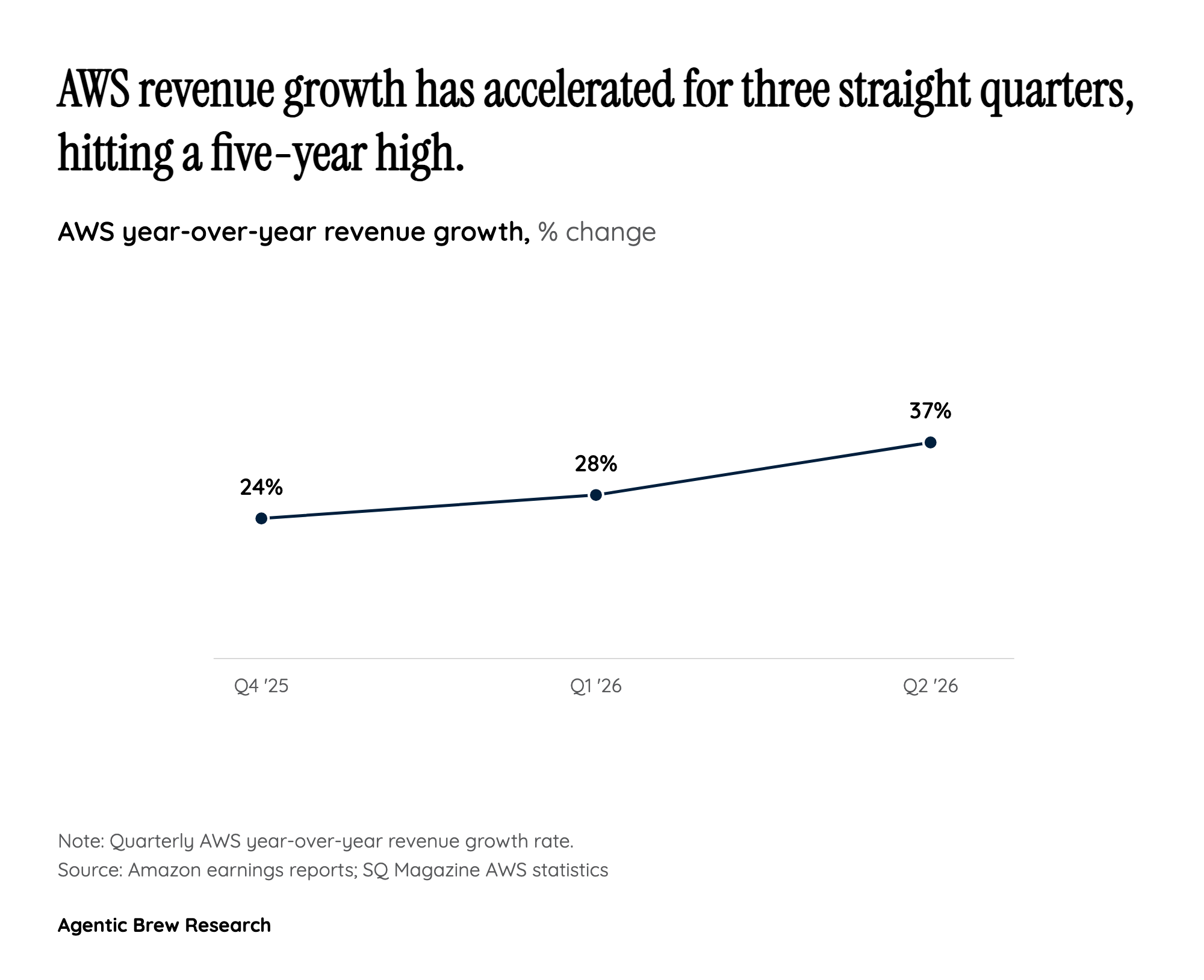
AWS year-over-year revenue growth accelerated for three consecutive quarters, from 24% in Q4 2025 to 37% in Q2 2026.

The starkest single-week contrast in this earnings cycle wasn't between Amazon and its cloud peers - it was between Amazon and Apple. Both companies reported the same week, and both were shaped by the same AI-driven chip and memory supply squeeze, but in opposite directions[3]. Amazon converted surging AI infrastructure demand into a 37% AWS growth beat and rallied as much as 12% the next session, while Apple fell roughly 8% on weak guidance tied to the same constrained chip supply chain[8]. Apple CEO Tim Cook explicitly flagged the 'increasing impact' of the memory shortage on the company's outlook[9]- the identical dynamic that let AWS raise prices and expand margins was squeezing Apple's hardware costs and availability. That divergence illustrates a broader pattern worth tracking through the rest of this AI infrastructure cycle: the same underlying scarcity (AI accelerators, high-bandwidth memory) can simultaneously reward cloud providers who can pass costs through to enterprise customers and punish device makers who compete for the same components at fixed consumer price points. AWS's own growth trajectory - 24% in Q4 2025, 28% in Q1 2026, then 37% in Q2 2026[10]- shows this is an accelerating story, not a one-quarter blip, which raises the stakes for how long the chip/memory bottleneck keeps cutting both ways.

Historical Context

2021-12
The last time AWS grew faster than 37% year-over-year was the quarter ending December 2021 - meaning Q2 2026's growth was its fastest in roughly five years, or 18 quarters.
2024
AWS revenue hit $100 billion for full-year 2024, the first cloud business to clear that annual threshold.
2025-12
AWS Q4 2025 revenue was $35.58 billion, up 24% year-over-year; full-year 2025 revenue was $128.7 billion, up 19.7%.
2026-02-05
Amazon stock fell 8% after Q4 2025 earnings on a $200 billion spending forecast and an earnings miss, setting the initial capex guidance later raised to $220 billion.
2026-03
AWS Q1 2026 revenue rose to $37.59 billion, up 28% year-over-year from $29.27 billion - at the time, its fastest pace in 15 quarters.

Power Map

Key Players
Subject

Amazon Q2 2026 earnings: AWS revenue grew 37% year-over-year to $42.2 billion, its fastest pace since 2021, driving a 9-14% stock surge even as capex guidance rose to $220 billion and free cash flow turned negative.

AM

Amazon.com, Inc. (AMZN)

Reporting company; parent of AWS

AM

Amazon Web Services (AWS)

Cloud computing division driving the earnings beat and stock surge - about one-fifth of revenue but the bulk of operating profit

AN

Andy Jassy

Amazon President and CEO; addressed AI demand, capacity constraints, and AWS's long-term trillion-dollar potential on the earnings call

AP

Apple Inc. / Tim Cook

Reported earnings the same week; stock fell roughly 8-9% on weak guidance as CEO Tim Cook flagged rising impact from the memory chip shortage

AN

Anthropic

AI company in which Amazon holds an equity stake; a mark-to-market gain of over $53 billion on this stake drove most of Amazon's reported net income beat

MI

Microsoft (Azure) / Google (Google Cloud)

Hyperscaler competitors also reporting cloud growth this earnings season; both carry larger absolute cloud backlogs than AWS

Fact Check

10 cited
  1. [1] Amazon Q2 2026 Earnings: AWS Revenue Jumps 37% as Cloud Growth Accelerates
  2. [2] CEO Andy Jassy Just Delivered Tremendous News to Amazon Investors
  3. [3] Apple, Amazon Stock Today: Investors Pick Post-Earnings AI Winners and Losers
  4. [4] Andy Jassy Says AWS Demand Still Outstrips Capacity Despite Record Capex
  5. [5] Amazon Stock Pops 10.8% on AWS Growth Payoff From AI Capex
  6. [6] Amazon (AMZN) Q2 2026 Earnings Report
  7. [7] Market Experiences an AI Capex Turning Point, With Tipping Point to Follow
  8. [8] Apple Sinks 8%, Amazon Soars 12% as Traders Pick Tech Earnings Winners and Losers
  9. [9] Apple Stock Falls on Weak Revenue Forecast as CEO Tim Cook Flags Increasing Impact From Memory Shortage
  10. [10] AWS Statistics 2026: Quarterly Revenue Growth Trends

Source Articles

Top 5

THE SIGNAL.

Analysts

Called Amazon's quarter the breakout the stock needed, framing AWS's growth acceleration as confirmation that AI infrastructure investment is starting to pay off.

Mark Mahaney (Evercore ISI)
Wall Street analyst

Called the results astonishing, while still noting Microsoft remains the standout performer among megacap tech peers.

Jim Cramer
CNBC commentator

Says AWS demand still outstrips capacity even at $220 billion in 2026 capex, expects the shortfall to persist into 2027-2028, and sees AWS potentially becoming a trillion-dollar annual revenue business.

Andy Jassy
Amazon President and CEO

Highlighted AWS's scale by noting its trailing-12-month revenue exceeds the annual revenue of 474 S&P 500 companies.

Charlie Bilello (Creative Planning)
Financial analyst

Called the AWS result nothing short of remarkable, while flagging that negative free cash flow is the tradeoff for that growth.

Gil Luria (D.A. Davidson)
Head of technology research
The Crowd

🦄Amazon reported Q2 earnings. Revenue was $200.6 billion, up 20%. AWS grew 37%, its fastest in 18 quarters. Net income was $62.6 billion, but $53.4 billion of that came from Anthropic investment gains. Strip those out and net income was about $9.2 billion. Free cash flow went...

@@HedgieMarkets453

$AMZN CEO Andy Jassy: “AWS will become a $1 trillion annual revenue business”

@@antibearthesis90

Wall Street just started betting against the same AI companies it is lending hundreds of billions of dollars to. This week four companies committed to spending almost a trillion dollars in a single year on AI infrastructure. Amazon raised its 2026 number to $220 billion.

@@Ric_RTP12

AMZN Quarterly Revenue $200.6 billion (up 20% YoY)

@u/Not69Batman675
Broadcast
Amazon's AWS Result Is 'Remarkable,' Analyst Luria Says

Amazon's AWS Result Is 'Remarkable,' Analyst Luria Says

LIVE NOW: AMAZON & APPLE EARNINGS REPORT TODAY!!!

LIVE NOW: AMAZON & APPLE EARNINGS REPORT TODAY!!!

Amazon & Apple Both Report Earnings | The Close 7/30/2026

Amazon & Apple Both Report Earnings | The Close 7/30/2026

Amazon Q2 2026 earnings: AWS revenue grew 37% year-over-year to $42.2 billion, its fastest pace since 2021, driving a 9-14% stock surge even as capex guidance rose to $220 billion and free cash flow turned negative. — AI News | Agentic Brew