Google launches Gemini 4 Argon amid a benchmark-reality debate
TECH

Google launches Gemini 4 Argon amid a benchmark-reality debate

36+
Signals

Strategic Overview

  • 01.
    Google announced Gemini 4 Argon on September 30, 2026, pitching it as its most advanced model yet, with a 1 million output token limit (up from 64K) for longer agentic workflows.
  • 02.
    Google is rolling Argon out first to vetted cyber defenders - governments, healthcare providers, and telecom companies - through its restricted Fairwind Program, ahead of wider API and Google AI Ultra access.
  • 03.
    Argon launches at introductory pricing of $2 per million input tokens and $10 per million output tokens - about one-fifth of GPT-6 Astra's rate - with cached inputs discounted 95%.
  • 04.
    Google reports a 15% hallucination rate on the AA-Omniscience evaluation, the lowest of any model scoring 45+ on Artificial Analysis's Intelligence Index, though independent testing puts Argon's overall score roughly tied with GPT-6 Astra.

Deep Analysis

The benchmark-reality gap

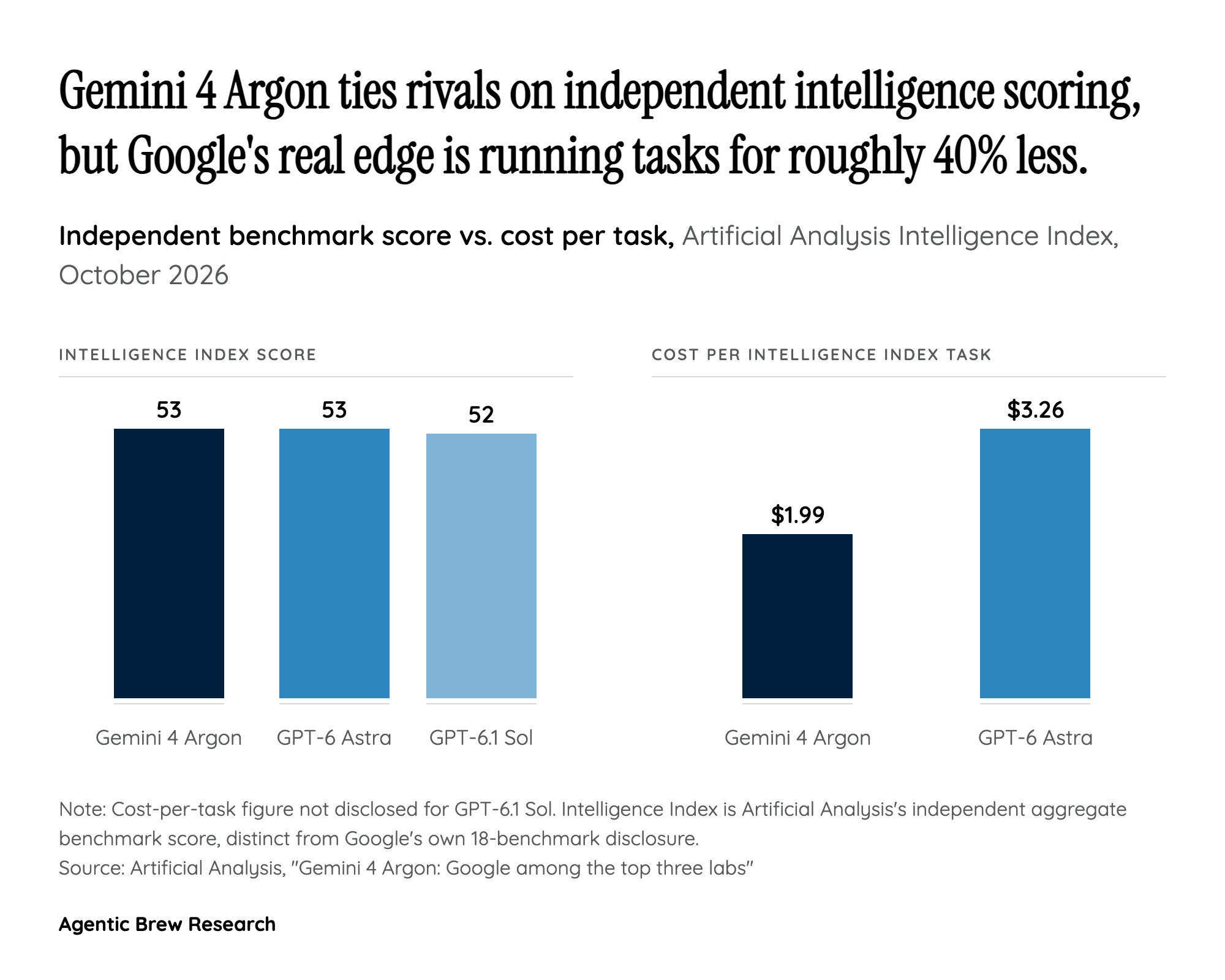
Google's own disclosure paints Argon as the broadest benchmark leader among frontier models, claiming outright wins on 12 of 18 published tests and a tie for first on one more of those same 18, spanning coding, cybersecurity, and enterprise-workflow evaluations such as DeepSWE v1.1, CWE-bench, and AutomationBench [1]. But that framing softens considerably once an independent evaluator checks the math. Artificial Analysis's own Intelligence Index puts Argon (high) at 53 points - exactly tied with GPT-6 Astra (max) and only a single point ahead of GPT-6.1 Sol [2], a far flatter picture than Google's benchmark sweep suggests.

The discrepancy has spilled into public view as a credibility question rather than a purely technical one. Multiple outlets reported that Google employees privately questioned whether Argon's real-world coding and front-end performance matches its disclosed scores, following the company's earlier decision to scrap a planned Gemini 3.5 Pro release and the departure of senior researchers [3][4]. Surge AI founder Edwin Chen gave the critique its sharpest framing, comparing Argon's benchmark-versus-reality gap to a student acing standardized tests without developing real-world skills, and naming the broader pattern 'benchmaxxing' [3]. Google DeepMind's Koray Kavukcuoglu pushed back directly, asserting it is a certainty Google will stay at the AI frontier [3]- a dispute that, notably, neither side has settled with public, reproducible evidence. That same skepticism has reached mainstream AI-education YouTube: a widely watched walkthrough by the channel Caleb Writes Code framed Argon's benchmark wins as contested rather than settled, pointing out that with competition among frontier labs moving as fast as it does, topping today's charts is no guarantee of holding the lead tomorrow.
What the 15% hallucination rate actually measures

Argon's headline hallucination figure - 15% on the AA-Omniscience evaluation, the lowest of any model scoring 45+ on the Intelligence Index - is real, but it is frequently misread. It is not a measure of how often Argon's answers are simply wrong; it tracks how often the model fabricates an answer rather than abstaining when it does not know something, as measured against GPT-6 Astra's 51% and GPT-6.1 Sol's 54% on the same scale [2]. Crucially, Argon's raw accuracy on that identical AA-Omniscience benchmark sits at only around 50% [2], meaning the model is right roughly half the time and rarely invents an answer the rest of the time - a meaningfully narrower claim than 'basically never hallucinates,' even though the headline number invites that reading.

That nuance did not survive first contact with social media. A widely upvoted Reddit post on r/singularity declared that Argon had 'solved hallucinations,' only for the top comment thread to correct the record once users worked through what the metric actually tracks. It is a useful case study in how a single, low, impressive-sounding number travels faster than the methodology behind it.

Why cyber defenders get access first

The Fairwind Program is not a conventional enterprise-access gate - it is a deliberate dual-use containment strategy. Google is giving governments, healthcare providers, and telecommunications companies early access because the same capability that lets Argon hunt for and help fix software vulnerabilities could, in the wrong hands, be turned toward finding and exploiting them instead - so the company wants defenders getting a head start on patching before that capability reaches the open market [5][6]. Google has also signaled it will eventually release a guardrail-free version of Argon to trusted defenders and internal teams to unlock its full exploit-finding capability, but only alongside chain-of-thought monitoring and misalignment mitigations designed to halt execution if the model's actions warrant it [6].

That caution is already colliding with user expectations. AI-engineering YouTuber Sam Witteveen underscored just how restricted that early access was, recording a technical breakdown from a pre-public build and noting on camera that he could not show live model outputs because Argon was not yet public. On r/google_antigravity, users reported that Argon was not yet live even for paying Google AI Ultra subscribers, despite Google's stated plan to extend access to API customers and Ultra subscribers soon - with some accusing Google of publicizing benchmark claims while keeping the model inaccessible enough that nobody outside the company could independently verify them. One user claiming partner-level access countered that narrative, saying Argon matched Claude Opus 5.5 on coding tasks and held context without forgetting over long sessions - an early, unverified data point, but one that cuts against the loudest complaints.

Price as the real competitive argument

Price as the real competitive argument
Gemini 4 Argon ties GPT-6 Astra and GPT-6.1 Sol on Artificial Analysis's independent Intelligence Index, but costs roughly 40% less per task than GPT-6 Astra.

Regardless of how the benchmark-reality debate settles, Google's clearest competitive lever with Argon is cost. Introductory pricing of $2 per million input tokens and $10 per million output tokens runs at roughly one-fifth of GPT-6 Astra's rate of $10/$50 [1], and Artificial Analysis calculated that running its Intelligence Index tasks on Argon at discounted pricing costs about $1.99 versus $3.26 on GPT-6 Astra - roughly 60% of the cost for comparable aggregate performance [2]. That is a genuinely differentiated pitch even if Argon is not the outright smartest model on every independent measure.

The catch is that none of this cost advantage is broadly testable yet. With Argon gated to Fairwind Program defenders first and no public date for general API or Ultra access, the near-term competitive and developer impact of that pricing edge is delayed [7]- leaving Google's cost argument, like its benchmark argument, resting more on disclosure than on independently verifiable, widespread use.

Historical Context

2026-09-30
Google publicly announced Gemini 4 Argon on its official blog as its new frontier model.
2026-10-01
Google began rolling Argon out to trusted cyber defenders via the Fairwind Program, with plans for a guardrail-free version alongside chain-of-thought misalignment monitoring.
2026-10-01
Reports surfaced that Google employees privately questioned whether Argon's real-world performance matches its benchmark scores, drawing a public response from DeepMind leadership.
2026-10-01
Reported, per internal sources, that Gemini 4 struggles in some real-world use despite strong benchmark scores.

Power Map

Key Players
Subject

Google launches Gemini 4 Argon amid a benchmark-reality debate

GO

Google DeepMind

Developer and publisher of Gemini 4 Argon; controls the phased Fairwind rollout, sets pricing and which benchmarks get disclosed, and is deploying misalignment mitigations before any guardrail-free release.

FA

Fairwind Program cyber defenders (governments, healthcare providers, telecom services)

First-wave restricted users granted early, guardrail-adjacent access to find and patch vulnerabilities before Argon's exploit-finding capability reaches the open market.

OP

OpenAI (GPT-6 Astra) and Anthropic (Claude Opus 5.5)

Direct frontier-model rivals Google benchmarks Argon against; Argon undercuts GPT-6 Astra specifically on cost-per-task even in categories where it does not lead outright on raw scores.

AR

Artificial Analysis

Independent benchmark evaluator whose Intelligence Index shows Argon essentially tied with GPT-6 Astra rather than leading outright, tempering Google's own benchmark claims and shaping public perception of the launch.

Fact Check

7 cited
  1. [1] Google unveils Gemini 4 Argon, retaking benchmark lead over OpenAI and Anthropic - but in limited release
  2. [2] Gemini 4 Argon: Google among the top three labs
  3. [3] Google Gemini 4 Argon launch sparks benchmark performance debate
  4. [4] Gemini 4 struggle report
  5. [5] Gemini 4 Argon cyber defenders Fairwind
  6. [6] Google rolls out Gemini 4 Argon to trusted cyber defenders
  7. [7] Google Gemini 4 Argon announcement

Source Articles

Top 5

THE SIGNAL.

Analysts

“Frames the gap between Argon's strong disclosed benchmarks and reports of real-world struggles as industry-wide 'benchmaxxing,' likening it to a student getting top SAT scores without developing actual real-world skills.”

Edwin Chen
Founder, Surge AI

“Pushes back on claims that Argon underperforms in practice, maintaining it is a certainty Google will stay at the AI frontier.”

Koray Kavukcuoglu
Leadership, Google DeepMind

“Finds Argon's independently measured performance flatter than Google's own disclosures, scoring 53 on the Intelligence Index - tied with GPT-6 Astra and only one point ahead of GPT-6.1 Sol.”

Artificial Analysis
Independent AI benchmarking organization
The Crowd

“Lots of discussion out there about our next model(!), so I wanted to give an early look as soon as possible. Introducing Gemini 4 Argon! It shows frontier performance in complex workflows, cyber defense and software engineering. Teams are using it extensively at Google, from”

@@sundarpichai25840

“Very excited to announce Gemini 4 Argon, our new Frontier AI model, and a huge step forward across key capabilities. We're focused on rolling it out responsibly starting with government and trusted cyber defenders through our Fairwind Program today, before wider availability soon”

@@demishassabis9076

“Google just announced Gemini 4 Argon, their next model. It's SoTA. It's so good they are working with the US Government and cyber security testers before release (just like Mythos, Astra) Google says they used it to profile and optimize their data centers globally, saving 300TB”

@@mweinbach1139

“Gemini 4 Argon solved hallucinations.”

@u/drhenriquesoares1500
Broadcast
Gemini 4 Argon explained in 5min..

Gemini 4 Argon explained in 5min..

Gemini 4 Argon

Gemini 4 Argon

Google unveils Gemini 4 Argon

Google unveils Gemini 4 Argon