Pew survey: American skepticism toward AI
TECH

Pew survey: American skepticism toward AI

24+
Signals

Strategic Overview

  • 01.
    A Pew Research Center survey released June 17, 2026 found only 16% of Americans believe AI's impact on society over the next 20 years will be positive, while around 40% say it will be negative.
  • 02.
    Roughly two-thirds of U.S. adults (about 63%) say AI is advancing too quickly, with only 19% saying it is moving at the right pace.
  • 03.
    Despite the skepticism, about half of U.S. adults now use AI chatbots, up from roughly a third in 2024, with about a quarter using them daily.
  • 04.
    The survey was conducted February 17-23, 2026 among 5,119 U.S. adults.

Deep Analysis

Americans Are Adopting AI Faster Than They Trust It

The defining tension in Pew's 2026 survey is not rejection but contradiction. Half of U.S. adults now use AI chatbots, up from about a third in 2024, and roughly a quarter reach for one daily [1]. Yet only 16% expect AI's societal impact over the next two decades to be positive, while around 40% brace for it to be negative [3]. People are folding the technology into their routines while withholding their faith in it. Pew's Jeffrey Gottfried captured the paradox plainly: usage is not endorsement, and Americans 'may use it, but they're still highly skeptical of it and how it will impact our society' [4]. That gap matters because it breaks the usual assumption that adoption signals approval. Habit, here, is running ahead of belief, and the product winning the most daily attention, ChatGPT at 44% of adults, is the same one feeding the unease [4].
The Expert-Public Chasm That Won't Close

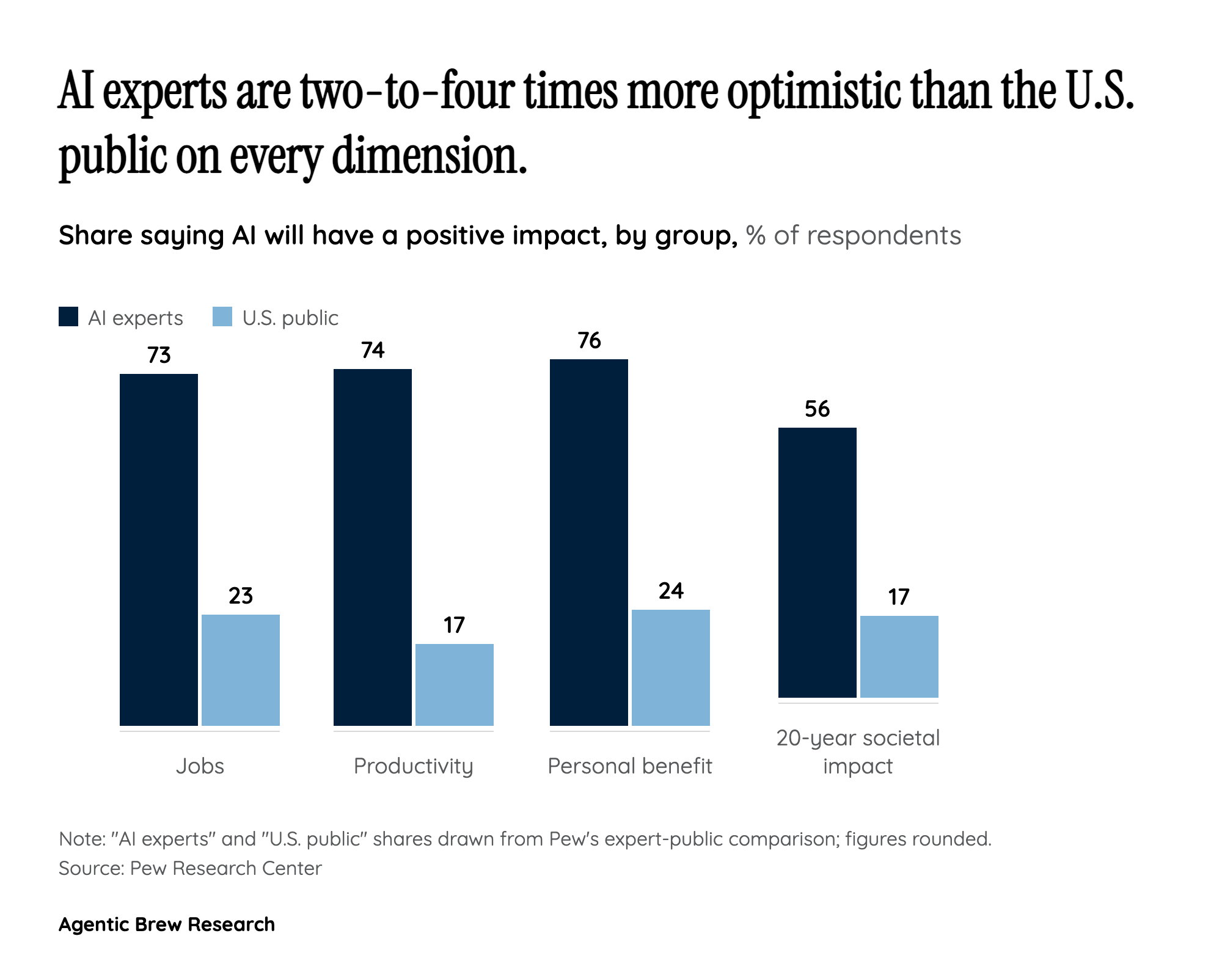
Beneath the headline numbers lies a deeper structural divide: the people building AI and the people living with it see almost opposite futures. Pew's Dr. Eileen Yam has detailed how the optimism gap holds across nearly every dimension. On jobs, 73% of AI experts are positive against just 23% of the public; on productivity, 74% versus 17%; on whether AI will personally benefit them, 76% of experts versus 24% of the public, with 43% of the public expecting personal harm. The earlier August 2024 study set the same pattern in the long view, with 56% of experts seeing a positive 20-year impact compared to only 17% of the public [5]. What makes this chasm notable is its durability and its breadth: it cuts across political affiliation, race, age, and gender, suggesting public skepticism is not a partisan artifact but a broad-based judgment that the industry's confidence has failed to earn.

A Trust Vacuum With No Obvious Referee

If Americans distrust AI's trajectory, the survey shows they also distrust the institutions meant to steer it. Sixty-seven percent have little or no confidence the U.S. government can regulate AI effectively, and 59% lack confidence that companies will develop and use it responsibly [1]. Neither the public sector nor the private sector commands a majority's trust to manage the technology, leaving a referee-shaped hole. The anxiety is concrete, not abstract: roughly seven-in-ten Americans (71%) predict AI will make their personal information less secure [2]. On X, Andrew Ng framed the broader pattern as a chasm between the AI community's optimism and the public's distrust, citing both Pew and Edelman findings, while TIME noted the rare cross-partisan consensus, from MAGA loyalists to Democratic socialists, that AI is simply moving too fast. On Reddit, the most-upvoted reactions traced the distrust to Big Tech's track record, energy and water costs of data centers, and AI-generated technical debt, echoing the survey's institutional skepticism rather than a fear of the technology itself.

The Generational Twist: Heaviest Users, Sharpest Doubts

Conventional wisdom says young people embrace new tech and older people resist it; Pew's age data complicate that story. Adults 18-29 are the heaviest chatbot users, at 66%, versus 23% of those 65 and older [2]. But familiarity has not bred comfort: 48% of under-30s expect AI to negatively impact society, against 35% of those 65-plus, and 37% think it will hurt them personally [2]. One-in-five under 30 even turn to chatbots for emotional support, a level of intimacy that coexists with deep wariness [2]. The Reddit response amplified this thread, with one widely surfaced statistic noting only 14% of under-30s view AI positively. The generation most fluent in AI is, in this reading, the most clear-eyed about its costs, a dynamic that should worry anyone betting that adoption alone will convert skeptics into advocates.

By The Numbers: The Skepticism Survey at a Glance

By The Numbers: The Skepticism Survey at a Glance
AI experts are 2-4x more optimistic than the public across jobs, productivity, personal benefit, and 20-year impact (Pew).

The survey's force comes from how consistently the numbers point one direction. Just 16% of Americans expect a positive 20-year societal impact, against roughly 40% who expect a negative one [3]. About 63% say AI is advancing too quickly, while only 19% say the pace is right and a mere 2% say it is too slow [4]. On trust, 67% doubt the government's ability to regulate AI and 59% doubt companies will act responsibly [1]. On personal stakes, 71% expect AI to erode their data security [2]. Adoption tells the counter-story: about half of adults now use chatbots, up from a third in 2024, led by ChatGPT (44%), Gemini (24%), Copilot (17%), and Meta AI (14%) [4]. And the expert-public split remains the widest gap of all, with 56% of experts versus 17% of the public foreseeing a positive long-run impact in Pew's 2024 study [5].

Historical Context

2021
When Pew first asked, 37% of Americans said they were more concerned than excited about AI in daily life, a share that climbed to roughly half by 2025, charting a steady rise in unease.
2024
Chatbot adoption stood at roughly one-third of U.S. adults in summer 2024, a baseline that would nearly double over the following 18 months.
2024-08
An August 2024 expert-public study revealed a stark divide: 56% of AI experts saw AI's 20-year impact on the U.S. as positive versus only 17% of the public.
2026-06-17
Pew released 'Americans and AI 2026' (fielded February 17-23, 2026, n=5,119), reporting a 16% positive versus roughly 40% negative societal outlook and two-thirds of adults saying AI advances too fast.

Power Map

Key Players
Subject

Pew survey: American skepticism toward AI

PE

Pew Research Center

Conducted and published the 'Americans and AI 2026' survey of 5,119 U.S. adults; the primary source of all findings and the body setting the public-opinion narrative amplified across tech and general press.

OP

OpenAI (ChatGPT)

The dominant chatbot in the survey, used by 44% of U.S. adults, far ahead of competitors; the leading product driving the adoption-versus-skepticism paradox.

GO

Google (Gemini), Microsoft (Copilot), Meta (Meta AI)

Other major chatbot providers measured by Pew: Gemini at 24%, Copilot at 17%, and Meta AI at 14% adoption among U.S. adults.

U.

U.S. government

The subject of low public confidence: 67% of adults have little or no confidence it can regulate AI effectively, a doubt expressed across the political spectrum.

U.

U.S. AI companies

Distrusted on responsible development: about six-in-ten adults (59%) lack confidence companies will build and use AI responsibly.

Fact Check

5 cited
  1. [1] Americans and AI 2026: Chatbots, Smart Devices and Views on Impact
  2. [2] How Opinions and Use of AI Differ by Age
  3. [3] Only 16 percent of Americans think AI will have a positive impact on society, a new study shows
  4. [4] Most Americans Think AI Will Have Negative Societal Impact, Don't Trust Government to Regulate It: Pew Study
  5. [5] How the US Public and AI Experts View Artificial Intelligence

Source Articles

Top 4

THE SIGNAL.

Analysts

"Frames AI as a present-day reality rather than a distant prospect, while stressing that everyday use does not equal endorsement. As he put it, "AI is no longer the future; for many, it's here and now," adding that "they may use it, but they're still highly skeptical of it and how it will impact our society.""

Jeffrey Gottfried
Associate Director, Pew Research Center

"Documents a stark expert-public perception gap that cuts across politics, race, age, and gender: on jobs, 73% of AI experts are positive versus 23% of the public; on productivity, 74% versus 17%; and on personal benefit, 76% of experts versus 24% of the public, with 43% of the public expecting personal harm."

Dr. Eileen Yam
Director of Science and Society Research, Pew Research Center
The Crowd

"Separate reports by the publicity firm Edelman and Pew Research show that Americans, and more broadly large parts of Europe and the western world, do not trust AI and are not excited about it. (Links in original text, below.) Despite the AI community's optimism about the"

@@AndrewYNg839

"Not much unites Americans these days. But a growing cross section of the public-from MAGA loyalists to Democratic socialists, pastors to policymakers, nurses to filmmakers-agree on at least one thing: AI is moving too fast. While most Americans use the tools, the U.S. is one of"

@@TIME191

"AI in daily life: concerns vs excitement. AFP Chart showing how people feel about the rise of AI in daily life, according to Pew Research Center survey conducted in 25 countries in 2025"

@@AFP42

"Only 16 percent of Americans think AI will have a positive impact on society, a new study shows"

@u/MarvelsGrantMan1363644
Broadcast
The American Public Kinda Hates AI. Why Exactly? | Dr Yam, Pew Research Center

The American Public Kinda Hates AI. Why Exactly? | Dr Yam, Pew Research Center

How do Americans view AI?

How do Americans view AI?

AI Pew survey: Not many trust US & China to regulate tech, worries trump excitement

AI Pew survey: Not many trust US & China to regulate tech, worries trump excitement