AI data center water usage: NVIDIA's 0.2% claim, liquid cooling, and the local-stress nuance
TECH

AI data center water usage: NVIDIA's 0.2% claim, liquid cooling, and the local-stress nuance

17+
Signals

Strategic Overview

  • 01.
    NVIDIA amplified a Manhattan Institute figure on X claiming US data centers consume only about 0.2% of national freshwater, most of it indirectly through electricity generation, framing AI's water footprint as a non-issue largely solved by liquid cooling.
  • 02.
    The national average is directionally defensible, but experts caution it papers over acute regional water stress: the same AI workload uses wildly different amounts of water depending on local climate, cooling technology, and electricity mix.
  • 03.
    Liquid and closed-loop cooling genuinely cut on-site water use sharply versus open evaporative cooling, but closed loop does not mean zero, and a methodology war over direct versus indirect water makes headline totals easy to inflate or deflate.

Deep Analysis

The claim is true, but the framing is the trick

NVIDIA's viral number is not made up. The Manhattan Institute estimates data centers account for roughly 0.2% of US freshwater consumption, most of it indirect through electricity generation [1]. The sleight of hand is the denominator. A national percentage averages a few water-stressed counties into the entire country's farms, lawns, and rivers, so the burden disappears in the rounding. Experts who study this insist the impact is fundamentally local: the same AI workload uses different amounts of water depending on climate, cooling technology, and electricity mix, so national averages obscure acute regional stress [3]. The local picture is where the friction actually lives. More than 97% of major operators' water is drawn from municipal drinking-water systems, putting data centers in direct competition with residents in drought-prone regions [6]. Google's thirstiest Iowa data center alone used about 2.7 million gallons per day in 2024 [3]. A figure that is technically accurate at the national scale can still describe a genuine fight over the tap in Arizona, Texas, or Iowa, which is precisely why a reassuring 0.2% and an angry zoning hearing can both be true at once.

The methodology war: what even counts as 'water use'

The most underappreciated part of this debate is that there is no agreed definition of how much water a data center uses, because the answer depends on what you decide to count. Independent analyst Brian Potter publicly revised his own estimate after scrutinizing the math, warning that headline figures are very easy to take out of context and that maximalist methods, such as counting evaporation from hydroelectric reservoirs at roughly 18 gallons per kilowatt-hour, inflate the totals [2]. The spread is enormous: Potter's realistic revised figure lands around 200 to 250 million gallons per day, against Berkeley Lab's 628 million gallons per day, which itself splits into 579 million indirect and 49 million direct [2]. In other words, the indirect electricity-related water dwarfs the water the building physically consumes, and whether you include it can change the answer by an order of magnitude. This is why the same topic produces both 'overblown' and 'crisis' headlines, often citing real numbers. Direct on-site consumption is itself non-trivial: US data centers directly consumed 17.4 billion gallons in 2023, comparable to roughly 160,000 households, and about 80% of withdrawn water evaporates rather than returning to the system [4]. The honest reading is that the methodology, not the technology, drives most of the disagreement.

Liquid cooling really works, but closed loop is not zero

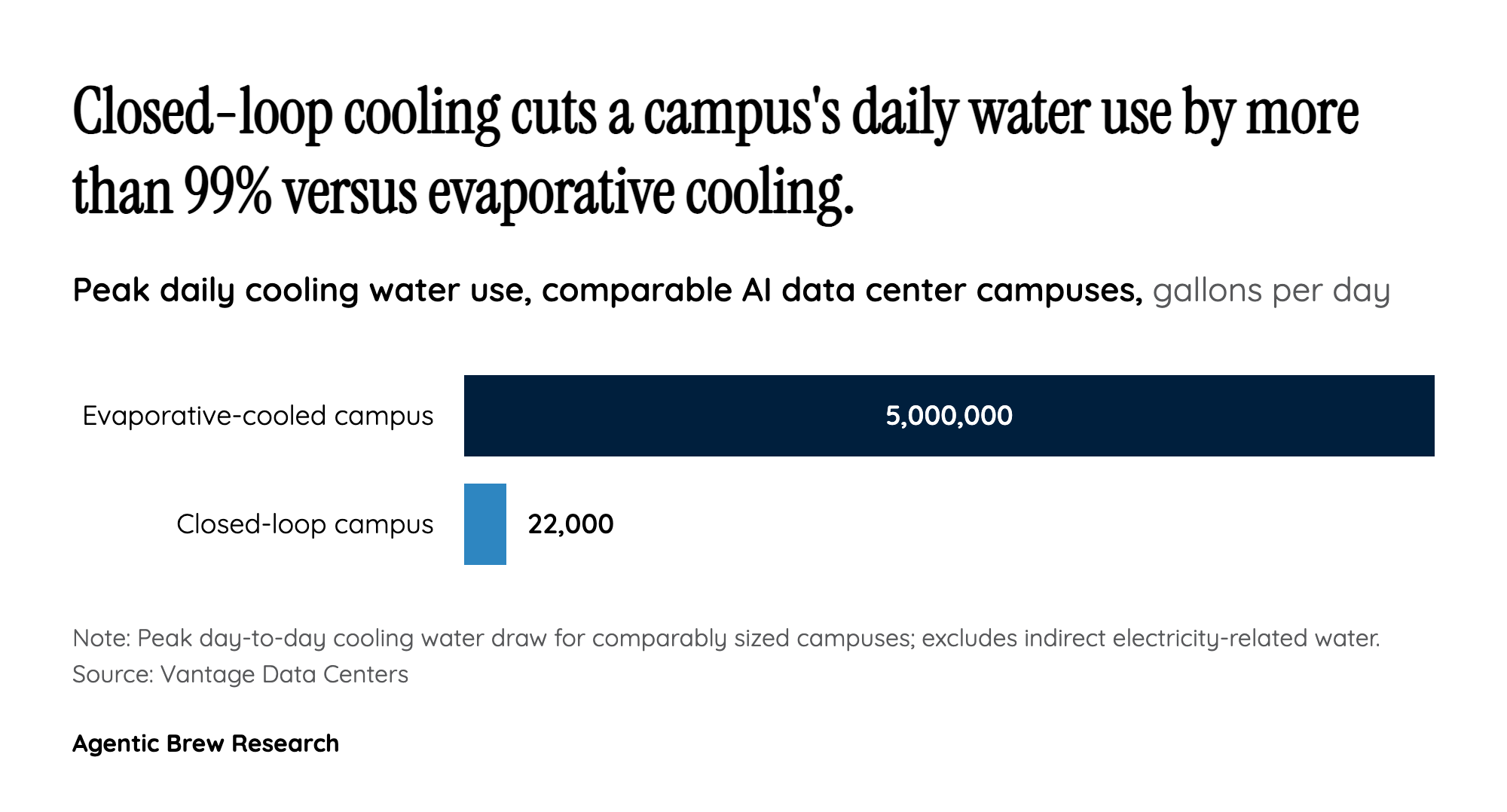
The technical core of NVIDIA's reassurance is real. Closed-loop and direct-to-chip or immersion liquid cooling sharply reduce on-site water use versus open evaporative cooling, which sprays water and lets roughly 80% of it evaporate away [4]. The contrast is stark: a closed-loop campus can peak around 22,000 gallons per day against roughly 5,000,000 gallons per day for a comparable evaporative-cooled campus [5]. Vendors put the reduction at up to about 70% versus traditional open evaporative methods, with immersion cooling claiming up to 99% less water than air cooling [4]. The mechanism matters: a closed loop recirculates the same coolant rather than continuously evaporating fresh water, and warm-water designs running coolant around 45 degrees Celsius let facilities in favorable climates lean on dry coolers instead of water. But the engineering caveat that gets lost in the viral framing is that closed loop does not mean zero. These systems still require periodic blow-down to flush mineral buildup, and the upfront water to fill the loop is real. The takeaway is that liquid cooling genuinely changes the day-to-day water curve, but it shifts the problem rather than erasing it, and a campus that runs near-zero on cooling water can still draw meaningfully when you count fill, blow-down, and the electricity it consumes.

By the numbers: the figures behind the fight

By the numbers: the figures behind the fight
Peak daily cooling water use: a closed-loop campus draws about 22,000 gallons per day versus roughly 5 million for a comparable evaporative-cooled campus.

The quantitative spine of this debate is a set of numbers that look contradictory until you line them up. The headline is 0.2% of US freshwater consumption, the Manhattan Institute figure NVIDIA amplified [1]. Cooling technology drives the widest on-site swing: a closed-loop campus peaks near 22,000 gallons per day versus roughly 5,000,000 gallons per day for a comparable evaporative campus, a difference of more than two orders of magnitude [5]. National estimates diverge almost as sharply: Brian Potter's revised realistic figure is roughly 200 to 250 million gallons per day, against Berkeley Lab's 628 million gallons per day [2]. And the framing-by-comparison favored by skeptics is striking: Arizona data centers used about 905 million gallons in 2025, while Phoenix-area golf courses use roughly 29 billion gallons annually, putting data center draw at a small fraction of recreational turf [1]. Set against rising disclosed totals, US data centers directly consumed 17.4 billion gallons in 2023 [4], and trajectories steepen fast, with Texas data centers projected to climb from 49 billion gallons in 2025 toward as much as 399 billion gallons by 2030 [6]. The numbers are not in conflict; they answer different questions about scale, location, and what counts.

Follow the money: who is amplifying this and why

The 0.2% talking point did not surface neutrally. It originates with the Manhattan Institute, a free-market think tank, packaged inside a specific policy argument: the problem is not how much water data centers use but how water gets allocated among competing demands, and the fix is tradable water markets rather than construction moratoria [1]. NVIDIA, whose business depends on the continued data center buildout, amplified that figure to a mass audience on X, where the sentiment skewed reassuring. The policy framing is coherent on its own terms: the Institute argues that when water rights are secure and transferable, new demand can be met without harming existing users [1]. But the counter-pressure is material and growing. Local opposition delayed or blocked roughly $98B in data center projects between March and June 2025, and a coalition of more than 230 environmental groups has campaigned to halt new construction over water, climate, and economic concerns [6]. That collision, a market-friendly reassurance campaign meeting organized community resistance, is the real story under the statistics. The 0.2% figure is a true number doing rhetorical work, and recognizing whose interests it serves is part of reading it honestly.

Historical Context

2023-01-01
Northern Virginia data centers used 2 billion gallons of water in 2023, a 63% increase from 2019.
2024-01-01
Google data center water consumption rose to 6.1 billion gallons in 2024, up from 4.3 billion gallons in 2021.
2025-09-01
Google pulled its rezoning proposal for a $1B Indianapolis data center after months of resident opposition.

Power Map

Key Players
Subject

AI data center water usage: NVIDIA's 0.2% claim, liquid cooling, and the local-stress nuance

NV

NVIDIA

AI chip vendor amplifying the 0.2% and liquid-cooling narrative on X to counter water-panic framing; holds a commercial interest in continued data center buildout.

MA

Manhattan Institute

Free-market think tank that originated the 0.2% figure and the 'water markets, not mandates' policy framing.

HY

Hyperscalers (Google, Amazon, Microsoft)

Operators whose disclosed water use is rising (Google went from 4.3B gallons in 2021 to 6.1B in 2024) and who face transparency pressure and local opposition.

HO

Host communities and local opposition

Residents and groups delaying or blocking projects; Google pulled an Indianapolis rezoning after months of resident opposition over land and water impacts.

Fact Check

6 cited
  1. [1] The Data Center Water Panic Has a Better Answer: Water Markets
  2. [2] I Was Wrong About Data Center Water Use
  3. [3] As AI Data Centers Multiply, So Do Concerns About Water
  4. [4] Data Centers and Water Consumption
  5. [5] Cooling Without the Drain: How Closed-Loop Systems Cut Day-to-Day Water Use
  6. [6] The Land and Water Impacts of Data Centers

Source Articles

Top 1

THE SIGNAL.

Analysts

"The data center water alarm is misplaced; the real problem is rigid water allocation. Secure, transferable water rights let new demand be met without harming existing users."

Shawn Regan
Senior Fellow, Manhattan Institute

"Common high-end water estimates are methodologically debatable and appear chosen to maximize the number; his realistic revised figure is roughly 200 to 250 million gallons per day."

Brian Potter
Author, Construction Physics

"Water needs for a given amount of AI vary by location, climate, cooling tech, and energy mix, so there is no single national number that captures the burden."

Fengqi You
Professor, Cornell Engineering

"Water concerns should not be dismissed; pricing and norms were set under a prior reality and the issue cannot be hand-waved away."

Jonathan Koomey
Computing and energy researcher
The Crowd

"Water usage has been a hot topic in the AI data center world, but the numbers may surprise you. According to the Manhattan Institute, data centers use 0.2 percent of daily water usage in the U.S. and that number has dramatically decreased in the past few years due to a new"

@@nvidia12497

"Nvidia announces a data center warm-water cooling system that eliminates “pretty much all water usage”"

@@interesting_aIl2279

"$NVDA has argued that AI’s water challenge is largely solved by liquid cooling as 45°C systems allow AI factories in favorable climates to use dry coolers instead of traditional cooling towers. That can reduce facility cooling water use from ~2.6M gallons per MW per year to near"

@@StockSavvyShay166

"Real facts on data center water use. Is it that big of a deal?"

@u/vtkarl195
Broadcast
Why people are throwing AI data centers into the ocean

Why people are throwing AI data centers into the ocean

Why data centers are eating up enormous water resources | Transforming Business

Why data centers are eating up enormous water resources | Transforming Business

The Truth About Data Center Water Usage

The Truth About Data Center Water Usage