Grok 4.5 private beta at SpaceX and Tesla
TECH

Grok 4.5 private beta at SpaceX and Tesla

32+
Signals

Strategic Overview

  • 01.
    On June 28, 2026, Elon Musk announced that xAI's Grok 4.5, built on the 1.5-trillion-parameter V9 foundation model with Cursor data added in supplemental training, entered private beta at SpaceX and Tesla.
  • 02.
    Musk said early internal evals show Grok 4.5 performing close to, perhaps exceeding, Anthropic's Claude Opus, while cautioning it would be a solid workhorse in the same league as Opus rather than a leap beyond everything.
  • 03.
    Grok 4.5 remains in private beta with no public release date, running roughly a month behind its original late-May 2026 target, and xAI plans to release a new model trained from scratch every month through year-end.
  • 04.
    Musk said a few dozen of SpaceX's top Starlink and Starship engineers have shifted much of their time to AI work to accelerate Grok's development cadence.

Deep Analysis

Musk Is Throwing Rocket Engineers at a Chatbot

The most revealing detail in Grok 4.5's debut is not the model - it is who built it. Musk says a few dozen of SpaceX's top Starlink and Starship engineers have shifted much of their time to AI work [1], and xAI has tapped a longtime Starlink engineer to run the Grok training team overseeing hundreds of experts [7]. This is the kind of talent that designs reusable orbital boosters, now pointed at making a language model improve faster. The logic is that the people who can squeeze performance out of constrained, high-stakes engineering systems can do the same for a training pipeline and its surrounding harness - the scaffolding of tools, evals, and orchestration that turns raw model weights into something useful.

The money side of the strategy is just as aggressive. SpaceX agreed to buy AI coding startup Cursor for $60 billion in stock, with the startup reporting roughly $2.6 billion in annual recurring revenue and over a million paying users [2]. The structure is a compute-for-product swap: SpaceX grants Cursor access to its Colossus supercluster, and in return Cursor's data and staff sharpen Grok's coding and technical competencies - exactly the skills SpaceX and Tesla engineering workflows demand [3]. In one move, xAI gets a competitive coding assistant to set against Claude Code and Codex, and Cursor gets the GPUs it could not otherwise afford. Whether diverting elite Starship and Starlink engineers slows SpaceX's core space programs is the open cost nobody has priced yet [1].

Monthly From-Scratch Models: A Different Bet Than Everyone Else

xAI's stated plan is to release a brand-new model trained completely from scratch every month through the rest of 2026 [4]. That cadence is the genuinely contrarian part of this story, and it is where the most technically grounded debate is happening. Most frontier labs do the opposite: they keep a base model (the expensive, foundational pretraining run) in place for a long time and ship improvements through post-training - reinforcement learning, fine-tuning, and harness work layered on top. xAI appears to be pushing new pretrains far more frequently, betting that with cheap captive compute it can simply re-bake the foundation every few weeks and fold in fresh real-world feedback from inside SpaceX and Tesla [3].

The community split on whether this is a real edge is sharp. On the skeptical side, observers note that point releases from rivals already ship at roughly six-to-seven-week intervals, so a four-week cadence is not the radical gap it sounds like. On the bullish side, the argument is that monthly pretrains plus a tight Cursor feedback loop could let xAI iterate on coding ability faster than labs that treat the base model as fixed. The deploy-inside-the-company design reinforces this: putting Grok 4.5 to work on actual engineering rather than static datasets creates a loop where the model improves by doing useful work [3]. The catch is that velocity only matters if each from-scratch run actually lands ahead of the last - and that is precisely what cannot be checked from outside a private beta.

The Opus Claim Is Doing a Lot of Work - and It Is Unverified

The Opus Claim Is Doing a Lot of Work - and It Is Unverified
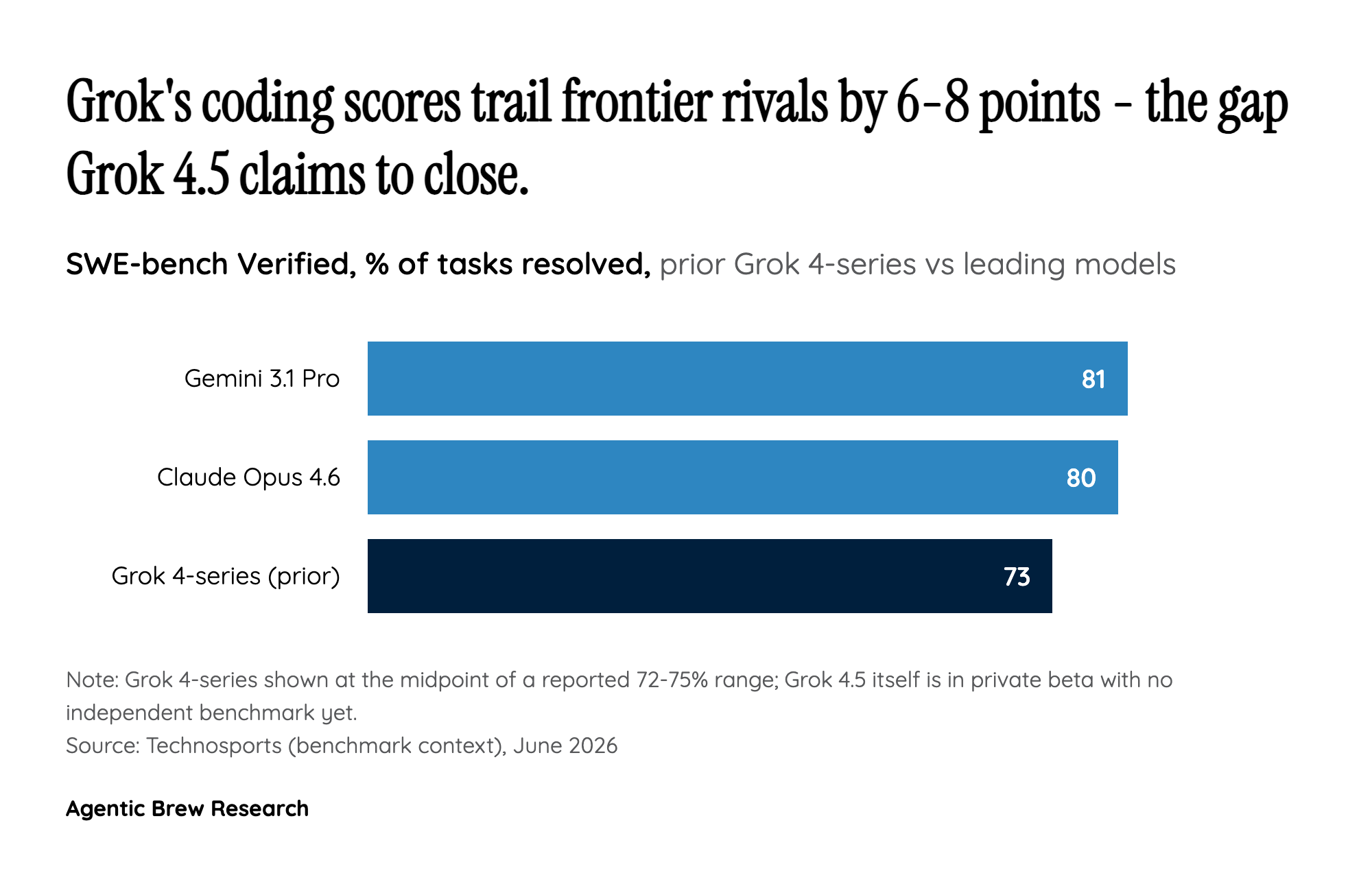
Prior Grok 4-series coding scores (SWE-bench Verified) trail Claude Opus 4.6 and Gemini 3.1 Pro by 6-8 points - the gap Grok 4.5 claims to have closed internally.

Strip away the announcement gloss and the headline reduces to one company grading its own homework. Musk's own follow-up is the tell: he said he was not claiming the V9 model would be mind-blowingly better than anything, only that it would be a solid workhorse in the same league as Opus. Reporting underscores that this comparison rests entirely on xAI's internal evaluations, with no independent or public benchmarks available yet [3]. Benchmark context makes the claim look ambitious rather than settled: prior Grok 4-series models score around 72-75% on SWE-bench Verified, while Claude Opus 4.6 and Gemini 3.1 Pro reach 80-81% [5]. Closing that gap in one generation, and only internally, would put xAI roughly where the leaders were months earlier - solid, but not frontier.

The community read captures the tension better than any single benchmark. On X, the reception skewed strongly positive and hype-forward, amplified by the xAI crowd framing the launch as Grok hunting Opus. On Reddit, the instinct ran the other way: the dominant move was to discount close-to-or-exceeding-Opus as owner-marketing - one widely echoed line was that perhaps-exceeds-Opus is what the company owner would say. The most substantive Reddit threads landed on a sober middle: a private, internal-only parity claim is not the same as a public, independently benchmarked one, and the bar that would actually excite practitioners is not raw parity but Opus-level quality at roughly half the price, given Grok's recent API price hikes. Developer-focused video coverage, meanwhile, treated the city-scale Colossus compute and the model's architecture as the strategically important story, rather than the marketing line.

The Burn Rate Behind the Scaling Race

The from-scratch monthly strategy is expensive in a way the announcement does not advertise. xAI's first-quarter 2026 operating loss reached $2.47 billion against $7.7 billion in capital expenditures [4]. Those numbers are the real engine of the parameter race: going from Grok 4.4's 1 trillion parameters to Grok 4.5's 1.5 trillion in roughly a month is only sustainable if you are willing to absorb losses at that scale, and the roadmap pushes further, with Grok 5 variants reportedly targeted at 6 trillion and 10 trillion parameters [6].

This reframes the SpaceX merger as a financing mechanism as much as an engineering one. Folding xAI into SpaceX - valued in the merger at roughly $250 billion, with some reports citing a far higher figure - gives the AI effort access to SpaceX's balance sheet, compute, and talent in a single structure [3]. The bet is that captive compute and a relentless release pace will let xAI compound its way past Anthropic and OpenAI before the losses become untenable. The risk is the mirror image: a parameter-count sprint funded by billions in quarterly losses, validated so far only by internal evals, with the genuinely independent test - a public release anyone can benchmark - still deferred.

Historical Context

2025-07
Grok 4 launched, the predecessor to the Grok 4.x series.
2026-02
Musk merged xAI into SpaceX, valuing xAI at roughly $250B, with other reports citing a ~$1 trillion acquisition valuation.
2026-05-06
The SpaceX-xAI merger was finalized.
2026-05
Grok 4.4 shipped at 1 trillion parameters, just ahead of Grok 4.5's 1.5T jump roughly a month later.
2026-06-16
SpaceX agreed to acquire AI coding startup Cursor in a $60B all-stock deal, days after its record IPO, with closing targeted for Q3 2026.
2026-06-28
Musk announced Grok 4.5 had entered private beta at SpaceX and Tesla.

Power Map

Key Players
Subject

Grok 4.5 private beta at SpaceX and Tesla

XA

xAI

Developer of Grok 4.5 and the V9 foundation model; merged into SpaceX in early 2026 and is driving the monthly from-scratch release strategy aimed at closing the gap with Anthropic and OpenAI.

SP

SpaceX

Parent company post-merger; supplies the Colossus compute and the Starlink/Starship engineering talent now redirected to Grok, hosts one of two private-beta sites, and acquired Cursor for $60B.

CU

Cursor

AI coding startup acquired by SpaceX for $60B in stock; its data and staff feed Grok's coding training in exchange for access to SpaceX's Colossus supercluster.

AN

Anthropic (Claude Opus)

The benchmark competitor xAI is explicitly measuring against; Musk claims Grok 4.5 matches or exceeds Claude Opus, though no independent benchmarks confirm it.

EL

Elon Musk

CEO of SpaceX, xAI, and Tesla; announced Grok 4.5, made the Claude Opus comparison, hedged it himself, and ordered the engineering reallocation.

JA

Jack Garabedian

Starlink engineer at SpaceX since 2021, brought in to run the Grok training team overseeing hundreds of experts.

Fact Check

7 cited
  1. [1] Elon Musk says SpaceX is putting top engineers on AI
  2. [2] SpaceX to acquire Cursor for $60B in stock days after blockbuster IPO
  3. [3] xAI Grok 4.5 V9 model upgrade
  4. [4] Grok at SpaceX and Tesla: Musk's Claude Opus challenge
  5. [5] Grok 4.5 private beta at SpaceX and Tesla
  6. [6] xAI Grok roadmap: 7 models, training Grok 5 to 10 trillion parameters
  7. [7] Musk's xAI Taps Starlink Staffer to Run Grok Training Team

Source Articles

Top 5

THE SIGNAL.

Analysts

"Claims Grok 4.5's performance is close to, perhaps exceeding, Claude Opus, while noting reinforcement learning is continuing to significantly improve the model."

xAI (internal evaluation)
Model developer, xAI

"Notes the Claude Opus comparison rests solely on xAI's internal claims, with no independent or public benchmarks available yet."

Cryptobriefing
Publication, reporting and analysis

"Frames the Opus-parity claim as ambitious, noting prior Grok 4-series models score around 72-75% on SWE-bench Verified while Claude Opus 4.6 and Gemini 3.1 Pro reach 80-81%."

Technosports
Publication, benchmark context
The Crowd

"Grok 4.5, based on our 1.5T V9 foundation model, with Cursor data added in supplemental training, is now in private beta at SpaceX & Tesla. Early evals show performance close to, perhaps exceeding Opus. RL is continuing to significantly improve the model, and the Grok Build harness is getting better every day."

@@elonmusk35654

"To be clear, I'm not saying the Grok v9 foundation model will be mind-blowingly better than anything, but it will be a solid workhorse in the same league as Opus. And the SpaceXAI cadence of model and harness improvement is speeding up tremendously, particularly due to a few of our best Starship and Starlink engineers joining the effort."

@@elonmusk9542

"BREAKING: Elon Musk confirms Grok 4.5 is now in private beta at SpaceX and Tesla. - Early evals show performance close to, possibly exceeding Opus - Based on xAI's 1.5T V9 foundation model - Trained with Cursor data added - Grok Build harness is getting better every day"

@@cb_doge1892

"Grok 4.5 is in private beta"

@u/Glittering_Night7681275
Broadcast
GPT-5.6 IS OUT! GLM 5.5 Is Mythos Level, U.S Governement Banning AI Cause of Dario?, & Grok 4.5!

GPT-5.6 IS OUT! GLM 5.5 Is Mythos Level, U.S Governement Banning AI Cause of Dario?, & Grok 4.5!

Grok 4.5 Explained: 6 TRILLION Parameters, City-Scale AI Training & xAI's AGI Plan

Grok 4.5 Explained: 6 TRILLION Parameters, City-Scale AI Training & xAI's AGI Plan

Elon Musk Announces Grok 4.5; How does It Work compared To Peers? Explained

Elon Musk Announces Grok 4.5; How does It Work compared To Peers? Explained