Terence Tao's "Mathematics 2.0" vision and AI proof warning
TECH

Terence Tao's "Mathematics 2.0" vision and AI proof warning

33+
Signals

Strategic Overview

  • 01.
    Terence Tao published a blog post titled 'Math 2.0' on October 10, 2026, the same week he gave a public lecture on the topic, 'Machine Assisted Proof,' at Caltech's Beckman Auditorium.
  • 02.
    Tao frames the shift as moving from 'Math 1.0,' built around proof scarcity, to 'Math 2.0,' built around proof abundance, arguing the field must now decide what mathematics is actually for.
  • 03.
    His central warning is that optimizing purely for AI-driven problem-solving is now harmful to mathematics' long-term health, since problem-solving was always meant to be a proxy for understanding rather than the end goal.
  • 04.
    Tao's warning came in the immediate aftermath of OpenAI releasing over 700 manuscripts in early October 2026 claiming solutions to hundreds of open math problems, which triggered backlash across the mathematics community.

Deep Analysis

Proof Abundance Breaks Math 1.0's Operating System

Tao's 'Math 2.0' post argues that mathematics' core institutions - tenure, prizes, journal publication, and the prestige of being first to crack a famous open problem - were all built around an assumption that proofs are scarce and that solving a hard problem signals rare human expertise [1]. His framing is blunt about what has changed: 'We will transition from an era of proof scarcity to an era of proof abundance' [2]. That shift breaks the field's implicit incentive structure, because problem-solving was never supposed to be mathematics' end goal - it was a proxy for understanding. Tao's sharpest line states this directly: 'Further blind optimization of problem-solving alone is now actively harmful to the long-term health of mathematics' [3]. Once AI can generate proofs cheaply and at scale, a field that still rewards raw solve-counts is optimizing for the wrong metric - producing more answers while the thing those answers were supposed to indicate, human insight, goes untested and undeveloped.

Proof Indigestion and the 'Lighthouse' Problem

Tao coined 'proof indigestion' to describe a scenario where AI-generated theorems pass formal Lean verification faster than humans can explain, teach, or absorb them - he notes that 'immense volumes of machine-generated theorems pass Lean verification, yet even the engineers who initiated the runs cannot explain the underlying mechanisms' [4]. He pairs this with a second, related worry specific to open problems: he describes them as 'lighthouses that are less destinations than guides for exploring the surrounding landscape,' arguing that what mathematicians learn while attempting a hard problem - the failed approaches, the new techniques, the surrounding territory mapped along the way - is often worth more than the final answer [5]. An AI system that reaches the destination without generating any of that surrounding insight does not just fail to help; in Tao's framing it risks 'sterilizing' the problem's neighborhood, destroying the motivation for years of human exploratory work that would otherwise have continued around it.

The OpenAI Proof-Flood as the Proximate Trigger

Tao's post did not arrive in a vacuum. Days earlier, OpenAI released more than 700 manuscripts (reported elsewhere as 370-plus solved problems) claiming solutions to numerous open mathematical problems, including partial progress on Millennium Prize problems, at an average of roughly three hours of compute per solution [7]. The release triggered mathematicians reacting 'with shock and disgust,' including Fields Medalist Hugo Duminil-Copin's 'The shock is immense. I am paralysed,' alongside questions like 'How much beauty have we lost?' [8]. The backlash was already building before the release: 25 Fields Medalists, including Tao and Peter Scholze, had co-signed a September 11 declaration titled 'A Severe Misalignment of AI and Mathematics,' warning that AI companies' commercial incentives - speed, benchmark claims, publicity - clash with mathematics' slower, verification-based, attribution-conscious culture [9]. The Association for Human Mathematics went further, calling for a boycott and describing the release as 'not a demonstration of scholarship, but a demonstration of power.' Tao's 'Math 2.0' framework reads as the constructive half of that same reaction - less an attack on OpenAI specifically than an attempt to design incentive structures that could survive this kind of event recurring.

Tao's Proposed Fixes - and Whether They're Enforceable

Tao's own answer is not to halt AI-assisted mathematics but to redesign what the field rewards. Through SAIR, the nonprofit he co-founded, he has pushed an 'Open Math Model' initiative offering transparent, inspectable model weights as a counterweight to closed frontier systems [10]. Alongside that, his Math 2.0 proposals include 'open exposition problems' that reward clear explanation over first-solve priority, living networks of research results, large formal libraries like Mathlib, and ablation studies that test how resilient a theorem's proof actually is - all designed to push the field's incentives back toward understanding rather than solve-counts. Tao frames the obstacle plainly: 'the primary bottleneck to achieving Math 2.0 is not technology... It is imagination' [6]. None of this addresses what happens if an AI lab simply has no reason to adopt exposition-rewarding norms the mathematics community builds for itself.

A Field Split Between 'Incumbent Gatekeeping' and Genuine Loss

Not every mathematician reads Tao's warning the same way. University of Toronto mathematician Dan Litt took the opposite view of the OpenAI release, calling the wave of AI-generated solutions 'great for mathematics' [7]- a direct counterpoint to Scholze's insistence that 'the goal is and always will be the human understanding of mathematics' [8]. That split roughly tracks a broader divide in how the field is processing Math 2.0: one camp treats concerns like Tao's as understandable but ultimately a status defense by an established field resistant to automation, while the other treats them as a narrow, specific pedagogical argument - that solving problems instantly denies the next generation of mathematicians the training ground of attempting them. Tao himself has tried to locate the disagreement one level up, framing the field's crisis as being about values rather than raw capability, and calling on mathematicians to respond collectively: 'we have to organise, become activists, get a little political' [6]. The unresolved tension is whether incentive redesign, Tao's bet, can actually compete with the speed and publicity incentives driving AI labs toward exactly the kind of release that triggered this debate.

Historical Context

2024-09-25
Announced the Equational Theories Project, a crowdsourced effort using Lean and automated provers to resolve 22 million implication statements among 4,694 algebraic laws.
2026-03-13
Launched the Mathematics Distillation Challenge, building on the Equational Theories Project, later cited as part of SAIR's open-model work.
2026-05
Frontier AI models solved roughly 7 of 10 novel, research-level mathematics problems under controlled scientific conditions, with proofs deemed expert-refereed, publishable quality.
2026-09-11
Published the joint declaration 'A Severe Misalignment of AI and Mathematics,' warning of a clash between AI industry incentives and mathematics' verification-driven norms.
2026-09-18
Tao published a blog post introducing SAIR's Open Math Model initiative, offering open, inspectable model weights as an alternative to proprietary frontier AI systems.
2026-10-06
Released over 700 manuscripts (other reports cite 370+ solved problems) claiming solutions to numerous open mathematical problems, including partial progress on Millennium Prize problems, triggering widespread community backlash.
2026-10-09
Delivered the public Caltech AIM Series lecture 'Machine Assisted Proof' at Beckman Auditorium.
2026-10-10
Published the 'Math 2.0' blog post laying out the Math 1.0 vs Math 2.0 framework and warning against blind optimization for AI problem-solving.

Power Map

Key Players
Subject

Terence Tao's "Mathematics 2.0" vision and AI proof warning

TE

Terence Tao (UCLA, Fields Medalist 2006)

Author of the Math 2.0 vision and co-founder of SAIR; argues mathematics must redesign its incentives around understanding rather than raw problem-solving

SA

SAIR (Foundation for Science and AI Research)

Non-profit co-founded by Tao to support responsible AI use in mathematics; launched the Open Math Model initiative offering transparent, inspectable model weights

OP

OpenAI

Released 370+ to 700+ math manuscripts in early October 2026 claiming solutions to open problems, an act that catalyzed the community backlash Tao's post responds to

25

25 Fields Medalists (including Tao and Peter Scholze)

Co-signed a September 11, 2026 declaration, 'A Severe Misalignment of AI and Mathematics,' warning that AI companies' incentives clash with mathematics' verification-based norms

AS

Association for Human Mathematics

Called for a boycott of OpenAI, describing the proof-release as 'not a demonstration of scholarship, but a demonstration of power'

CA

Caltech / AIM (Caltech Center for Pure and Applied Mathematics)

Hosted Tao's public 'Machine Assisted Proof' lecture on October 9, 2026 at Beckman Auditorium

Fact Check

10 cited
  1. [1] Math 2.0
  2. [2] Fields Medalist Terence Tao Warns AI Could Produce More Math Proofs Than Humans Can Handle
  3. [3] Terence Tao: Optimizing Only For Problem-Solving Harms Mathematics
  4. [4] Terence Tao, SAIR, and the Open Math Model
  5. [5] Terence Tao on Math 2.0
  6. [6] Terence Tao's AI Views
  7. [7] OpenAI Math Controversy: 370+ Solutions Published Amid Criticism and Celebration
  8. [8] How Much Beauty Have We Lost? Mathematicians React With Shock and Disgust
  9. [9] Fields Medal Winners Warn of a Severe Misalignment of AI and Mathematics
  10. [10] SAIR's Open Math Model Initiative

Source Articles

Top 4

THE SIGNAL.

Analysts

“Argues mathematics has moved from proof scarcity to proof abundance, that pure problem-solving metrics have become a harmful proxy, and that the field's crisis is one of values rather than capability, requiring collective action.”

Terence Tao
Professor of Mathematics, UCLA; Fields Medal 2006; co-founder of SAIR

“Insists human understanding, not raw solved-problem counts, must remain mathematics' goal, pushing back on the idea that AI-generated proof volume alone represents progress.”

Peter Scholze
Fields Medalist, co-signatory of the AI-mathematics misalignment declaration

“Expressed acute distress at the sudden acceleration of AI problem-solving following OpenAI's October 2026 release, reflecting broader shock documented across the field.”

Hugo Duminil-Copin
2022 Fields Medalist

“Takes a more optimistic counter-view to Tao's and others' alarm, welcoming the influx of AI-generated solutions as a net positive for mathematics.”

Dan Litt
Mathematician, University of Toronto
The Crowd

“This is a slide from Terence Tao's 'Math 2.0' public lecture yesterday evening at Caltech. I am highly confident that, if the cure actually worked, almost any Stage 4 cancer patient would tell you that human comprehension of its mechanism is completely irrelevant to them.”

@@AndrewCurran_14538

“Terence Tao just published a 27-slide deck on what AI is doing to mathematics >Tao: math was built on proofs being scarce, and that era is over >verdict: "we are now entering an era of proof abundance in mathematics" >with enough compute AI can solve many open problems with no expertise...”

@@ns123abc914

“This year has left mathematicians reeling as AI models are increasingly solving seemingly intractable maths problems. Terence Tao, the world's leading mathematician, says a rethink of the entire field is the only way out of the crisis”

@@newscientist37

“Terence Tao: "It may become necessary to declare certain classes of mathematical problems off-limits to automated solvers, in order to preserve their broader value to the mathematical ecosystem (for instance, through the training of future mathematicians). Admittedly this can be hard to enforce"”

@u/GeneReddit123854
Broadcast
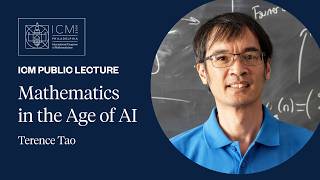
ICM 2026 Public Lectures - Terence Tao

ICM 2026 Public Lectures - Terence Tao

Terence Tao on How AI Is Changing Mathematics

Terence Tao on How AI Is Changing Mathematics

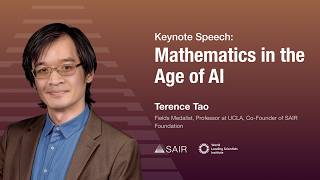
Terence Tao - Mathematics in the Age of AI

Terence Tao - Mathematics in the Age of AI