Bill Gates' AI Job-Loss and Global Safety Warning
TECH

Bill Gates' AI Job-Loss and Global Safety Warning

42+
Signals

Strategic Overview

  • 01.
    Bill Gates published a roughly 5,800-word essay on gatesnotes.com on August 26, 2026, warning that AI will rapidly transform the labor market and put millions of jobs at risk within about a decade.
  • 02.
    The essay names three central dangers: widespread and permanent job losses, AI enabling bad actors to cause greater harm through cyberattacks and bioterrorism, and damage to children's development and human relationships.
  • 03.
    Gates says there is currently no coordinated plan from leaders, experts or communities to manage the transition into the AI era.
  • 04.
    He predicts the disruption will not stop at desk jobs: 'smart' robots are expected to begin competing with people on physical tasks in construction and hospitality by the end of the decade.

Deep Analysis

The Thresholds Gates Says We've Already Crossed

On August 26, 2026, Gates published a roughly 5,800-word essay on gatesnotes.com, 'The turbulent AI era is here,' arguing that several AI danger thresholds have already been crossed rather than lying somewhere in the future [1]. In an interview tied to the release he said: 'We've crossed the threshold in terms of AI's bio-capabilities, cyber-capabilities, psychosocial capabilities, job-market-destruction capabilities, and even the lack of control.' [2]On cyberattacks specifically, he says the line has already been passed: 'I expected a lot of loud voices as we even got close to the threshold of can a nontechnical person do a cyberattack just using AI. We're there!' [2]On bioterrorism he goes further, rating it far more dangerous than a naturally occurring pandemic: 'I view bioterrorism risk, versus a natural pandemic, as about 50 times more scary, more likely than a natural pandemic risk.' [2]The essay organizes these into three central risks - permanent job loss, AI enabling bad actors toward cyberattacks and bioterrorism, and harm to children's development and human relationships [3]- with outlets including CBS News noting the job disruption alone is expected to hit law, customer service, medicine, software and manufacturing within about a decade, far faster than past technological shifts [4].
The Hidden Subsidy for Replacing You With a Robot

Gates traces part of the job-loss problem to an accident of tax policy: employers pay payroll taxes on human wages but can typically write off a robot or AI system as an immediate business expense. 'Right now, if you're an employer and you hire someone, you pay payroll taxes on their earnings. But if you buy a robot, you can usually write it off right away as a business expense. The tax system nudges you toward replacing people with machines.' [5]His proposed fix, a 'token tax' on AI and robot labor substitution, would channel the resulting revenue toward retraining and safety nets for displaced workers [5]. One third-party analysis of the proposal estimated it would collect only around $1,200 relative to wages from a $130,000 job displaced by AI, illustrating how light the levy could land relative to the wage it replaces [6]. Gates frames the deeper technical obstacle as a 'separation problem': the same AI capability that can find a security hole in order to patch it can just as easily be used to exploit it, which is part of why he thinks the danger can't simply be engineered away [7].

Human Reserved: Choosing Which Jobs Stay Ours

Human Reserved: Choosing Which Jobs Stay Ours
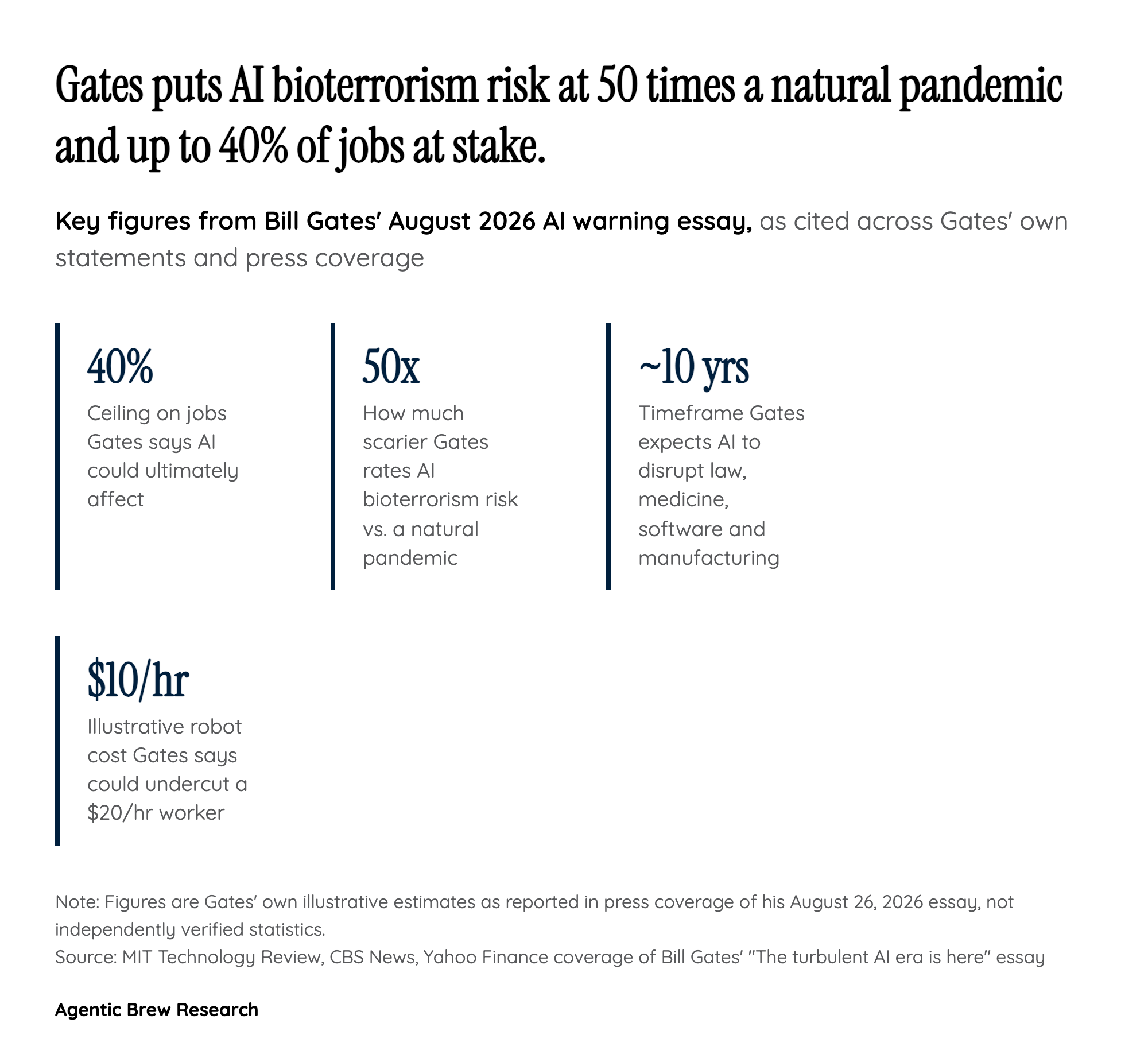
Key figures from Bill Gates' August 2026 AI warning essay

Beyond taxation, Gates proposes legislating categories of 'Human Reserved' work that AI would be barred from taking over, comparing the idea to land conservation: 'I like the phrase Human Reserved because it makes me think of nature reserves - places where we could put buildings and roads, but we choose not to.' [8]He argues the disruption will hit white-collar and blue-collar work alike, striking law, customer service, medicine, software and manufacturing 'over the course of a decade rather than a few generations' [4]. Physical labor is not exempt either: he predicts 'smart' robots will begin competing with people on tasks in construction and hospitality by the end of the decade, pointing to a scenario where a $10-an-hour robot could undercut a $20-an-hour worker [4]. Overall, Gates puts a ceiling of up to 40% on the share of jobs that could ultimately be touched by AI automation [9]. Unlike past downturns, he warns many of the resulting losses may be permanent rather than cyclical, since AI displaces cognition itself rather than automating a single task, leaving entry- and mid-level workers especially exposed while any newly created jobs may demand skills that take years to acquire [10].

Gates Wants a Seat Across From Xi Jinping

Gates is also pursuing a diplomatic track alongside his domestic policy proposals: his staff are reportedly working to finalize a meeting with Xi Jinping during his next tentative China trip, expected around November 2026, to propose shared AI safety norms between the US and China [11][12]. The reported agenda includes possible restrictions on releasing the most dangerous models and monitoring of AI systems capable of designing novel molecules - a direct extension of his bioterrorism warning into policy territory [12]. It would not be a first encounter: Gates met Xi roughly three years earlier as the first foreign entrepreneur Xi hosted after the pandemic, and the new outreach is framed as a continuation of that relationship [12]. He pairs the diplomatic push with a flat rejection of industry self-regulation: 'You can't count on an industry to self-regulate. You can't. It's kind of a crazy idea.' [2]He has also accused tech companies directly of downplaying AI's cyber, bio and psychosocial dangers for commercial reasons [13].

The Messenger Problem: Why Even Believers Don't Trust Gates

The essay landed in a media environment already primed to question its author. Reddit threads that broadly agreed AI job loss is a real and unmanaged risk still spent much of their energy on 'shoot the messenger' skepticism, pointing to Gates' own AI-related investments and unrelated personal controversies as reasons to discount the warning, alongside a smaller contrarian strand dismissing the whole AI buildout as an overhyped bubble. A more sympathetic reading reframed the essay as evidence of systemic corporate and billionaire accountability failures rather than a purely technological problem, and Gates' proposed token/robot tax split opinion between those who saw it as a workable funding mechanism and those who called it unenforceable or regressive; a vocal fringe pushed a 'deliberate depopulation' narrative, though this stayed a marginal reaction rather than a mainstream one. Television coverage carried a version of the same tension: an ABC News segment relaying Gates' warning that AI could be 'the greatest equalizer ever invented, or the worst source of injustice' also had its anchor note that the US lags the EU on AI governance despite hosting the leading AI labs, and openly question Gates' credibility given Microsoft's own early, heavy investment in AI. Not every high-profile reaction was alarmed: coverage of the essay also carried JPMorgan Chase CEO Jamie Dimon's more optimistic counter-framing, suggesting AI could let people live to 100 and work a 3.5-day week [3].

Historical Context

2023
Gates previously described bioterrorism as the next major threat facing humanity, a theme he now ties directly to AI-enabled pathogen design in his 2026 essay.
2023
Gates met with Xi Jinping roughly three years before the 2026 essay, becoming the first foreign entrepreneur Xi hosted after the pandemic - a relationship his new outreach is framed as continuing.
2024-01-17
Gates and OpenAI's Sam Altman weighed AI risks together in a Bloomberg piece tied to the 2024 election year, showing his AI-risk commentary predates the 2026 essay.
2026-08-26
Gates published his essay 'The turbulent AI era is here' on his personal blog, triggering wide press coverage of his job-loss and safety warnings.

Power Map

Key Players
Subject

Bill Gates' AI Job-Loss and Global Safety Warning

BI

Bill Gates

Microsoft co-founder and Gates Foundation chair; author of the warning essay, driving the public debate on AI job displacement and safety, proposing the token tax and 'Human Reserved' jobs, and pursuing direct diplomatic engagement with Xi Jinping on AI safety norms.

AI

AI industry / tech companies

Accused by Gates of downplaying AI's cyber, bio and psychosocial dangers for commercial reasons; the target of his call for external oversight rather than self-regulation.

XI

Xi Jinping / Chinese government

Target of Gates' proposed diplomatic outreach; his staff are reportedly working to finalize a meeting around November 2026 to propose shared US-China AI safety norms, including restrictions on dangerous model releases and monitoring of molecule-design AI.

GO

Governments / policymakers

Called on by Gates to implement a 'token tax' on AI/robot labor substitution, fund retraining and safety nets, and legislate 'Human Reserved' job categories off-limits to AI.

DI

Displaced and vulnerable workers

The group most exposed under Gates' scenario - entry- and mid-level workers in law, customer service, medicine, software and manufacturing, plus older construction and manual laborers who cannot easily retrain.

Fact Check

13 cited
  1. [1] Five Takeaways From Bill Gates' Essay on AI's Potential Risks
  2. [2] Bill Gates says we've crossed a dangerous AI threshold
  3. [3] Bill Gates warns AI's risks could outweigh its benefits without action from world leaders
  4. [4] Bill Gates issues stark warning about AI and the future of humanity
  5. [5] Bill Gates wants to see a robot tax and 'Human Reserved' jobs to mitigate harms from AI
  6. [6] Gates' Token Tax: The Displaced-Wage Math
  7. [7] Bill Gates warns AI is more dangerous than the tech industry will admit
  8. [8] Bill Gates says some jobs should be off-limits to AI - who's impacted
  9. [9] Bill Gates warns up to 40% of jobs could be affected by AI
  10. [10] Bill Gates warns AI could permanently wipe out jobs, calls for 'Human Reserved' work
  11. [11] Bill Gates warns of AI's impact, urges US and China to cooperate
  12. [12] Bill Gates seeks meeting with Xi Jinping to push global AI safety rules
  13. [13] Bill Gates criticizes tech companies for downplaying AI's risks

Source Articles

Top 5

THE SIGNAL.

Analysts

Says AI has already crossed thresholds on bio-capabilities, cyber-capabilities and psychosocial capabilities, not just future risks: 'We've crossed the threshold in terms of AI's bio-capabilities, cyber-capabilities, psychosocial capabilities, job-market-destruction capabilities, and even the lack of control.'

Bill Gates
Microsoft co-founder, Gates Foundation chair

Rates AI-enabled bioterrorism as far more dangerous than a natural pandemic: 'I view bioterrorism risk, versus a natural pandemic, as about 50 times more scary, more likely than a natural pandemic risk.'

Bill Gates
Microsoft co-founder, Gates Foundation chair

Says the threshold enabling nontechnical people to carry out AI-driven cyberattacks has already been crossed: 'I expected a lot of loud voices as we even got close to the threshold of can a nontechnical person do a cyberattack just using AI. We're there!'

Bill Gates
Microsoft co-founder, Gates Foundation chair

Argues the tax code structurally favors automation over human workers and proposes a 'token tax' to correct it: 'Right now, if you're an employer and you hire someone, you pay payroll taxes on their earnings. But if you buy a robot, you can usually write it off right away as a business expense.'

Bill Gates
Microsoft co-founder, Gates Foundation chair

Rejects industry self-regulation as sufficient oversight for AI risk, calling instead for external, government-led governance: 'You can't count on an industry to self-regulate. You can't. It's kind of a crazy idea.'

Bill Gates
Microsoft co-founder, Gates Foundation chair
The Crowd

In an exclusive television interview, Microsoft co-founder Bill Gates is sounding the alarm about artificial intelligence, saying "the turbulent AI era is here." He warns that AI models are "now capable of causing cyberattack risk, bioterrorism risk, and psychosocial risk."

@@AC360494

Bill Gates has a new warning on AI. ‼️

@@YahooFinance286

🚨 TODAY: Bill Gates warns AI could trigger mass unemployment, cyberattacks and bioterrorism, urging global institutions to help manage the transition.

@@Cointelegraph248

Even Bill Gates is admitting that corporations have 'no plan' for the mass unemployment AI is about to cause.

@u/unconventionalbook5000
Broadcast
Bill Gates sounds the alarm on the future of A.I.

Bill Gates sounds the alarm on the future of A.I.

Bill Gates Surprising AI Statement " Humans Will No Longer Be Needed"

Bill Gates Surprising AI Statement " Humans Will No Longer Be Needed"

“This is bigger than everything” — Bill Gates SHOCKS the World With AI Prediction

“This is bigger than everything” — Bill Gates SHOCKS the World With AI Prediction