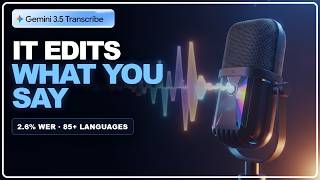
Google launches Gemini 3.5 Transcribe
TECH

Google launches Gemini 3.5 Transcribe

21+
Signals

Strategic Overview

  • 01.
    Google announced Gemini 3.5 Transcribe on August 26, 2026, in public preview via the Gemini API, describing it as its most precise speech-to-text model yet.
  • 02.
    The model ships as two separate endpoints: gemini-3.5-transcribe for pre-recorded audio via the Interactions API, and gemini-3.5-transcribe-live for real-time streaming via the Live API.
  • 03.
    The model performs "smart transcription" - dropping filler words like "um"/"ah", resolving mid-sentence self-corrections, and auto-formatting the output into clean text, rather than producing a raw verbatim transcript.
  • 04.
    The model already powers consumer features: the 'Rambler' dictation feature in Gboard on Android and the Gemini app on macOS (English), with Chrome browser support coming soon for dictating into any web text field.

Smart transcription rewrites what a transcript is

Gemini 3.5 Transcribe does not just convert audio into text - it edits it. Google calls this "smart transcription": the model strips filler words like "um" and "uh," resolves mid-sentence self-corrections, and reformats rambling speech into clean, readable text rather than a literal record of what was said. In Google's own example, "Um, so for the meeting, I think we should, uh, invite Alice and, wait no, Bob and Carol" becomes simply "For the meeting, I think we should invite Bob and Carol."[2]That is a break from older ASR systems built to match the audio waveform word-for-word - this one is built to match what the speaker meant to say[1].
Two engines, one brand: batch precision vs. live speed

Under the hood, "Gemini 3.5 Transcribe" is really two separate models. gemini-3.5-transcribe handles pre-recorded audio through the Interactions API, supporting speaker diarization, word-level timestamps, and custom vocabulary biasing of up to 1,000 terms, on files up to one hour long (30 minutes if diarization or timestamps are switched on). gemini-3.5-transcribe-live streams through the Live API instead, trading those features for sub-200ms interim latency - but it caps sessions at 10 minutes and skips diarization and word timestamps entirely[2]. The split mirrors how the launch itself was framed: one endpoint built for accuracy on recordings, the other for responsiveness in real time[3].

The benchmark scorecard: 2.6% WER and what it's up against

Google, citing independent measurement from Artificial Analysis, reports a 2.6% average word error rate on pre-recorded audio and 4.0% on live streaming audio[2]. On the FLEURS multilingual benchmark the model scores 5.04% WER non-streaming and 5.50% streaming[2]- one independent breakdown of that same benchmark put those numbers ahead of Google's own prior model Chirp 3, OpenAI's live transcription model, and Deepgram's Nova 3, though reviewers caution that different benchmarks use different audio conditions and recommend testing against your actual use case rather than relying on headline numbers alone. Google also claims a 70% improvement in time-to-final-transcription versus Chirp 3[3][4], with estimated pricing of about $0.005 per batch minute and $0.009 per live minute[2].

From standalone tool to agent infrastructure

Chirp 3, Google's previous flagship transcription model, was a standalone engine. Gemini 3.5 Transcribe is pitched differently: as a substrate for agentic workflows, with function-calling support that lets a transcription session hand off follow-up tasks - like generating an image or running a web search - to other Gemini models[4]. That reframing matters because it puts transcription inside the same interface teams use to build voice agents rather than as a separate pipeline stage bolted on afterward, a positioning reinforced by the platform's own list of early integration partners spanning voice-agent infrastructure (LiveKit, Pipecat, Agora, Vision Agents), developer tooling (LangChain, Vercel), and vertical apps (IntelliTek Health, Lingopal).

Early reception: fast adoption, a few real frictions

Within a day of launch, independent developers were already shipping demos - one builder open-sourced a Wispr Flow-style dictation app built directly on the new model, and Google's developer account followed up by showcasing community projects ranging from voice-first agents to multilingual audio tools. The most-repeated proof point across social discussion was the model's ability to handle mid-sentence language switching accurately. Reddit reaction was largely positive, with one thread reporting the model outperforming Whisper and OpenAI's transcription model on a difficult Finnish-language dataset, but the response was not uniform: one user said a rival ASR vendor beat it in their own side-by-side test, another hit a usage cap on a paid Gemini subscription tier, and others pointed out that the live/streaming endpoint still cannot distinguish between multiple speakers, since diarization is batch-only.

Historical Context

2025-03-17
Google announced Chirp 3 (Chirp 3 Transcription, Chirp 3 HD text-to-speech, and Chirp 3 Instant Custom Voice) at a 'Gemini for the United Kingdom' event in London. Chirp 3 was Google's prior-generation flagship transcription model, now superseded by Gemini 3.5 Transcribe.
2026-08-26
Gemini 3.5 Transcribe launched in public preview, positioned as Chirp 3's successor with a 70% improvement in time-to-final-transcription.

Power Map

Key Players
Subject

Google launches Gemini 3.5 Transcribe

GO

Google DeepMind / Google Gemini Audio team

Creator of Gemini 3.5 Transcribe; named spokespeople Diego Melendo Casado (Senior Director, Engineering, Gemini Audio) and Luke Leonhard (Chief of Staff, Gemini Audio)

GO

Google Cloud / Gemini Enterprise Agent Platform

Enterprise distribution channel for the model, with support coming soon to Gemini Enterprise for Customer Experience

CO

Consumer surfaces: Gboard 'Rambler' (Android), Gemini app (macOS), Chrome (coming soon)

Products already running on Gemini 3.5 Transcribe or slated to add it for in-field voice dictation

EC

Ecosystem integration partners (Agora, Fishjam, LangChain, LiveKit, Pipecat, Vercel, Vision Agents, vivo, IntelliTek Health, Lingopal, Stream)

Named launch partners building voice-agent infrastructure, developer tooling, and vertical apps on top of the model

AR

Artificial Analysis

Independent benchmark firm whose word-error-rate measurements (4.0% streaming / 2.6% non-streaming) are cited by Google and press coverage

Fact Check

4 cited
  1. [1] Gemini 3.5 Transcribe: Our most precise speech-to-text model yet
  2. [2] Google AI Releases Gemini 3.5 Transcribe: A Speech-to-Text Model Reporting 2.6% Average WER Across 85+ Languages
  3. [3] Google announces Gemini 3.5 Transcribe, its most precise speech-to-text model yet
  4. [4] Gemini 3.5 Transcribe positions Google's new speech model as agent infrastructure

Source Articles

Top 3

THE SIGNAL.

Analysts
The Crowd

Introducing Gemini Transcribe. Our most precise speech to text model, that can handle over 85+ languages, has smart correction, and custom vocabulary. I vibe coded a Wispr Flow like app powered by the model. Demo + open sourcing below!

@@ammaar985

Gemini Transcribe can accurately turn speech into text across 85+ languages for building intelligent audio experiences. Watch the model seamlessly switch across 4 different languages while accurately transcribing complex numbers.

@@googledevs201

Gemini 3.5 Transcribe is live, and the community is already putting it to work. From voice-first agents to tackling complex, multilingual audio, here are a few of our favorites to inspire your next build.

@@googledevs142

Introducing Gemini 3.5 Transcribe

@u/Stoneonn233
Broadcast
How to build with Gemini 3.5 Transcribe

How to build with Gemini 3.5 Transcribe

New Gemini 3.5 Transcribe Is WILD!

New Gemini 3.5 Transcribe Is WILD!

Forget Everything You Know About Audio AI: Gemini 3.5 Transcribe is Here.

Forget Everything You Know About Audio AI: Gemini 3.5 Transcribe is Here.