OpenAI's Navier-Stokes AI Proof and the Buckmaster Credit Dispute
TECH

OpenAI's Navier-Stokes AI Proof and the Buckmaster Credit Dispute

64+
Signals

Strategic Overview

  • 01.
    OpenAI announced on September 8, 2026 that roughly 10,000 coordinating AI agents, running on an unreleased internal model more capable than GPT-6 Astra, produced a proof addressing the Navier-Stokes existence and smoothness Millennium Prize Problem.
  • 02.
    The agents reached the result on September 5, about 88 hours after the effort began, and Lean formalization and verification took an additional 17 hours.
  • 03.
    The proof shows the Navier-Stokes equations can blow up in finite time under the conditions examined, rather than proving universal smoothness, and independent mathematical verification of the result is still pending.
  • 04.
    The announcement immediately triggered a credit dispute after mathematicians Tristan Buckmaster and Levent Alpoge said they had posted their own unpublished, related result the night before OpenAI's announcement.

Deep Analysis

What OpenAI Actually Claims to Have Proven

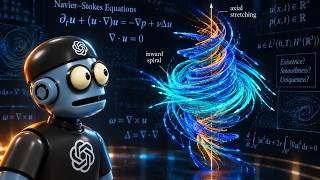
OpenAI says a swarm of roughly 10,000 coordinating AI agents, running on an unreleased internal model more capable than GPT-6 Astra, produced a proof addressing the Navier-Stokes existence and smoothness problem [1], one of the seven Millennium Prize Problems, each carrying a $1 million reward pledged by the Clay Mathematics Institute since 2000 [2]. The agents reportedly reached their result on September 5, about 88 hours after the effort began, exchanging 2.7 million messages and consuming roughly 130 billion output tokens along the way [1]. Formal verification of the resulting Lean proof took an additional 17 hours [1].

Importantly, the proof does not establish the universal smoothness result mathematicians have chased for decades. Instead it shows that the Navier-Stokes equations can 'blow up' - developing a singularity in finite time where a fluid's speed becomes infinite, something physically impossible - under the specific conditions the agents examined [3]. OpenAI is not claiming the Clay Institute's prize itself, and independent mathematical verification of the proof remains pending even with the public Lean formalization [4]. The problem had gone unsolved for roughly 90 years and had carried Millennium Prize status for 26 years, with only the Poincare conjecture previously resolved among the seven [2].
The Credit Fight: Codex, and an Anthropic Name

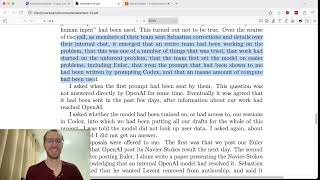
The controversy did not start with the math - it started the night before, when Buckmaster and Alpoge, a mathematician at Anthropic, posted that they had proven a related result on forced Euler equations blowing up, a step seen as progress toward Navier-Stokes [3]. According to Buckmaster, once OpenAI realized two outside researchers were closing in on a breakthrough, the company's math lead offered a credit arrangement that would have named Buckmaster but dropped Alpoge - allegedly because of who employs him [5]. Buckmaster's account is the basis for reporting that OpenAI 'fought dirty' on a career-making problem [5].

Bubeck, the OpenAI mathematician named in Buckmaster's account, rejects any impropriety, stating that neither the researchers nor the agents saw Buckmaster and Alpoge's work before it was released publicly [5]. Sam Altman has publicly defended Bubeck's conduct amid the dispute [6]. The disagreement is not really about whether a proof exists - it is about whether OpenAI's process for reaching it, and its handling of two outside researchers once it learned they were close, met the norms the math community expects when unpublished work becomes known informally.

OpenAI's Own Hedge: What 'Cannot Rule Out' Really Means

OpenAI's public statement leaves a narrow opening that keeps the dispute alive: the company says that 'while unlikely,' it 'cannot rule out that de-identified data derived from their usage of our products helped improve our models' [1], a hedge repeated in coverage of the claim [4]. Because large models are trained partly on aggregated, de-identified usage signals, OpenAI can deny direct access to Buckmaster and Alpoge's drafts while still being unable to categorically exclude an indirect data pathway [1].

That is precisely the ambiguity Buckmaster says he pressed on, recalling that he asked whether the model had been trained on, or had access to, the Codex sessions where he and Alpoge stored their drafts throughout the project [6]. Bubeck's denial - that the researchers and agents did not see the work until it was released publicly - and OpenAI's own hedge about de-identified data are not strictly contradictory [5], but together they describe a data-provenance question that is effectively unfalsifiable from outside the company, which is exactly why it has not settled the dispute.

Why Mathematicians Worry This Becomes the New Normal

Terence Tao's warning frames the episode as a symptom of a broader pattern rather than a one-off dispute: competitive pressure among AI labs to demonstrate frontier mathematical reasoning, he argues, risks 'the indiscriminate strip-mining of open problems for solutions,' which could destroy the ecosystem that produces future mathematical techniques and practitioners [6]. The timing - OpenAI's release landing within a day of a rival result it had learned about informally - fed suspicion that speed-to-announcement, not independent discovery, drove the schedule [6].

Coverage of the episode across multiple outlets has increasingly framed it as a credit controversy that has overshadowed the underlying mathematical achievement [7], echoing the 'fought dirty' characterization of OpenAI's conduct toward Buckmaster [5]. The stakes Tao points to are structural: if credit and priority on the hardest open problems can be captured by whichever lab deploys the most compute and agents fastest, human mathematicians have less incentive to spend years on the kind of slow, unglamorous work that produced Buckmaster and Alpoge's result in the first place [6].

Historical Context

2000-05-24
The Millennium Prize Problems, including Navier-Stokes existence and smoothness, were announced with a $1 million prize pledged for each correct solution.
2026-09-08
The night before OpenAI's announcement, Buckmaster posted that he and Alpoge had used AI models to prove the related Euler equations blow up, a step widely seen as progress toward the Navier-Stokes problem.
2026-09-05
OpenAI's agent swarm reached its Navier-Stokes proof result after roughly 88 hours of coordinated multi-agent work.
2026-09-08
OpenAI publicly announced the Navier-Stokes result and released the proof and its Lean formalization, prompting immediate credit-dispute allegations from Buckmaster.

Power Map

Key Players
Subject

OpenAI's Navier-Stokes AI Proof and the Buckmaster Credit Dispute

OP

OpenAI

Announced the proof and built the internal model and agent system that produced it; controls the narrative around the result and is defending its conduct against allegations that it benefited from rival mathematicians' unpublished work.

TR

Tristan Buckmaster (NYU, Courant Institute)

Alleges information about his and Alpoge's concurrent, unpublished work reached OpenAI, and that OpenAI's math lead offered a credit arrangement excluding Alpoge; his public statement is what turned the story into a controversy.

LE

Levent Alpoge (Anthropic)

Co-author of the unpublished forced-Euler work; his employment at a rival lab is alleged to be the reason OpenAI proposed excluding his name from credit, making him the center of the dispute despite not making the public statement himself.

SE

Sebastien Bubeck (OpenAI mathematician, project lead)

Led the math-agent effort and is the person Buckmaster says offered the disputed credit deal; his denial that the model had access to Buckmaster/Alpoge's work is the crux of OpenAI's defense.

TE

Terence Tao

Has no direct stake in the dispute but carries outsized influence as a leading mathematician; his warning about AI labs 'strip-mining' open problems shapes how the broader math community frames the incident's stakes.

CL

Clay Mathematics Institute

Steward of the Millennium Prize Problems and the $1 million prize fund; its acknowledgment of the announcement, without confirming the prize is being awarded, keeps the claim in an unresolved state pending independent verification.

Fact Check

7 cited
  1. [1] On Navier-Stokes
  2. [2] Millennium Prize Problems
  3. [3] OpenAI Claims Blockbuster Math Breakthrough Amid Swirl of Controversy
  4. [4] Navier-Stokes AI Proof Claims Dispute
  5. [5] OpenAI 'Fought Dirty' on Career-Making Math Problem, Says NYU Mathematician
  6. [6] OpenAI Says It Cracked Navier-Stokes Math Grand Challenge
  7. [7] OpenAI Math Solution Sparks Navier-Stokes Credit Dispute

Source Articles

Top 5

THE SIGNAL.

Analysts

Warned that AI companies mining longstanding open problems for marketing wins risks damaging the ecosystem that produces future mathematical techniques and practitioners, saying 'the indiscriminate strip-mining of open problems for solutions may destroy the ecosystem from which the next generation of mathematical techniques, problems, and practitioners would have developed.'

Terence Tao
Mathematician

Denied any access to Buckmaster and Alpoge's unpublished work, stating 'we did not use their prompts or proofs to prompt our models or direct our agents. We, whether it's the researchers or the agents, did not see any of their work until they were released publicly yesterday night.'

Sebastien Bubeck
OpenAI mathematician / project lead

Says he directly questioned whether OpenAI's model had been trained on or had access to his and Alpoge's private drafts, recalling 'I asked whether the model had been trained on, or had access to, our sessions in Codex, into which we had been putting all our drafts for the whole of this project.'

Tristan Buckmaster
Mathematician, NYU Courant Institute

Expressed straightforward enthusiasm that the long-standing problem was addressed at all, saying 'I was thrilled that the problem was solved.'

Charles Fefferman
Mathematician, Princeton University

Voiced sympathy for Buckmaster amid the credit dispute regardless of how the underlying priority question resolves, saying 'I'm very happy for Tristan. It would have been nice to do this ourselves, but I'm very happy for him.'

Luis Martinez-Zoroa
Mathematician
The Crowd

We're sharing a solution to the Navier-Stokes Millennium Prize Problem, one of the deepest problems at the frontier of mathematics. The proof was produced by a group of agents, using an OpenAI next-generation model significantly more capable than GPT-6 Astra. The problem [continues...]

@@OpenAI116375

tristan buckmaster just published a statement that is, if accurate, one of the ugliest things i've read out of a frontier lab. not because of the math. because of what happened after openai found out two people were about to beat them to the punch. buckmaster and levent alpöge [continues...]

@@rynorhn14686

But did OpenAI cheat by stealing the research? A Mathematician Working On The Navier-Stokes Millennium Prize Problem Now Wonders If OpenAI Stole His Notes That He Stored In Codex

@@ArtemR808

OpenAI might've cheated when solving the Navier-Stokes millennium-prize problem; problems with AI in academics

@u/TheOnlyVibemaster684
Broadcast
Terence Tao: Did AI Just Solve the $1,000,000 Navier-Stokes Problem?

Terence Tao: Did AI Just Solve the $1,000,000 Navier-Stokes Problem?

Allegations that OpenAI stole a Navier-Stokes solution?? Infinite drama blowup in finite time!

Allegations that OpenAI stole a Navier-Stokes solution?? Infinite drama blowup in finite time!

OpenAI Just Solved the Biggest Problem in Mathematics

OpenAI Just Solved the Biggest Problem in Mathematics