Why Crypto Is the Default Rail for Machines, Not a Choice
The core thesis driving every launch this year is mechanical, not ideological: AI agents cannot exist inside the traditional banking system. A bank account requires a human identity that passes know-your-customer verification, and an autonomous agent has no identity to give. A crypto wallet, by contrast, needs only a private key to send and receive value, with no human identity attached [1]. Former Binance CEO Changpeng Zhao frames this as the reason crypto wins by default rather than by preference — agents will make orders of magnitude more payments than humans, and those payments simply cannot run on rails built around human KYC [2].
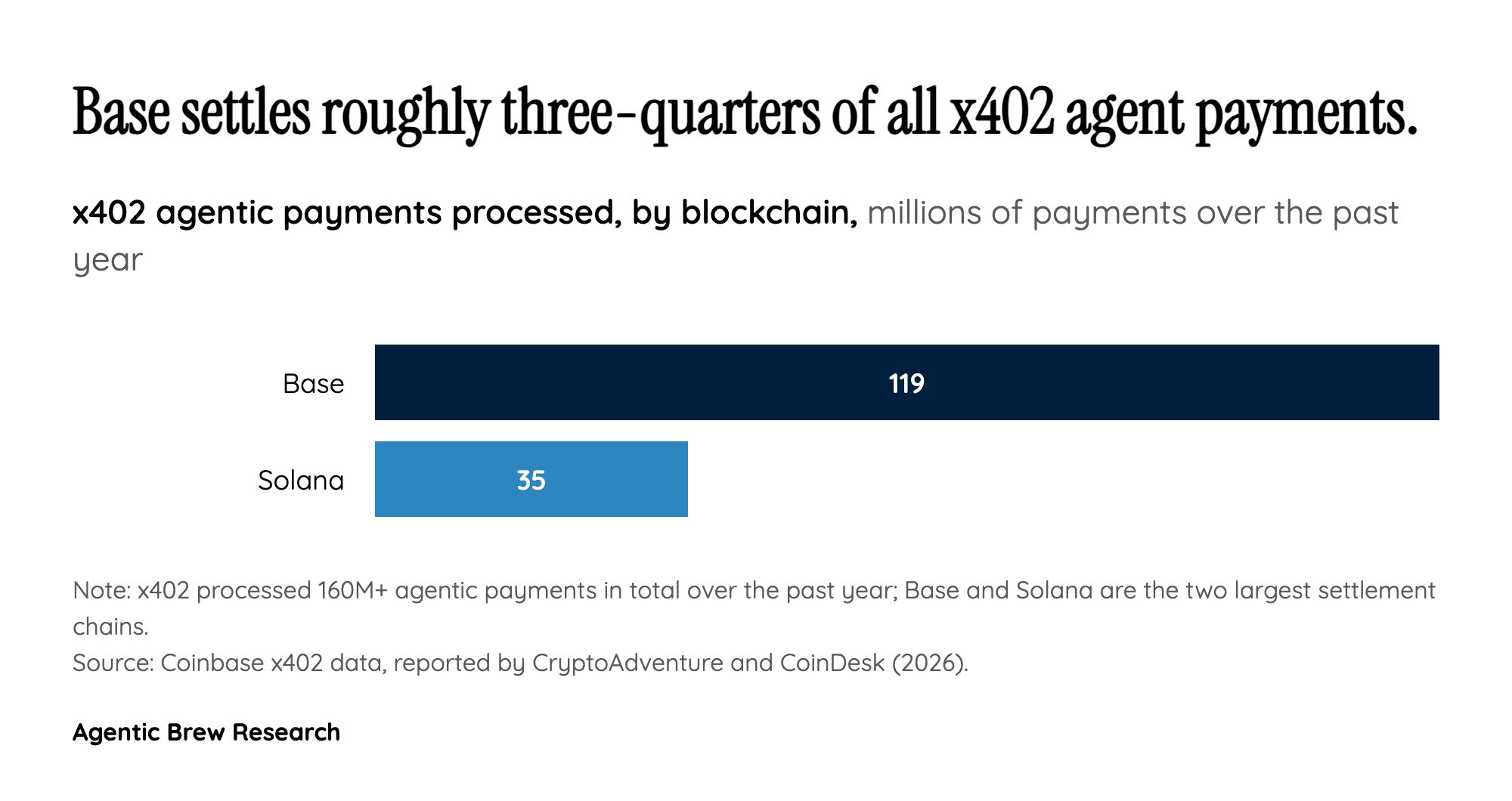
The second leg is micropayment economics. Card networks carry a fixed fee floor of roughly 30 cents per transaction, but 76% of agent transactions fall below that floor, with most payments landing between one and ten cents [3]. At that scale, settling on a card is economically impossible — the fee dwarfs the payment. Stablecoin settlement on low-fee chains like Base costs a fraction of a cent, making programmable, always-on, globally-settling money the only financial layer that actually fits machine-driven activity. This is why the industry argues blockchain 'was built for machines all along,' a framing that has gained sharp momentum across crypto-native voices even as the consumer adoption story stalled.