'Europe 2031' Scenario: Europe Sliding Into Irrelevance by Underinvesting in AI
TECH

'Europe 2031' Scenario: Europe Sliding Into Irrelevance by Underinvesting in AI

30+
Signals

Strategic Overview

  • 01.
    'Europe 2031' is a novella-style speculative scenario tracing AI's impact on Europe from January 2025 through March 2031, depicting how slow action, weak investment, and overregulation could leave Europe sliding into economic and political irrelevance. It is explicitly modeled on the 'AI 2027' project.
  • 02.
    The scenario is told through fictional characters - Caroline, a policy worker in Brussels, and Christian, a German founder in San Francisco - via their text messages across the scenario's 2025-2031 span, framed as 'disciplined imagination' rather than a prediction.
  • 03.
    The scenario launched around June 11, 2026, inspired by the AI Futures Project's 'AI 2027' though not affiliated with it, and was amplified by press including Semafor, Cybernews, and Table.Briefings.
  • 04.
    It ends with five proposed actions, each described as 10-100x bolder than current EU policy: far more compute on European soil, an AI middle-power coalition, labour-market reforms, a bold robotics/industrial-AI position, and a positive societal vision for AI.

Deep Analysis

Forecasting As Fiction: The 'Disciplined Imagination' Method Europe Borrowed From AI 2027

Europe 2031 is not a white paper or a model run - it is a novella. The argument arrives through six years of text messages between two invented characters, Caroline, a policy worker in Brussels, and Christian, a German founder who decamped to San Francisco, narrating the continent's slow slide from January 2025 to March 2031 [2]. The authors call this 'disciplined imagination,' insisting the future they sketch is plausible enough to be taken very seriously rather than a literal prediction [2]. The genre is borrowed wholesale from 'AI 2027,' the AI Futures Project scenario published in April 2025 that forecast superhuman AI exceeding the Industrial Revolution in impact [7][8]; the Europe 2031 team names it as 'a major inspiration' [1]. The narrative device is the whole strategy: rather than debating policy in the abstract, it dramatizes each individually-reasonable EU decision compounding into what the authors call an 'incremental rationality trap' - a Europe that 'keeps its procedures while losing its principles' [3]. The bet is that a story moves a policymaker where a chart does not.

The 5% Problem: The Compute And Money Gap, By The Numbers

The 5% Problem: The Compute And Money Gap, By The Numbers
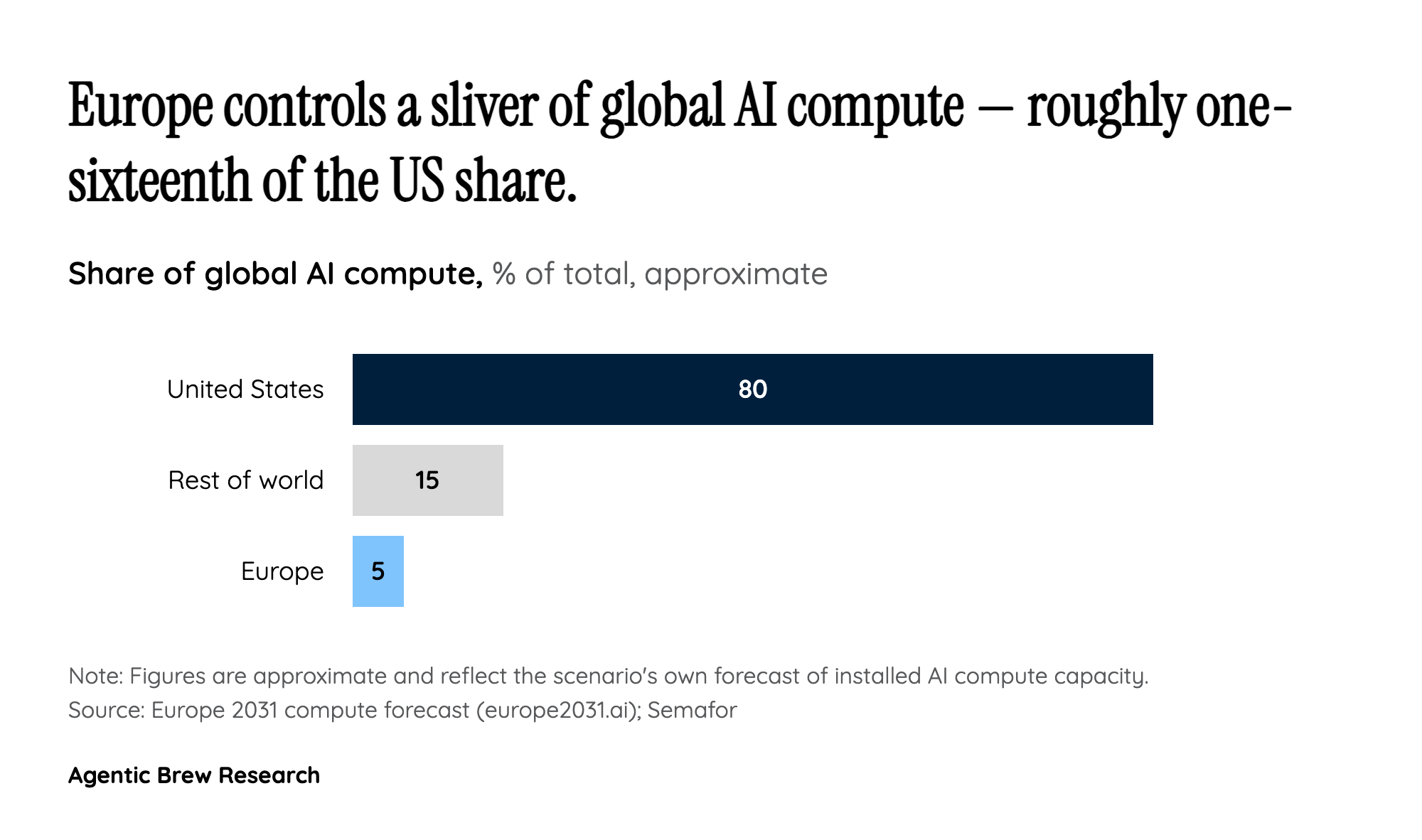
Europe holds roughly 5% of global AI compute against the US share of about 80%, per the Europe 2031 forecast.

Strip away the fiction and the alarm rests on a small set of numbers. By the project's own forecast, Europe hosts roughly 5% of global AI compute against the United States' ~80%, and each of three American labs alone is said to operate more compute than all of Europe combined [3][5]. The money gap is starker: US tech firms spent over $400 billion largely on AI infrastructure in 2025 alone, dwarfing the EU's flagship ~200 billion EUR (~$230 billion) InvestAI plan - which the scenario dismisses as 'mostly repackaged money' spread out to 2030 [5][6]. The compute-forecast page models Europe's share drifting from 6-7% in early 2025 down to ~5% now, peaking near 8% in 2028, then falling back to ~5% by 2031 in the default case (~21 GW capacity), with France projected to own 37% of European compute [4]. The ambitious epilogue triples Europe's share to 15% by 2031 - but only with the 10-100x bolder action the authors prescribe [4]. The takeaway the makers want: the gap is not a rounding error a course-correction closes, but a structural deficit that compounds.

Warning Or Wishlist? The Makers-Versus-Skeptics Fight Over What Europe 2031 Really Is

The most revealing thing about Europe 2031 is the gulf between how its makers frame it and how online communities received it. The authors and amplifying press treat it as a sober alarm: AI policy analysts in Semafor's coverage warn that without action Europe is 'left as an economic backwater' as AI dominates defense, cybersecurity, and geopolitics [5], and mainstream outlets like Table.Briefings echoed the 'Europe loses the AI race' framing [9]. Community reception ran the other way. On Reddit the dominant read was skeptical to hostile - the scenario was dismissed as 'AI boosters writing fanfiction,' and a top comment called it 'blatant fearmongering' designed to pressure Europe into handing money and data to tech companies. More analytically-minded threads debated whether EU regulation is genuinely the bottleneck, whether the data-center buildout is even feasible, and whether AI labs are profitable enough to matter. That tension is the story: a polished, professionally-produced doom scenario landing as lobbying-by-narrative to a sizable, technically-literate audience - which sharpens the question of who built it and why.

The Authors, The Asks, And The Conflict-Of-Interest Question

Europe 2031's credibility cuts both ways through its roster. The public face is Michiel Bakker, an MIT assistant professor and Google DeepMind researcher who co-authored the Dutch National AI Plan, lending genuine policy and technical weight [1]. Much of the team sits inside the Arq Foundation, with Daan Juijn and Alex Petropoulos as core authors [1]. But co-author Judith Dada is a General Partner at the VC firm Visionaries Club [1]- exactly the profile that fuels the skeptics' 'investor lobbying' read, since the prescribed fix is more capital flowing into AI infrastructure. The five asks are each pitched as 10-100x bolder than current EU proposals: dramatically more compute on European soil, an 'AI middle-power coalition' with other nations, labour-market reforms, a bold robotics and industrial-AI position, and a positive societal vision for AI [1][3]. The authors frame this as the most ambitious political agenda in post-war European history, insisting that 'unless we embark on it now, Europe will lose the ability to shape its own future' [3]. Whether that reads as a warning or a wishlist depends largely on whether you trust the messengers - which is precisely the debate the scenario has provoked.

Historical Context

2025-01-01
The scenario's timeline begins in January 2025 with the release of DeepSeek's R1 model and runs through March 2031.
2025-04-03
Published 'AI 2027', the scenario-forecast that directly inspired Europe 2031, predicting superhuman AI's impact would exceed the Industrial Revolution.
2026-06-11
Europe 2031 launched and was amplified by press including Semafor, Cybernews, and Table.Briefings.

Power Map

Key Players
Subject

'Europe 2031' Scenario: Europe Sliding Into Irrelevance by Underinvesting in AI

MI

Michiel Bakker

Co-creator of Europe 2031; Assistant Professor at MIT and Researcher at Google DeepMind; co-author of the Dutch National AI Plan and the public face/launcher of the project.

AR

Arq Foundation

Organization behind much of the team; Daan Juijn and Alex Petropoulos are core authors.

JU

Judith Dada

Co-author and General Partner at Visionaries Club (VC); publicly promotes the AI-gap argument.

TO

Tom Chivers

Provided editing and audio for the project and authored the Semafor coverage amplifying it.

EU

European Commission / EU

Subject of the critique; its flagship ~200B EUR InvestAI plan is characterized as 'mostly repackaged money' and far too small relative to US spending.

Fact Check

9 cited
  1. [1] Europe 2031 - About
  2. [2] Europe 2031 scenario coverage (Digg)
  3. [3] Europe 2031 - Summary
  4. [4] Europe 2031 - Compute Forecast
  5. [5] Europe at risk of AI-driven irrelevance (Semafor)
  6. [6] EU InvestAI Initiative: Can 200 Billion Close the AI Gap? (FintechWeekly)
  7. [7] AI 2027
  8. [8] AI Futures Project (Wikipedia)
  9. [9] Scenario 2031: Europe loses the AI race (Table.Briefings)

Source Articles

Top 4

THE SIGNAL.

Analysts

"Argue the current AI trajectory demands the most ambitious political agenda in post-war European history, and that inaction means Europe loses the ability to shape its own future."

Europe 2031 authors (collective)
AI policy / research team (Arq Foundation, MIT, Google DeepMind)

"Hold that Europe's underinvestment, regulatory constraints, and tech skepticism position the continent to become an economic backwater as AI dominates defense, cybersecurity, and geopolitics."

AI policy analysts (per Semafor)
AI policy analysts cited in Semafor coverage

"Frames compute as a top strategic resource, arguing the amount a continent controls increasingly determines its ability to build advanced AI."

Europe 2031 compute forecast
Project's compute-forecast analysis
The Crowd

"The elephant in the room: What happened to Europe? While US and Chinese AI companies are announcing trillions of dollars in AI deals, the EU is rolling out a $1.1 billion AI plan to "ramp up AI." There is virtually no competition coming from the EU when it comes to AI"

@@KobeissiLetter2718

"I'm deeply concerned about Europe's future on AI. One of my biggest worries is our erosion of agency, our ability to stay relevant and fight for our values in a future where AI becomes a civilisationally important technology. Myself, @DadaJudith , @bakkermichiel and others have"

@@AlexTPet102

"Europe 2031: What getting AI wrong means for us - discussed it all with @SebJohnsonUK"

@@DadaJudith41

"Europe 2031"

@u/New_Camera375237
Broadcast
The AI Gap Europe Can't Ignore - with Judith Dada

The AI Gap Europe Can't Ignore - with Judith Dada

AI 2027: A Realistic Scenario of AI Takeover

AI 2027: A Realistic Scenario of AI Takeover

Europe's fight to stay in the AI race - FRANCE 24 English

Europe's fight to stay in the AI race - FRANCE 24 English