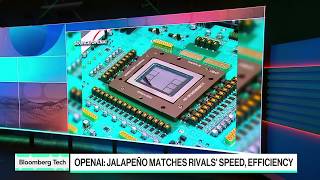
What Jalapeño Actually Claims - And What The Numbers Say
OpenAI published Jalapeño's first public benchmark results at Hot Chips 2026 on August 25, 2026, running the chip through SemiAnalysis's InferenceX suite rather than a benchmark of its own design [1]. The chip itself is a 700-watt-TDP ASIC fabricated on TSMC's N3P process, packing 13.4 petaFLOPS of MXFP4 matrix compute per chip with 216 GB of HBM4 memory delivering 15.4 TB/s of bandwidth; a single rack holds 128 chips, and OpenAI's full reference system scales to 2,048 chips for 27 exaFLOP/s and 432 TiB of pooled memory [2]. On the two flagship workloads OpenAI published, GPT-OSS 120B and DeepSeek R1 670B, Jalapeño posted 1.9x and 1.7x higher peak mixed tokens-per-second-per-kilowatt than Nvidia's GB200, alongside 1.7x and 3.6x lower end-to-end latency [2].
The efficiency gap traces to a specific architectural choice: OpenAI designed the chip to minimize data movement so that model state, including the KV cache generated while a response streams out, can be explicitly placed and kept local rather than shuttled across the system [3]. That is what let OpenAI claim something GPUs traditionally struggle to deliver at once - high throughput and low latency on the same hardware - a result OpenAI's head of hardware, Richard Ho, described as a very significant performance advance over the state of the art [1]. A later B0 silicon stepping is reported to add roughly another 25% performance-per-watt over the earlier A0 silicon [4].