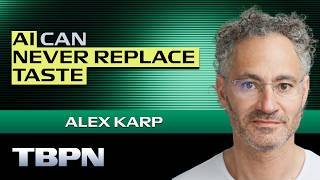
Palantir CEO Alex Karp's criticism of OpenAI and Anthropic
TECH

Palantir CEO Alex Karp's criticism of OpenAI and Anthropic

36+
Signals

Strategic Overview

  • 01.
    On July 1, 2026, Palantir CEO Alex Karp went on CNBC's Squawk Box and attacked OpenAI's and Anthropic's token-based pricing, saying 'something has gone completely wrong' with how AI is sold.
  • 02.
    Karp framed per-token pricing as a 'wealth tax' on American business, arguing enterprises pay for tokens that create no value while frontier labs absorb their proprietary data and IP to sharpen their own models.
  • 03.
    The interview followed Palantir's June 29, 2026 partnership with Nvidia to deploy Nvidia Nemotron open models via a Sovereign AI Operating System, letting customers run and customize AI in air-gapped environments while retaining full ownership of the model weights.
  • 04.
    Palantir (PLTR) shares rose more than 9% on the combined Nvidia sovereign-AI deal and Karp's interview.

Deep Analysis

The Argument Hiding Inside the Insult: Pay for Value, Not Tokens

Strip away the profanity and Karp's core complaint is an economic one about how AI is metered. Frontier labs charge per million input and output tokens, an incentive that rewards heavy consumption rather than customer outcomes [1]. Karp's objection is that this decouples price from value entirely: a company can burn through tokens all day and still be no better off, yet the meter keeps running. He crystallized it with a deliberately provocative counterexample from the cluster materials - if he could make a customer a billion dollars, he would take a 30% cut of that billion, not bill them by the token. The point is that outcome-based or value-based pricing aligns the vendor with the buyer, while token pricing aligns the vendor with usage.

He extended this into a jab at enterprise behavior itself, coining 'tokenmaxxing' to describe firms that 'chillax and waste my time with tokens' while getting no measurable return [2]. The claim that executives are privately 'livid' - reported across coverage of the interview [3]- is the demand-side of his thesis: buyers have started noticing that a large AI bill is not the same thing as a large AI benefit. Reports that firms including Uber and Microsoft capped or restricted expensive AI coding tools after budgets overran give the argument a concrete anchor beyond rhetoric [1].

Rent the Tokens, Lose the Alpha: The IP-Capture Thesis

The sharper, less obvious half of Karp's case is not about price at all - it is about what flows the other direction when you use a hosted frontier model. He argues that when enterprises pipe their proprietary data through a lab's API, the lab effectively captures their 'alpha,' the competitive edge encoded in that data, and can fold it into future products [2]. In his framing the customer is not just overpaying; they are training the very system that may later commoditize their advantage. This is why he keeps returning to ownership of 'compute, models, data stack, and alpha' as the thing enterprises actually want.

The cluster materials sharpen this with the Figma cautionary tale that circulated alongside the interview: the observation that Claude Design shipped only a few days after a prominent Figma board departure, offered as evidence that a lab can move into an adjacent category once it understands the domain. Coverage of the interview cited the broader Figma-versus-Anthropic dynamic - Figma's stock under pressure while Anthropic expanded into adjacent product categories like Claude Code - as the archetype of the risk [4]. Whether or not the causation holds, the fear is legible to any enterprise: 'rent tokens, lose alpha.' It reframes API access from a convenience into a slow transfer of moat.

Follow the Money: A Sales Pitch Wearing a Manifesto

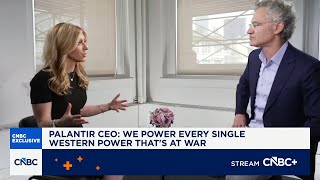
The uncomfortable context is that every element of Karp's critique maps onto something Palantir is now selling. Two days before the interview, Palantir and Nvidia launched an engine for deploying Nemotron open models in sovereign, air-gapped environments, with customers retaining full ownership of the resulting weights [5]. That is the literal product answer to 'you lose your alpha': open-weight models the customer owns, running on Nvidia hardware that, in Karp's telling, 'sells you the hardware and walks away' rather than caching prompts or retraining on your inputs. The market read the alignment plainly - PLTR rose more than 9% on the deal and the interview [6], against a sovereign-AI opportunity that coverage pegged at a roughly $600 billion market by 2030 [7].

Community reaction split along exactly this fault line. On investor-leaning forums the argument resonated, with the strongest thread distilling it to the idea that ownership of your data is your alpha and that token spending had become a lazy KPI. But skeptics were quick to note the messenger problem: threads on general tech forums pointed at Palantir's own surveillance and data-aggregation history as reason to distrust a data-ownership sermon coming from Karp specifically. Even a forum openly hostile to AI hype landed on grudging agreement with the substance while flagging his obvious self-interest - a rare case of 'the worst person you know just made a good point.' The tension - real argument, conflicted messenger - is the whole story.

Redefining Safety and the Real Fault Line: Open vs Closed

Karp and his defenders used the moment to redraw two debates at once. The first is 'AI safety.' Where the term usually points at alignment research, David Sacks - defending Karp on X - recast enterprise AI safety as something concrete and commercial: customers controlling their own data, weights, and compute so a frontier lab cannot absorb their operational knowledge into its next release [2]. It is a definition tailored to sell control, but it also reflects a genuine enterprise anxiety that abstract alignment talk never addresses.

The second reframing is geopolitical. Per the cluster materials, Karp praised the open-weight approach of Chinese labs like DeepSeek, Kimi, and GLM and argued the real AI race is 'closed vs open,' not 'US vs China' - a striking position from a defense contractor. It positions Palantir as the neutral application layer sitting atop whichever open models win, and it quietly reframes open weights from a security liability into a strategic advantage for whoever controls the surrounding stack. Taken together, the safety and open-versus-closed moves let Karp turn a pricing gripe into an argument about who owns the means of AI production - which is, not coincidentally, the exact thing Palantir now sells.

Historical Context

2026-03
Palantir and Nvidia published a Sovereign AI Operating System Reference Architecture, a full-stack AI data center design around Nvidia Blackwell Ultra where data never leaves the building.
2026-06-29
Palantir launched an engine for deploying Nvidia Nemotron open models in sovereign, air-gapped environments for U.S. government agencies, with customers retaining ownership of the model weights.
2026-07-01
Karp's CNBC Squawk Box interview aired, escalating the token-pricing criticism into a viral 'wealth tax' and 'effing insane' takedown of OpenAI and Anthropic.

Power Map

Key Players
Subject

Palantir CEO Alex Karp's criticism of OpenAI and Anthropic

AL

Alex Karp / Palantir

Source of the criticism; positions Palantir and Nvidia as the enterprise-controlled alternative to token-metered frontier labs. His remarks moved PLTR stock and set the debate agenda.

OP

OpenAI and Anthropic

Target of the criticism; their token-metered API pricing is the object of Karp's 'wealth tax' framing and his accusation that labs capture customer data and IP.

NV

Nvidia

Palantir's partner; supplies Nemotron open-weight models and accelerated compute for the Sovereign AI Operating System that underpins Karp's alternative.

DA

David Sacks

Trump administration AI policy advisor; publicly defended Karp on X, reframing the interview as a serious articulation of enterprise AI safety as data, weight and compute control.

EN

Enterprise CEOs and AI buyers

The constituency Karp claims to speak for; described as 'livid' and pulling back from wasteful token spending toward ROI and open-weight or in-house tools.

Fact Check

7 cited
  1. [1] Palantir's Karp rips OpenAI and Anthropic over token-based pricing
  2. [2] The tokenomics worldview according to Palantir CEO Alex Karp, who lays into OpenAI and Anthropic's 'effing insane' models
  3. [3] Palantir Billionaire Alex Karp Calls AI Industry 'Effing Insane' In Heated Interview
  4. [4] Palantir CEO Alex Karp doesn't hold back in interview railing against the AI industry
  5. [5] Palantir and NVIDIA Bring Secure AI to US Agencies With Nemotron Open Models
  6. [6] Palantir Stock (PLTR) Rallies 9% as CEO Blasts OpenAI and Anthropic's 'Wealth Tax' on Tokens
  7. [7] Palantir Jumps 9% on Nvidia Sovereign AI Deal, Palo Alto Networks Climbs 4%

Source Articles

Top 5

THE SIGNAL.

Analysts

"Defended Karp, arguing that media dismissal of the interview as a 'crash-out' was itself the clue Karp was making an insightful point, and that real enterprise AI safety means customers controlling their own data, model weights, and compute so a frontier lab cannot absorb their proprietary knowledge into its next product."

David Sacks
AI and Crypto Policy Advisor, Trump administration
The Crowd

"Palantir's CEO just exposed Sam Altman and Dario Amodei for robbing every Fortune 500 company. Within two minutes, Alex Karp took the entire frontier AI industry apart on national television. His exact words: "Every single enterprise in this country, these people are LIVID."

@@Ric_RTP15246

"Palantir CEO Alex Karp on what customers actually want, the real business of frontier labs, and the importance of open source models: “What the technical customers want is control over their compute, their models, their data stack, and their alpha. They want to know they own the"

@@PalantirTech5056

"Alex Karp reveals why he believes American enterprises have completely lost trust in the frontier AI labs "Something has gone completely wrong. The basic view among enterprises in this country is, I'm going to chill lax and waste my time with tokens, I'm going to get no value,"

@@jaynitx17

"Palantir CEO: "These models have been completely oversold", "Every enterprise tells me in private that they are paying for tokens that create no value, they are livid". Throws shade at Anthropic and OpenAI, says open source models are good enough."

@u/Gil_berth862
Broadcast
Palantir CEO Alex Karp says 'something has gone completely wrong' with how AI is sold

Palantir CEO Alex Karp says 'something has gone completely wrong' with how AI is sold

Alex Karp: Most of the things Anthropic talks about in public are running on Palantir

Alex Karp: Most of the things Anthropic talks about in public are running on Palantir

Palantir CEO Alex Karp on Tokenmaxxing & Taste

Palantir CEO Alex Karp on Tokenmaxxing & Taste