Musk's AI power crisis warning at G20
TECH

Musk's AI power crisis warning at G20

27+
Signals

Strategic Overview

  • 01.
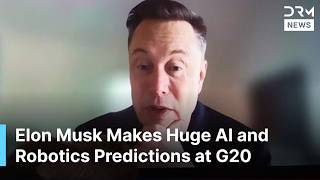
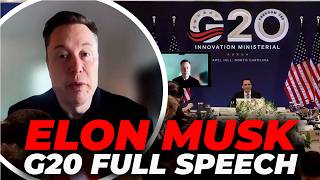
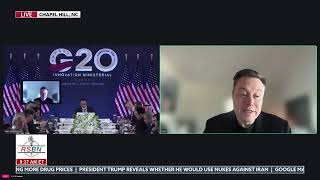
    Elon Musk addressed the G20 virtually on September 1, 2026, at a technology ministers meeting in Chapel Hill, North Carolina, warning that AI faces a near-term electricity shortfall rather than a distant one: "There will be a significant power shortfall next year, so not like the distant future."
  • 02.
    He cited a projected shortfall of at least 15 gigawatts of power for AI chips by 2027.
  • 03.
    Musk framed the core problem as a growth-rate mismatch: AI chip production is rising roughly 40-50% a year while power supply outside China is growing only 10-20% a year.
  • 04.
    He projected AI could add $20-30 trillion annually to the global economy, a 20-30% increase in its size, and predicted AI software would reach human-matching, "Stockfish-level" capability on digital tasks within 12-18 months.
  • 05.
    Musk also used the appearance to argue against EU-style AI regulation, saying new technologies should be presumed legal absent explicit restriction: "You have to have an environment that's relatively free of regulation, meaning that new things must be default legal as opposed to default illegal."
  • 06.
    Mark Zuckerberg spoke at the same session, pleading for more AI data centers and citing a shortage of skilled tradespeople as an added bottleneck.

Deep Analysis

The Warning and the Windfall

Musk told G20 technology ministers that electricity, not chips or algorithms, is now the binding constraint on AI growth [1]. What went less remarked in the framing is that SpaceX is a direct beneficiary of exactly the scarcity he was describing. Google is paying SpaceX $920 million a month for bridge compute through mid-2029 [2], and Anthropic has leased the entirety of SpaceX's Colossus 1 data center in Memphis for $1.25 billion a month through 2029, a contract worth more than $40 billion in total and roughly half Anthropic's current annualized revenue [3]. Combined, the two deals are worth more than $26 billion a year, more than SpaceX's entire 2025 revenue [3]. That does not make the underlying shortage untrue, but it does mean the loudest global messenger for the crisis is also its most immediate commercial winner, arriving just as SpaceX and xAI merge into a $1.25 trillion entity ahead of a planned IPO [3].
The Numbers Behind the 15-Gigawatt Warning

Musk's specific claim was a projected shortfall of at least 15 gigawatts of power for AI chips by 2027 [1]. His reasoning: AI chip production is rising roughly 40-50% a year, while power availability outside China is growing only 10-20% a year [4], a gap that compounds fast enough to outpace new data-center buildout well before the decade is out. SpaceX's own Colossus 1 facility, built in a record 122 days with 200,000 GPUs and 300 megawatts of capacity, is effectively Musk's proof of concept that compute can be stood up faster than traditional utility-scale power projects can catch up [3]. Video coverage of the same G20 appearance corroborates the same figures verbatim, along with Musk's aside that China has abundant electricity but remains blocked from the most advanced chips by export controls, and that combined digital-plus-robotics AI value could run "10x or more" beyond his headline $20-30 trillion estimate.

A Deregulation Push Riding on the Power Panic

The power-shortage framing did not stand alone at the G20 session; it was paired with an explicit push against AI oversight. Musk argued that new technologies should be presumed legal absent explicit restriction, and singled out the EU by name: "the regulation level is extraordinarily high, and things are generally default illegal, and this inhibits progress with new technologies" [5]. David Sacks, the Trump administration's AI czar, spoke at the same session opposing the creation of strict AI regulatory bodies [5]. Not everyone in the room agreed: Google DeepMind's Demis Hassabis used his remarks to call for pre-release testing of powerful AI systems, a more cautious counterpoint delivered at the exact same event [5]. The sequencing is notable - an infrastructure-scarcity argument for building faster, immediately adjacent to an argument for regulating less.

Skepticism Meets a Substantive Debate

Public reaction split along two tracks. On X, Musk's own recap of his G20 remarks was widely amplified alongside straight news relays of the Musk-Zuckerberg data-center plea, with little visible pushback in the immediate response. On Reddit, the tone was sharper: threads discussing the power-shortage claim leaned heavily skeptical of Musk personally, citing his track record on prior predictions and his evident financial interest through SpaceX and his other energy holdings. Underneath the distrust, though, a more substantive technical argument played out - whether the real bottleneck is power generation at all, or grid transmission and interconnect capacity, with commenters pointing to Texas alone fielding requests for 474 gigawatts of new grid interconnects, far beyond what the state can currently produce. That debate, over whether more power plants or more transmission lines are the actual fix, unfolded alongside broader distrust of Musk's own predictive track record.

Historical Context

2026-06-05
Google agreed to pay SpaceX $920 million a month (October 2026 to June 2029) for about 110,000 Nvidia GPUs of bridge compute, with a 90-day cancellation clause after December 31, 2026.
2026
Anthropic signed a deal for the entirety of SpaceX's Colossus 1 data center capacity in Memphis, worth $1.25 billion a month through May 2029, following the 122-day build of the 200,000-GPU, 300MW facility.
2026
SpaceX merged with xAI, valuing the combined entity at $1.25 trillion, ahead of SpaceX's planned IPO.
2026-09-01
Musk and Zuckerberg addressed the G20 virtually from a White House-organized meeting in Chapel Hill, North Carolina, dedicated to keeping AI largely free of government regulation.

Power Map

Key Players
Subject

Musk's AI power crisis warning at G20

EL

Elon Musk (Tesla, SpaceX, xAI)

Delivered the G20 warning on AI power constraints; his company SpaceX is simultaneously the counterparty leasing compute capacity to Google and Anthropic from its Colossus data centers, giving him a direct commercial stake in the power/compute shortage narrative.

GO

Google

Paying SpaceX $920 million per month (October 2026 to June 2029) for roughly 110,000 Nvidia GPUs of bridge compute capacity to meet surging demand for its Gemini Enterprise agent platform.

AN

Anthropic

Leasing the entirety of SpaceX's Colossus 1 data center capacity in Memphis for $1.25 billion a month through 2029 (over $40 billion total), roughly half its current annualized revenue.

SP

SpaceX

Emerging as a major AI compute lessor; combined Google and Anthropic deals worth over $26 billion annualized, versus SpaceX's roughly $18.7 billion total 2025 revenue, positioning it ahead of a planned IPO following its merger with xAI.

MA

Mark Zuckerberg (Meta)

Co-appeared virtually at the same G20 session pleading for more AI data centers and citing a shortage of skilled tradespeople as a bottleneck alongside power.

DA

David Sacks (Trump's AI czar)

Also spoke at the G20 session, opposing the creation of strict AI regulatory bodies.

DE

Demis Hassabis (Google DeepMind)

Called for pre-release testing of powerful AI systems at the same event, a more cautious counterpoint to Musk and Sacks.

Fact Check

5 cited
  1. [1] Musk: 15 gigawatt AI power shortfall looms by 2027
  2. [2] Google will pay SpaceX $920M per month for compute
  3. [3] Why Anthropic and Google are renting compute from SpaceX
  4. [4] Musk warns G20 summit of imminent AI power shortfall
  5. [5] Musk defends AI data centers, slams regulation at G20

Source Articles

Top 1

THE SIGNAL.

Analysts

"Electricity is the single binding constraint on artificial intelligence growth" - a present, not future, crisis unfolding due to the gap between chip production growth (40-50% a year) and non-China power growth (10-20% a year).

Elon Musk
CEO, Tesla/SpaceX/xAI

Opposes creating strict AI regulatory bodies, arguing such oversight would be harmful to the pace of AI development.

David Sacks
Trump administration AI czar

Called for pre-release testing of powerful AI systems, offering a more cautious counterpoint to the deregulation push from Musk and Sacks at the same session.

Demis Hassabis
CEO, Google DeepMind
The Crowd

Summary of my G20 address

@@elonmusk5744

ELON MUSK: The AI industry is running into a power problem, and it could be a huge opportunity for countries around the world. Musk says power shortages are already affecting AI companies, which is why Google, Anthropic and others are leasing compute from SpaceX. His solution?

@@teslaownersSV108

Mark Zuckerberg and Elon Musk push for more AI data centers and the power needed to support them at G20 meeting. The tech leaders' comments came a day after Trump attacked opponents of AI data centers as "backwards and poor." Polls show a majority of Americans are against the...

@@AFP5

AI could perform virtually anything digital at a superhuman level by the end of 2027, according to Elon Musk.

@u/cheesemezzz0
Broadcast
Elon Musk UNLEASHES his AI VISION at the G20: the FUTURE is CLOSER than YOU THINK

Elon Musk UNLEASHES his AI VISION at the G20: the FUTURE is CLOSER than YOU THINK

"AI Will Crush All Humans": Elon Musk on Extreme Advancements in AI at G20 Summit - 09/01/26

"AI Will Crush All Humans": Elon Musk on Extreme Advancements in AI at G20 Summit - 09/01/26

Elon Musk Warns Against AI Regulation, Predicts 1 Billion Humanoid Robots at G20 Ministerial

Elon Musk Warns Against AI Regulation, Predicts 1 Billion Humanoid Robots at G20 Ministerial

Musk's AI power crisis warning at G20 — AI News | Agentic Brew