AI data center energy and water consumption surge
TECH

AI data center energy and water consumption surge

19+
Signals

Strategic Overview

  • 01.
    Global data centers consumed 448 TWh of electricity last year, more than the entire country of Saudi Arabia, along with 4.5 trillion liters of water, with AI accounting for roughly a fifth of total power use.
  • 02.
    By 2030, data center power demand is projected to reach 945 TWh and water use 9.3 trillion liters (about 2.5 trillion gallons), with AI's share rising to 40% and the land footprint more than doubling from 6,900 to over 14,500 sq km.
  • 03.
    US data centers consumed 183 TWh in 2024, over 4% of national electricity, and accounted for around 50% of all US electricity demand growth, a share the IEA expects to persist through 2030.

Deep Analysis

The Doubling: Power and Water on the Same Steep Curve
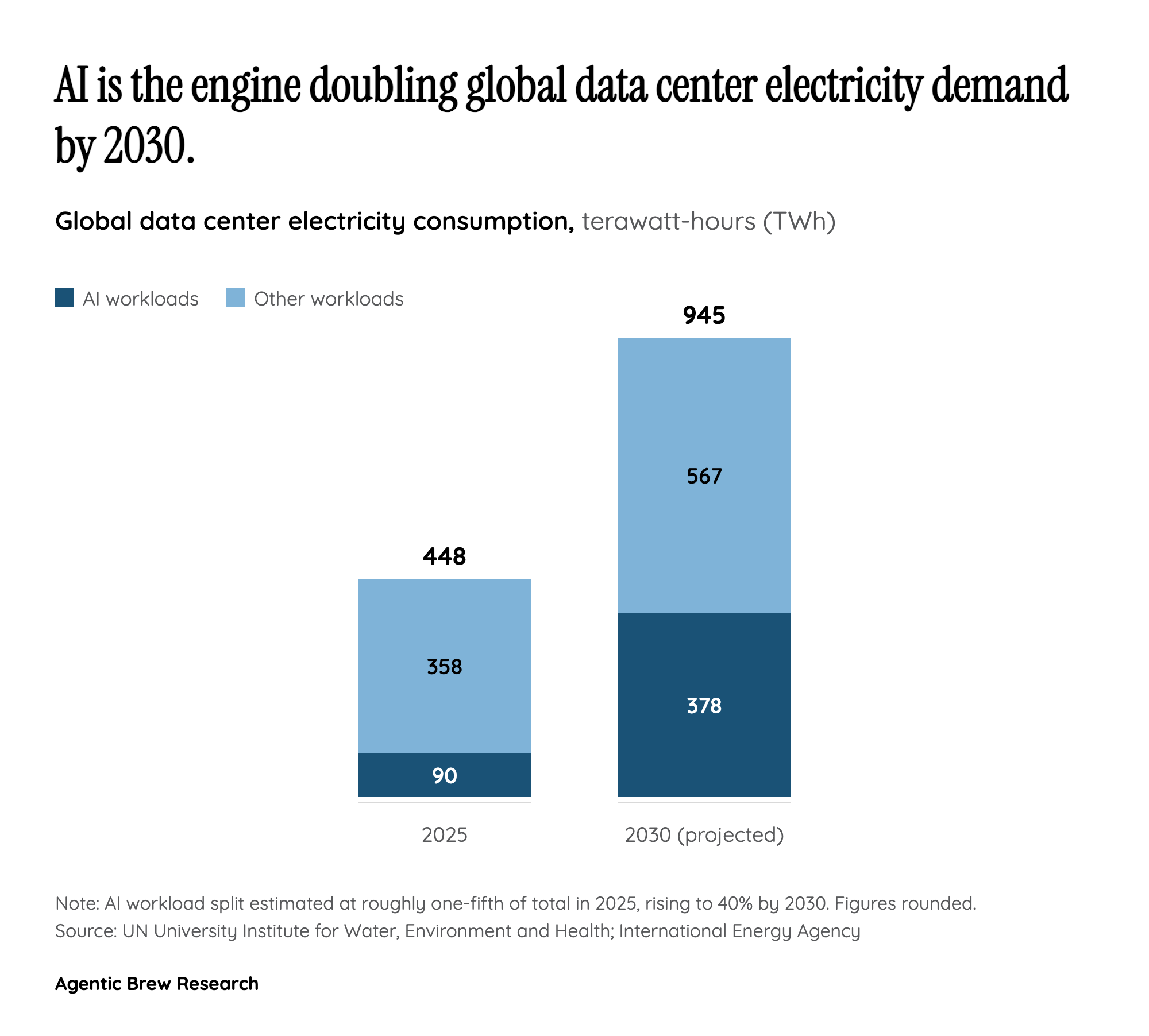
The Doubling: Power and Water on the Same Steep Curve
Global data center electricity is projected to more than double to 945 TWh by 2030, with AI workloads driving the bulk of the increase.

The headline number is a doubling, and it arrives twice. Global data centers burned through 448 TWh of electricity last year, more than all of Saudi Arabia consumes, and that figure is projected to hit 945 TWh by 2030 [1]. The IEA and Gartner converge on the same trajectory: Gartner forecasts demand roughly doubling from 448 to 980 TWh over the decade, with 16% growth in 2025 alone [3]. Water tracks power almost in lockstep. The UN University report projects annual consumption climbing from 4.5 trillion liters to 9.3 trillion liters, about 2.5 trillion gallons, by 2030 [1]. Carbon follows the same shape, from 189 million tons of CO2 to 399 million tons [1]. What makes these projections more than extrapolation is the composition shift underneath them: AI's slice of data center power is forecast to grow from roughly a fifth today to 40% by 2030 [1], and the IEA attributes nearly half the net increase in demand to accelerated servers whose electricity draw is rising about 30% a year against 9% for conventional servers [2]. The growth is not the internet getting bigger. It is a single workload class bending the curve.
Who Actually Pays: The Bill Lands on the Ratepayer

The cost of the AI buildout is not staying inside the hyperscalers' balance sheets. In the US, residential electricity prices rose 11.5% in 2025, and utilities requested more than $29 billion in rate increases in the first half of the year alone [6]. Carnegie Mellon researchers estimate data centers could raise average US electricity bills by 8% by 2030 [5]. The mechanism is the grid itself: in PJM, the largest US grid operator, data center demand helped drive capacity-market costs up roughly $9.3 billion for 2025-26, a charge that flows to every customer on the network [6]. The regional concentration sharpens the pain. In Virginia, the densest data center corridor on earth, wholesale electricity prices climbed as much as 267% over five years [6]. The political consequence is showing up in town halls rather than spreadsheets. Local opposition blocked or delayed at least 16 data center projects worth roughly $64 billion in the prior year [4], and community pushback online has shifted from abstract climate concern toward a concrete grievance: residents bearing higher bills and water draws for facilities they did not vote for and cannot connect to.

The Counterintuitive Bottleneck: It's the Grid, Not the Generation

The instinct is to frame this as a generation crisis, but the more granular reporting points somewhere else: the constraint is delivery, not supply. The choke point is interconnection, the queue to physically wire a facility into the grid, where waits can stretch toward seven years and transformer shortages stall projects that already have chips racked and idle. The IEA estimates around 20% of planned data center projects could face delays from grid-connection challenges [2]. This reframes the entire debate. Building more power plants does not help if the wires, substations, and transformers to move that power do not exist, and those take far longer to permit and build than a data center shell. It also explains the policy response: Executive Order 14318, signed in July 2025, explicitly targets permitting for transmission lines and supply chains alongside the data centers themselves [7], an acknowledgment that the binding constraint is the connective tissue of the grid, not the megawatts. The independent tech-explainer community has seized on exactly this point, arguing the real story is a delivery and interconnection failure that headline power-consumption numbers obscure.

The Flexibility Escape Hatch: Data Centers as Grid Assets

If interconnection is the bottleneck, the most interesting proposed fix flips the data center from a grid liability into a grid asset. The argument, advanced by Boston University computer scientist Ayse Coskun in a widely watched talk, rests on a property of AI workloads that the alarm narrative ignores: much of the compute is predictable, controllable, and delayable. Training runs and batch inference do not need to happen at a fixed second. That makes a data center capable of acting as a flexible reserve, capping its draw during peak strain, shifting load to off-peak hours, and syncing consumption with intermittent wind and solar output. The payoff is twofold. A facility that can promise to throttle on demand can connect to a constrained grid faster, sidestepping part of the interconnection queue, and a fleet of such facilities helps keep electricity affordable rather than bidding up scarce peak capacity. This is the optimistic counterweight to the doubling story: the same workloads driving demand are unusually well suited to being managed as a flexible load, if operators and regulators build the incentives to do so. It does not erase the water and carbon footprint, but it directly attacks the grid-stress problem that drives the worst ratepayer outcomes.

Is the Alarm Overstated? The Contrarian Read

Not everyone buys the crisis framing, and the skepticism is more sophisticated than denial. The sharpest pushback, surfacing prominently in technical online communities, targets the headlines rather than the trend. Data centers represented only around 1.5% of world electricity in 2024, and even after doubling by 2030 the AI portion lands near 3% of humanity's electricity, a real but bounded figure that critics say gets distorted when reporters compare AI demand to the consumption of the world's lowest-electricity populations. The water comparisons draw similar fire, with skeptics noting that the gallons-per-query framing looks alarming until set against the water embedded in everyday agriculture. There is also genuine uncertainty about attribution: estimates of how much current data center load is actually AI range widely, from a low-double-digit share today to projections of a clear majority by 2030. The honest synthesis is that both things are true. The underlying growth is real, steep, and concentrated enough to stress specific regional grids and water tables, exactly as the UN University and IEA document. But the most viral comparisons inflate it, and the strongest version of the trend is a serious infrastructure-planning problem, not an imminent civilizational reckoning.

Historical Context

2024-01-01
Data center electricity consumption was about 176 TWh in 2023 per a DOE study, the baseline before the AI surge; the US figure reached 183 TWh in 2024, over 4% of national consumption.
2025-07-23
Executive Order 14318 signed to accelerate federal permitting of data center infrastructure, transmission lines, and supply chains.
2025-12-31
Electricity demand from data centers surged roughly 17% in 2025, with AI-focused facilities growing about 50%, far outpacing the 3% growth in overall global electricity demand.
2026-06-03
Report published warning AI will roughly double data center power and water consumption by 2030.

Power Map

Key Players
Subject

AI data center energy and water consumption surge

UN

United Nations University Institute for Water, Environment and Health

Authored the June 2026 report warning AI will double data center power and water use by 2030, lending institutional weight to the sustainability alarm.

IN

International Energy Agency (IEA)

Primary forecaster projecting global data center electricity roughly doubling by 2030, with AI-focused facilities the dominant driver and 2025 demand surging about 17% (around 50% for AI-focused sites).

PJ

PJM Interconnection and residential ratepayers

PJM, the largest US grid operator, saw data center demand drive capacity-market costs up roughly $9.3 billion for 2025-26; those costs flow to consumers, whose residential prices rose 11.5% in 2025.

TR

Trump Administration

Signed Executive Order 14318 in July 2025 to accelerate federal permitting of data center infrastructure, transmission, and supply chains, tilting policy toward faster buildout.

Fact Check

7 cited
  1. [1] AI Data Centers Expected to Double Power, Water Use by 2030: UN Report
  2. [2] Energy demand from AI
  3. [3] Gartner Says Electricity Demand for Data Centers to Grow 16% in 2025 and Double by 2030
  4. [4] US data center electricity demand and public opinion
  5. [5] What we know about energy use at US data centers amid the AI boom
  6. [6] Data Center Power Demands Are Contributing to Higher Energy Bills
  7. [7] Accelerating Federal Permitting of Data Center Infrastructure

Source Articles

Top 3

THE SIGNAL.

Analysts

"AI should be treated as physical infrastructure, not just software, and the competition to grow fastest is overshadowing the basic principles of sustainable growth."

Kaveh Madani
Director and Lead Author, UN University Institute for Water, Environment and Health

"Data centers could raise average US electricity bills by 8% by 2030 as grid buildout costs are socialized across ratepayers."

Carnegie Mellon University researchers
Academic energy researchers

"AI workloads are predictable, controllable, and often delayable, so data centers can act as flexible grid reserves, capping power and shifting compute to sync with wind and solar, which would let them connect faster while keeping electricity affordable."

Ayse Coskun
Computer scientist, Boston University
The Crowd

"We need more electricity: AI data centers are set to consume 1,600 terawatt-hours of power demand by 2035, equal to 4.4% of global electricity. In other words, power demand from AI data centers is set to QUADRUPLE over the next 10 years. If counted as a country, AI data"

@@KobeissiLetter3908

"Data centers and AI are gobbling up electricity, but the share differs significantly by state. Between 2010 and 2025, data centers went from less than 5% to roughly 40% of Virginia's electricity consumption. Sweet jesus."

@@DKThomp1651

"Global electricity consumption from data centres surged in 2025, driven by AI And it’s set to grow quickly ahead – with demand almost doubling by 2030 For AI-focused facilities, power use is expected to climb even faster, tripling over the same period:"

@@IEA50

"AI data centres may use as much electricity as 1.3 billion people by 2030"

@u/imfrom_mars_463
Broadcast
The Fatal Flaw in America's AI Infrastructure

The Fatal Flaw in America's AI Infrastructure

The Story You're Not Hearing About AI Data Centers | Ayşe Coskun | TED

The Story You're Not Hearing About AI Data Centers | Ayşe Coskun | TED

Data centers for AI use huge amounts of electricity, water, driving up costs and climate concerns

Data centers for AI use huge amounts of electricity, water, driving up costs and climate concerns