The USB Moment: What MHS Actually Standardizes
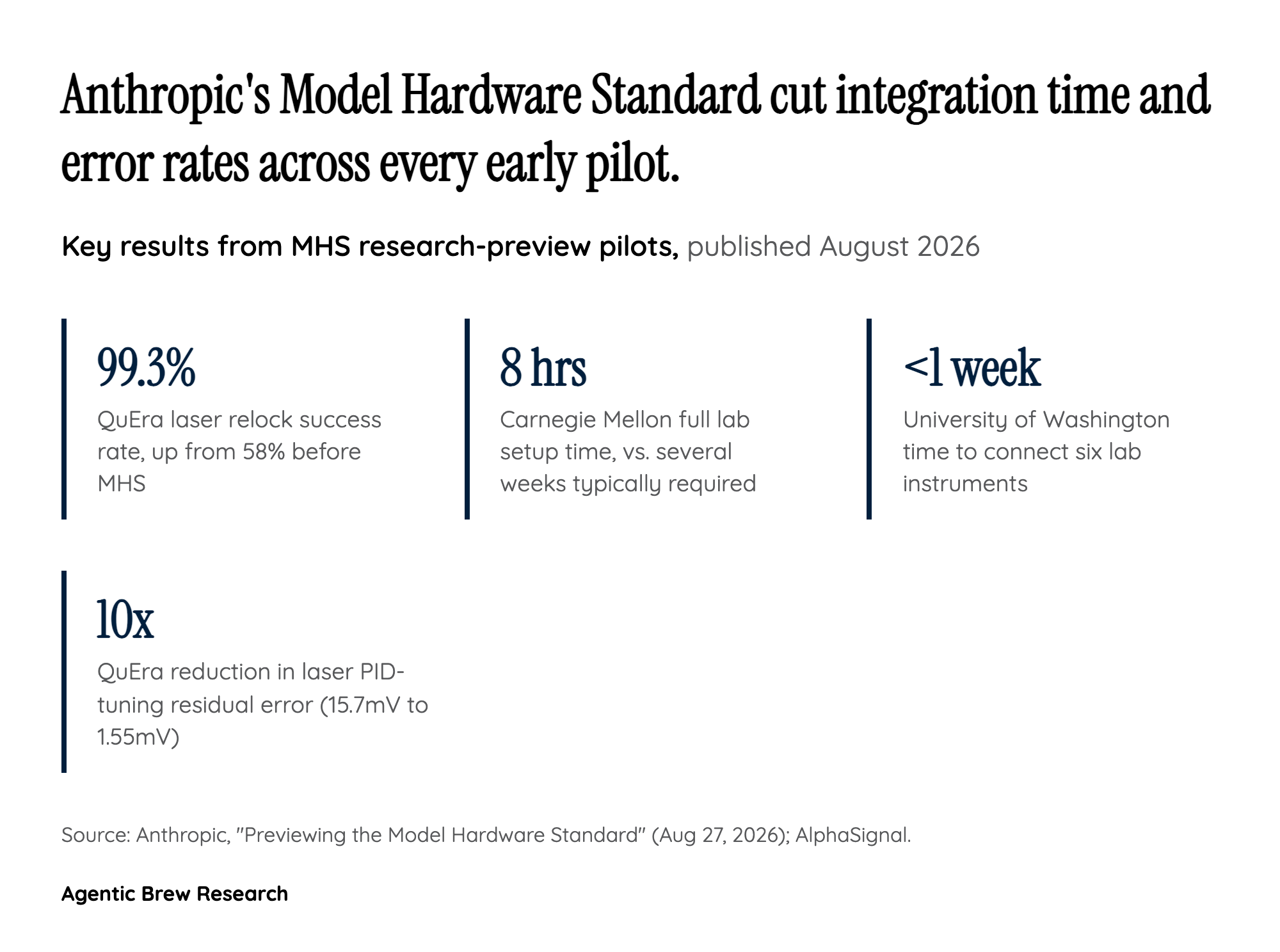
Model Hardware Standard introduces a standardized driver that translates between operating systems and physical devices using two primitives: 'read' (retrieve a value, like temperature) and 'write' (set a value, like target temperature) [1]. Every device that speaks MHS becomes discoverable and self-documenting, with its safety limits expressed in natural language rather than buried in a vendor's PDF manual [1]. Anthropic's Alek Kemeny, on the Beneficial Deployments team, frames it as a hardware analog to a familiar plug-and-play standard: MHS is 'kind of like the USB for AI to software connection,' extending the same read/write logic that made the Model Context Protocol (MCP) work for software into motors, sensors, lasers, and liquid handlers [2]. Because MHS is built on MCP, it inherits MCP's access patterns: agents can reach a device through the MCP interface, a command-line tool, or direct code and API calls, and none of it is Claude-exclusive - any LLM, including competitors' models, can drive an MHS-equipped instrument [3].