GPT-5.6 Sol launches under US government-gated access
TECH

GPT-5.6 Sol launches under US government-gated access

64+
Signals

Strategic Overview

  • 01.
    On June 26, 2026 OpenAI previewed the GPT-5.6 family - Sol (flagship), Terra (mid-tier), and Luna (fastest/cheapest) - where the number marks the generation and Sol/Terra/Luna are permanent performance tiers.
  • 02.
    Initial access is restricted to roughly 20 trusted, government-approved partners through the OpenAI API and Codex, at the explicit direction of the US government, with broader availability planned within weeks.
  • 03.
    Sol shipped with OpenAI's most robust safety stack to date and is flagged High-risk for cybersecurity and biology, while OpenAI publicly argued that government-managed access should not become the long-term default.

Deep Analysis

The first customer-by-customer gate on a frontier model

The story that outlasts the benchmarks is procedural. For the first documented time, the White House directly restricted a commercial frontier AI release, and it did so not with a blanket ban but with a government-managed, customer-by-customer access list [1]. Sam Altman reportedly told staff the government would approve commercial access one customer at a time during the preview, while Commerce Secretary Howard Lutnick wanted to confirm that the relevant government parts had tested and approved the model first [2]. There is no published approval criteria and no public waitlist - just roughly 20 organizations cleared to reach Sol, Terra, and Luna through the API and Codex [3].

That mechanism is what makes this more than a slow rollout. A waitlist rations capacity; an approval list rations permission. By inserting itself between OpenAI and each individual buyer, the administration converted a product launch into a licensing event, and it did so through consultation with the Office of Science and Technology Policy and the Office of the National Cyber Director rather than through any statute written for this purpose [1]. The precedent, not the partner count, is the headline.
The model the administration's own executive order was built to allow - and to forbid

The legal scaffolding here cuts both ways. The administration's June 2, 2026 executive order designated advanced systems as 'covered frontier models' and required federal agencies to benchmark them before public release, which is precisely the hook that let the government gate GPT-5.6 [4]. OpenAI agreed to the limited preview inside that framework, and the framework was described as a voluntary pre-release review rather than a mandate [5].

The tension is that the same policy environment that produced this review is also where critics see a contradiction. The executive order's framing leaned on voluntary benchmarking, yet a customer-by-customer approval list reads functionally like the preclearance regime that frontier-model policy language had explicitly tried to avoid. Community discussion of the launch fixated on exactly this gap between 'voluntary review' on paper and 'approve each buyer' in practice, treating the distinction as the whole ballgame for whether this becomes a durable precedent or a one-off security exception [1].

OpenAI's public dissent against a rule it chose to follow

OpenAI did something unusual for a company that just complied with a government request: it published its objection alongside its compliance. The company stated plainly that it does not believe this kind of government access process should become the long-term default, and warned that withholding the models keeps the best tools from users, developers, enterprises, cyber defenders, and global partners who need them [1]. The Decoder went further, characterizing the arrangement as something OpenAI itself calls unsustainable and as an escalating entanglement between frontier labs and national security protocols [6].

The competitive backdrop sharpens the stakes. Roughly two weeks earlier the administration reportedly took Anthropic's Claude Mythos 5 and Fable 5 offline for all users, which leaves OpenAI as effectively the only accessible frontier provider even as it argues against the very gate that produced that outcome [6]. TechTimes captured the bind by calling the launch simultaneously a safety case, a policy case, a government-relations case, and an access-control case - Sol crosses the frontier cybersecurity risk threshold at the same moment most users cannot touch it [7].

Why a security gate pushes the community toward open weights

The capability that triggered the restriction is the same capability the community most wants to use, and that mismatch reshaped the conversation around the launch. Sol is flagged High-risk for cyber and bio, shipping with OpenAI's most robust safety stack to date and guardrails that block offensive activity, while OpenAI notes its capabilities do not extend to autonomous end-to-end attacks against hardened targets [4]. Defenders and developers who would benefit from a stronger tool are precisely the population locked out by the approval list.

Sentiment in the developer community ran strongly against the gating, and the reaction was less protest than substitution. The dominant thread was a pivot toward open-weight preservation - mirroring and torrenting weights, and leaning on accessible alternatives - on the logic that a model you cannot be approved to use is, for practical purposes, a model that does not exist for you. The lesson the community drew was not about Sol specifically but about exposure: the more a frontier release can be gated by request, the more attractive weights you can simply download become.

By The Numbers

By The Numbers
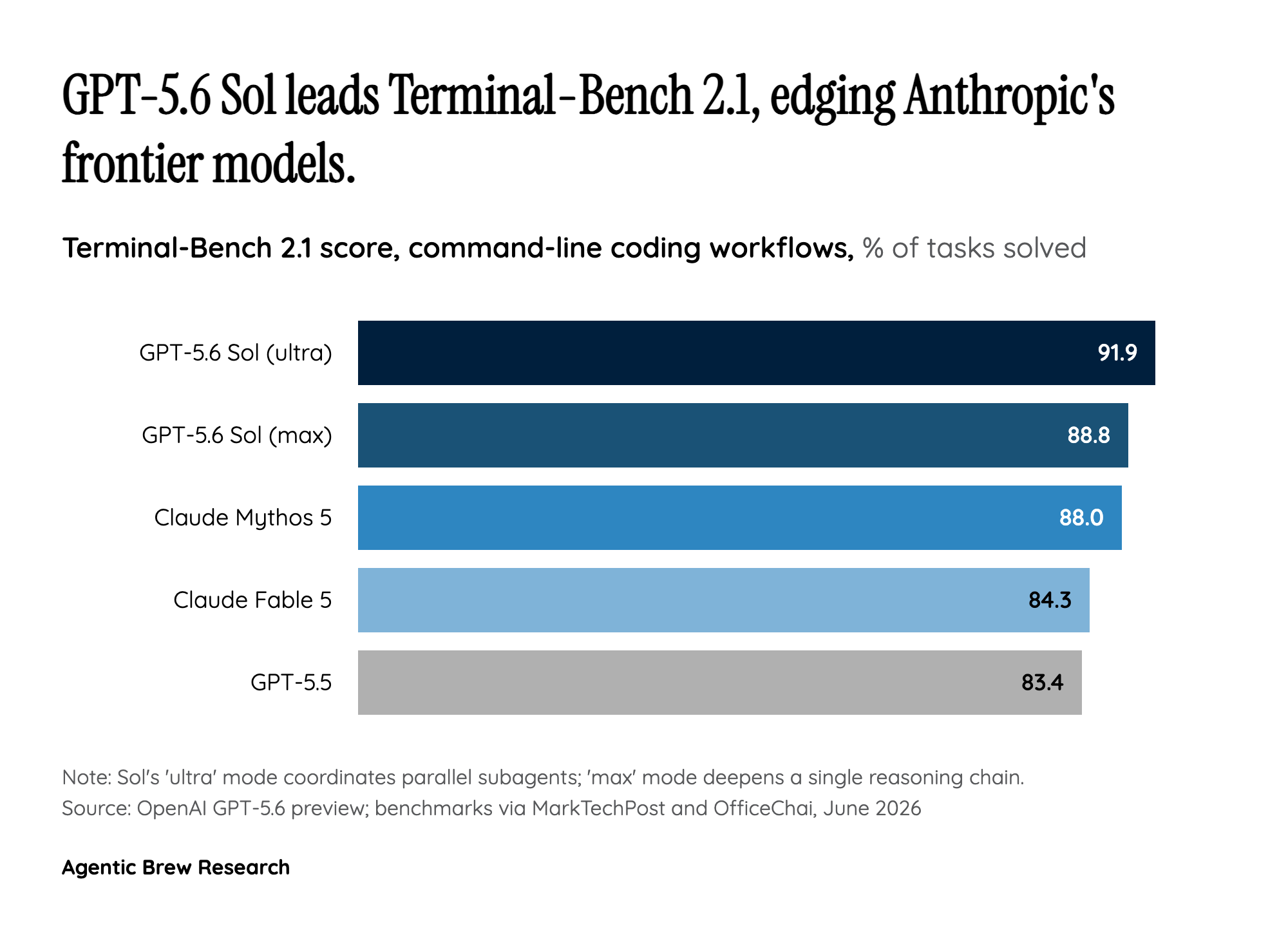
GPT-5.6 Sol tops Terminal-Bench 2.1, ahead of Claude Mythos 5, Fable 5, and GPT-5.5.

The benchmarks explain why the administration cared and why developers are frustrated to be locked out. On Terminal-Bench 2.1, Sol in 'ultra' mode hit 91.91% and 'max' mode 88.76%, edging Claude Mythos 5 at 88%, Claude Fable 5 at 84.3%, and GPT-5.5 at 83.4% [3]. On ExploitBench, Sol matched Anthropic's Mythos Preview while using only about one-third of the output tokens, roughly 150,000 [4]. On GeneBench v1 it scored 30% against GPT-5.5's 22% on long-horizon genomics, again with fewer tokens, and on Agent's Last Exam it reached 50.9% in 'code mode' [3][6].

The efficiency story extends to price. Per 1M tokens, Sol runs $5 in and $30 out, Terra $2.50 in and $15 out, and Luna $1 in and $6 out [3]. The safety case rests on the cyber numbers: Sol reportedly clears 96.7% of cyberattack benchmarks, crossing the frontier AI cybersecurity risk threshold that drove the restriction in the first place [7]. The new 'max' mode deepens a single chain of reasoning while 'ultra' coordinates parallel subagents to accelerate complex work [3].

Historical Context

2026-06-02
Trump's AI executive order established a voluntary pre-release review framework requiring federal agencies to benchmark new 'covered frontier' models before public release.
2026-06-12
Roughly two weeks before the GPT-5.6 preview, the administration reportedly took Anthropic's Claude Fable 5 and Mythos 5 offline for all users.
2026-06-25
The White House asked OpenAI to limit the release of GPT-5.6 to government-approved partners ahead of the public launch.
2026-06-26
OpenAI previewed GPT-5.6 Sol, Terra, and Luna under the government-managed access list.

Power Map

Key Players
Subject

GPT-5.6 Sol launches under US government-gated access

OP

OpenAI

Developer of GPT-5.6; agreed to the limited preview but publicly argued government-gated access should not be the norm.

TR

Trump administration / White House

Requested OpenAI limit initial access; request made in consultation with the Office of Science and Technology Policy and the Office of the National Cyber Director.

HO

Howard Lutnick (Commerce Secretary)

Discussed GPT-5.6 with Sam Altman; wanted to ensure relevant government parts had tested and approved the model.

SA

Sam Altman (OpenAI CEO)

Discussed the model with Lutnick; reportedly told staff the government will approve commercial access customer by customer during the preview.

AN

Anthropic

Competitor; its Claude Mythos 5 and Fable 5 frontier models were reportedly restricted/taken offline by the US government weeks earlier.

Fact Check

7 cited
  1. [1] OpenAI limits GPT-5.6 rollout after government request, says restrictions shouldn't be the norm
  2. [2] Trump administration asks OpenAI to limit new GPT model release
  3. [3] OpenAI Previews GPT-5.6 with Sol, Terra, and Luna Tiered Models, New Reasoning Modes, Limited Access
  4. [4] OpenAI Limits GPT-5.6 Rollout as Sol Crosses Cyber Risk Threshold
  5. [5] OpenAI's GPT-5.6 Sol launches in limited preview for government-approved partners
  6. [6] OpenAI's Claude Mythos competitor GPT-5.6 Sol launches under government-controlled access it calls unsustainable
  7. [7] GPT-5.6 Sol Launches Under Government Lock as Cyber Risk Sets New Access Precedent

Source Articles

Top 5

THE SIGNAL.

Analysts

"Complied with the limited preview but warned that withholding the models keeps the best tools from the legitimate users who need them, and that this access process should not become the long-term default."

OpenAI
Developer of GPT-5.6

"Discussed the model with Commerce Secretary Howard Lutnick and reportedly told staff the government would approve commercial access customer by customer during the preview window."

Sam Altman
OpenAI CEO

"Frames the government-controlled access as something OpenAI itself calls unsustainable, and as an escalating entanglement between frontier AI labs and national security protocols."

The Decoder
Tech analysis publication

"Calls the launch a watershed in AI policy that is simultaneously a safety, policy, government-relations, and access-control case, noting Sol crosses the frontier AI cybersecurity risk threshold while most users cannot reach it."

TechTimes
Tech news publication
The Crowd

"Introducing a limited preview of GPT-5.6 Sol, our next generation frontier model, as well as GPT-5.6 Terra, a balanced model for efficient, everyday work, and GPT-5.6 Luna, a fast and affordable model for high-volume work."

@@OpenAI36906

"OpenAI is reportedly releasing GPT-5.6 only as a limited preview to a small group of partners. Via The Information The reason, according to Sam Altman: the U.S. government asked it to. Altman reportedly told staff that the government will be "approving access customer by customer""

@@kimmonismus997

"OpenAI just dropped GPT 5.6 benchmarks. GPT 5.6 Sol Ultra hits 91.9% on TerminalBench 2.1. That mogs Mythos 5 at 88.0% and Fable 5 at 84.3%. Even base Sol (88.8%) beats both Anthropic frontier models. The unlock is a new ultra mode that uses subagents to accelerate complex work."

@@bridgemindai866

"US Govt to individually approve who gets GPT 5.6."

@u/AtlanticHM1100
Broadcast
GPT 5.6 is HERE! but you can't use it!

GPT 5.6 is HERE! but you can't use it!

GPT-5.6 Just Got Restricted (The US AI Crackdown)

GPT-5.6 Just Got Restricted (The US AI Crackdown)

NEW GPT 5.6 is INSANE!

NEW GPT 5.6 is INSANE!