Kimi K3 AI Audits Bitcoin Code for Vulnerabilities
TECH

Kimi K3 AI Audits Bitcoin Code for Vulnerabilities

30+
Signals

Strategic Overview

  • 01.
    By August 8, 2026, the volunteer Bitcoin Red Team's AI-assisted audit had scanned 501 open-source Bitcoin projects and logged 7,958 findings, of which 1,280 were rated high or critical severity, after more than 100 hours of work from roughly 16 contributors.
  • 02.
    The initiative was triggered by a catastrophic exploit of Coinkite's Coldcard hardware wallet: a five-year-old firmware flaw in random key generation let an attacker drain more than $116 million from over 5,200 addresses starting around July 30, 2026.
  • 03.
    The audit's primary tool was Kimi K3, an open-weight model from China's Moonshot AI, supported by OpenAI's GPT Sol, Anthropic's Claude Fable and Opus, and Zhipu/Z.ai's GLM 5.2, funded by more than $40,000 in AI compute paid for by the nonprofit OpenSats rather than any corporate sponsor.
  • 04.
    Lead researcher Rob Hamilton said OpenAI restricted his access to its 'trust cyber' program and Daybreak Blue cyber model mid-project, despite prior KYC and onboarding approval, pushing the Red Team back toward Chinese open-weight models for security-critical review.

Deep Analysis

Why an American Security Researcher Went Back to Chinese AI

Hamilton has said OpenAI restricted his access to its 'trust cyber' program and the Daybreak Blue cyber model mid-project, despite having already completed KYC and onboarding approval [2]. The block pushed the Bitcoin Red Team back toward Kimi K3, the open-weight model from China's Moonshot AI, as the audit's primary workhorse [1]. Hamilton did not hide his discomfort: "It absolutely guts me as a patriotic American to have to do this, but I will be going back to using Chinese open source models to conduct my research," he said [1]. Bull Bitcoin founder Francis Pouliot was blunter, saying "I have never seen OpenAI this cucked. It's cucked beyond belief now" after a Chinese model reviewed and helped patch an exploit that American models had refused to touch [1]. Galaxy's Alex Thorn framed the stakes in strategic terms: "Americans should not have to rely on Chinese AI to defend themselves, their projects, companies, or clients from cyber-attacks" [1]. One Bitcoin Core contributor summed up the contrast more bluntly, pairing a US model's hedging against a Chinese model that simply listed 78 critical vulnerabilities [1].
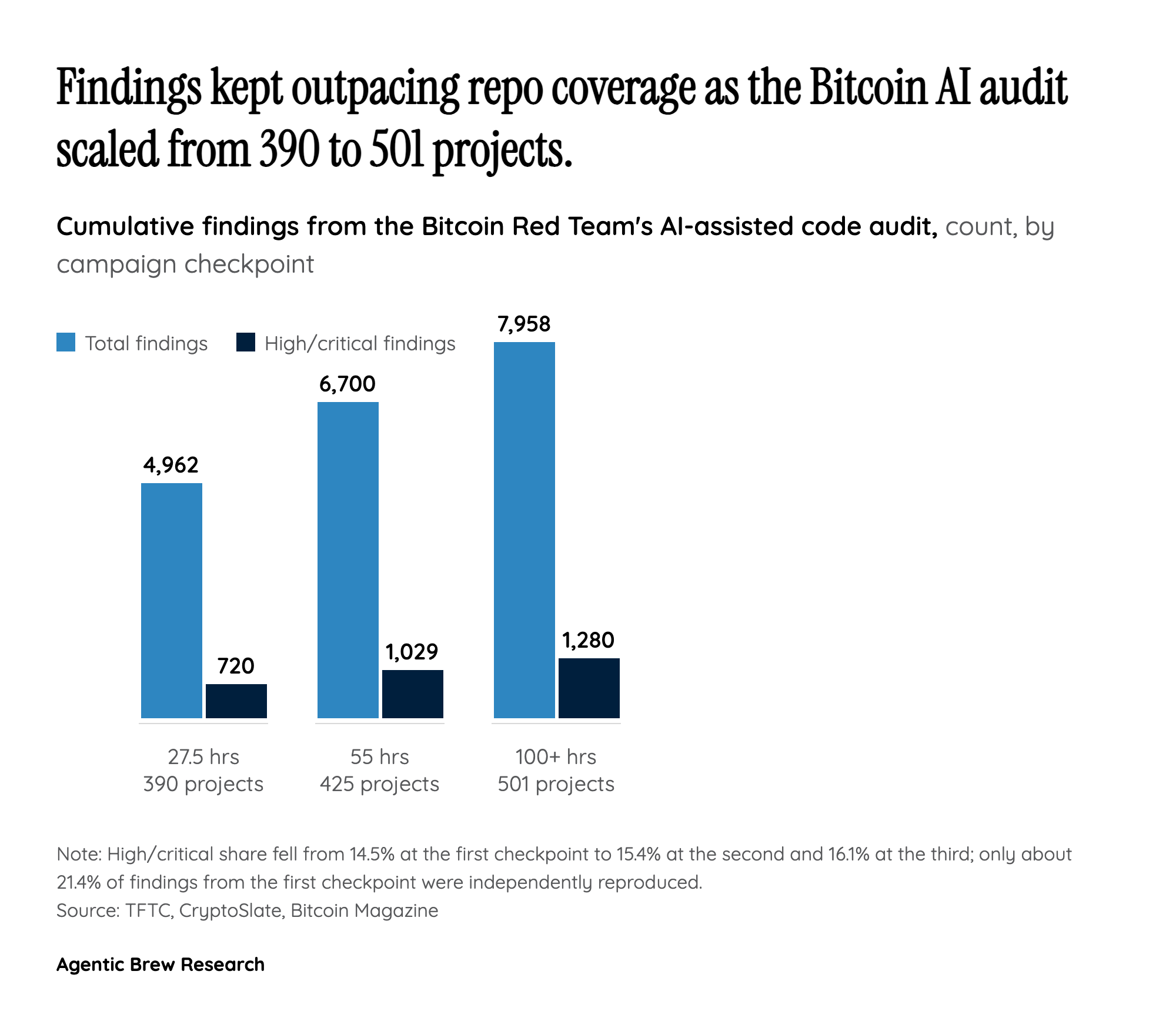

By the Numbers: A Volunteer Team Outpaced Professional Audits

By the Numbers: A Volunteer Team Outpaced Professional Audits
Total and high/critical findings climbed at every checkpoint of the Bitcoin Red Team's AI-assisted audit, from 390 projects scanned in the first 27.5 hours to 501 projects after more than 100 hours.

The scale of the effort becomes clear when its three public checkpoints are lined up. After the first 27.5-hour sprint, volunteers had scanned 390 open-source Bitcoin projects and logged 4,962 findings, including 85 rated critical and 635 rated high severity [3]. A 55-hour checkpoint pushed that to 425 projects and 6,700 total findings, with 1,029 (15.4%) rated high or critical [4]. By August 8, after more than 100 hours of work from roughly 16 globally distributed contributors [3], the count reached 501 projects and 7,958 findings, 1,280 of them high or critical [1]. The team spent more than $40,000 on AI compute to get there, burning roughly $10,000 a day at points [3]. Developer Calle, the team's co-lead, described the pace as roughly one critical exploit found per person per hour [3].

The Skeptics: How Many of Nearly 8,000 Findings Are Real?

Not everyone treats the raw finding counts as an unqualified security win. In the first sprint, only about 21.4% of flagged issues were independently reproduced or confirmed as real vulnerabilities [3], and neither of the later checkpoints published an updated reproduction rate. Critic JW Weatherman argued the campaign could not properly triage the sheer volume of AI-flagged output it was generating [4]. The numbers around basic security hygiene reinforce the concern: only 19.5% of the scanned projects had a SECURITY.md file and just 13.1% listed a disclosed security contact email [4], and by the time some of these reports were published, only 19 of the scanned projects had completed upstream disclosure [3]. Hamilton himself has pointed to operations, disclosure handoff, and triage - not the discovery step - as the real bottleneck going forward [3].

The Spark: A Five-Year-Old Bug and a $116 Million Loss

The audit did not start as an abstract academic exercise. Coinkite's Coldcard hardware wallet had shipped a firmware flaw since version 4.0.0 in March 2021 that made its random key generation predictable [5]. Beginning around July 30, 2026, an attacker exploited that flaw to drain funds, eventually stealing more than $116 million (about 1,816 BTC) from over 5,200 addresses, with the effective strength of some keys collapsing from 128 bits to as low as 40 bits [5]. Forbes covered the incident under the headline "I Did Everything Right" [6]. That catastrophe is what galvanized volunteer Bitcoin developers to launch a large-scale, AI-assisted audit of the wider open-source ecosystem [5].

What Comes Next: Rewriting Bitcoin's Security-Critical Code

Beyond the headline finding counts, the audit is reshaping how some Bitcoin developers think about the tools they build with. Calle has argued publicly that the scale of memory-safety and cryptographic-library flaws uncovered means Bitcoin projects should stop writing security-critical code in C [1]. Hamilton has tied the effort back to Bitcoin's founding premise, saying "there is no Bitcoin without self custody. This is non negotiable" [3]. With Bitcoin Core itself excluded from the current scope and the focus instead on wallets, cryptographic libraries, and surrounding infrastructure [3], the unresolved question is whether the ecosystem can build durable disclosure and remediation processes fast enough to keep pace with how quickly cheap AI review can now generate new findings.

Historical Context

2021-03
The underlying firmware flaw (introduced in version 4.0.0) that caused predictable key generation was introduced and remained undiscovered for roughly five years.
2026-07-30
An attacker began systematically draining bitcoin from Coldcard wallets by exploiting the RNG/key-generation flaw, eventually stealing over $116 million (about 1,816 BTC) from more than 5,200 addresses.
2026-08-04
Midpoint checkpoint update with approximately 150 repositories scanned early in the campaign.
2026-08-08
After 100+ hours, the team reported 501 projects scanned and 7,958 total findings, 1,280 of them high or critical severity.
2026-08-09
Hamilton publicly disclosed that OpenAI's trust cyber program blocked his access mid-project despite completed KYC/onboarding, prompting a pivot back to Chinese open-weight models.

Power Map

Key Players
Subject

Kimi K3 AI Audits Bitcoin Code for Vulnerabilities

RO

Rob Hamilton

AnchorWatch CEO/co-founder and leader of the Bitcoin Red Team; personally spent over $10,000 scanning 100+ Bitcoin ecosystem libraries with Kimi K3 before scaling into the wider volunteer effort.

CA

Calle

Pseudonymous Bitcoin developer and co-lead of the Red Team; wrote multiple audit harnesses and coordinated the review wave across core Bitcoin ecosystem projects.

MO

Moonshot AI

Chinese AI lab behind Kimi K3, the open-weight model that became the audit's primary workhorse after US frontier model access was restricted, receiving the majority of the compute spend.

OP

OpenSats

501(c)(3) nonprofit that funded the initiative's AI compute costs, with no corporate sponsor or venture capital involved.

OP

OpenAI

Restricted Rob Hamilton's access to its 'trust cyber' program and Daybreak Blue cyber model mid-project despite prior KYC/onboarding approval, pushing the team toward Chinese open-weight models.

CO

Coinkite (Coldcard)

Maker of the Coldcard hardware wallet whose five-year-old firmware key-generation flaw (since v4.0.0, March 2021) triggered the audit initiative after over $116 million in bitcoin was stolen from 5,200+ addresses.

Fact Check

6 cited
  1. [1] Chinese AI Beats Restricted OpenAI and Anthropic Cybersecurity Models, Bitcoin Industry Warns
  2. [2] OpenAI Blocks Bitcoin Security Researcher
  3. [3] Bitcoin Red Team AI Audit: 85 Critical Findings, 390 Repos
  4. [4] Bitcoin's AI Security Sprint Found 6,700 Issues in 55 Hours - But No One Knows How Many Are Real
  5. [5] The Largest Hardware Wallet Exploit of 2026: Inside the $116 Million Coldcard Hack
  6. [6] 'I Did Everything Right': AI Warning After $116 Million Bitcoin Hack

Source Articles

Top 1

THE SIGNAL.

Analysts

Expressed reluctance but necessity in switching to Chinese open-weight models after being blocked by OpenAI's cyber program.

Rob Hamilton
CEO/Co-founder, AnchorWatch; Bitcoin Red Team leader

Reported extremely high productivity from AI-assisted review and argued that AI-based verification is now cheap enough to reshape how security-critical code should be written.

Calle
Pseudonymous open-source Bitcoin developer, Red Team co-lead

Criticized OpenAI's restrictiveness compared to a Chinese model that both found and helped patch a money-stealing exploit that American models refused to review.

Francis Pouliot
Founder, Bull Bitcoin

Warned about the strategic risk of American security efforts depending on Chinese AI models for cyber defense.

Alex Thorn
Galaxy

Contrasted the caution and refusal behavior of US frontier models with the direct vulnerability output of Chinese open models.

PortlandHODL
Bitcoin Core contributor
The Crowd

HUGE: China's Kimi AI just scanned nearly ALL of Bitcoin's open-source code, flagging almost 8,000 flaws. The Bitcoin Red Team has now covered 501 projects, finding 1,280 critical or high-severity issues, with maintainers validating and patching flaws. The team leaned on Kimi [text truncated by X's "Show more"]

@@coinbureau904

JUST IN: Team formed after Coldcard's $130 MILLION exploit finds 4,962 flaws across 390 Bitcoin projects using AI. The Bitcoin Red Team used Kimi K3, GPT Sol, and Opus to scan wallets, libraries, and infrastructure in under 30 hours, averaging "1 critical exploit per hour."

@@coinbureau1657

JUST IN: Researchers uncovered numerous critical vulnerabilities across Bitcoin open-source projects with the help of Kimi K3 AI.

@@CryptooIndia16

Why were Coldcard hackers so stupid?

@u/ineedanamegenerator406
Broadcast
Meet the Red Team: How Open-Source AI Is Rewriting Security

Meet the Red Team: How Open-Source AI Is Rewriting Security

AI Has Changed Bitcoin Security Forever

AI Has Changed Bitcoin Security Forever

Kimi K3 ve Bitcoin Cüzdanlarına Yapılan AI Saldırısı

Kimi K3 ve Bitcoin Cüzdanlarına Yapılan AI Saldırısı

Kimi K3 AI Audits Bitcoin Code for Vulnerabilities — AI News | Agentic Brew