AI Impact on White-Collar Jobs and Knowledge Work
TECH

AI Impact on White-Collar Jobs and Knowledge Work

40+
Signals

Strategic Overview

  • 01.
    AI drove 26% of US layoffs in April 2026 (21,490 cuts), per the Challenger, Gray & Christmas monthly job-cuts report.
  • 02.
    BLS data shows unemployment for AI-exposed occupations is actually lower than for less-exposed ones, with only ~1 in 5 US companies formally adopting AI in any business function.
  • 03.
    Entry-level damage is the one place every camp agrees: recent-grad unemployment ~5.6% (highest since 2008), 22-25 year-old developer employment down ~20% from late-2022, software dev postings down 53%.
  • 04.
    A contrarian thesis from Every's Dan Shipper argues commoditized AI output raises the value of human taste — PMs, full-stack designers, and forward-deployed engineers gain leverage, not lose it.

Deep Analysis

The bloodbath is louder than the data

Dario Amodei's warning that AI could eliminate half of entry-level white-collar jobs within a few years has become the master narrative [1], amplified by Challenger's report that AI drove 26% of April 2026 US job cuts — 21,490 positions, a leading category in the monthly job-cuts scoreboard [2]. On YouTube, the 'bloodbath' and 'purge' framings dominate view counts; on retail-finance corners of X, the alarmist take that AI is destroying jobs by the tens of thousands every month travels faster than any nuanced economist read.

And yet the macro labor data refuses to cooperate. The BLS shows unemployment for the occupations most exposed to AI is actually lower than for less-exposed ones, and former BLS Commissioner Erika McEntarfer is blunt: 'It could be disruptive, but the data is telling us right now that disruption is not yet here, and we have time to plan' [3]. Only about 1 in 5 US companies have formally adopted AI in any business function, while roughly 40% of workers personally use generative AI — meaning capability and individual usage are running well ahead of org-level deployment [3]. The first thing this cluster wants you to internalize is the gap: the most cited number (Amodei's '50% in years') and the most measurable number (BLS occupation-level unemployment) are in different rooms.


Where the damage is real: the entry-rung cliff

There is one part of the labor data the bulls and the bears actually agree on, and it's brutal. Recent college graduate unemployment is roughly 5.6%, the highest since 2008, and entry-level postings in AI-exposed occupations fell 16% from 2024 to 2025 [3]. Software developer employment among 22-25 year-olds has fallen nearly 20% from its late-2022 peak, and software development job postings are down 53% over the same window [4]. Yale's Jeffrey Sonnenfeld frames the mechanism clearly: AI is helping mid-career engineers do more, but it's also doing exactly the bounded, well-specified work that used to train juniors [4].

The community signal mirrors this. On the senior-engineer side of Reddit, the dominant thread is a multi-year contiguous decline in US software developer employment — the longest on record in available time-series data — paired with an uncomfortable consensus that juniors can no longer climb the ladder they used to climb because the bottom rungs are gone. The implication is structural: even if total white-collar employment looks fine in aggregate, the pipeline that produces the next decade's senior practitioners is quietly being cut off. That is the AI jobs story that genuinely matches the data.

AI washing: when 'AI did it' is the cheapest excuse

A second reason the AI-jobs narrative diverges from the BLS data: a meaningful share of 'AI layoffs' aren't really AI layoffs. Babson's Peter Cohan calls AI 'the least bad' public justification a CEO can give for cuts, noting 'there's a huge gap between the ease of saying something and the difficulty of making it happen' [5]. A Resume.org survey cited in the same reporting found nearly 60% of hiring managers emphasize AI in layoffs because it tests more favorably than the honest answer (financial constraints), while only 9% say AI has actually fully replaced any role [5]. An HBR study referenced alongside it puts the gap in starker terms: about 60% of executives cut headcount in anticipation of AI gains, but only 2% based on actual implementation [5].

Andy Challenger's quote — 'Regardless of whether individual jobs are being replaced by AI, the money for those roles is' — is the cleanest way to read 2026's tech layoffs [2]. Meta's 8,000 cuts and 6,000 closed roles, Cisco's nearly 4,000 cuts, and Coinbase's 14% headcount reduction are first capital reallocation toward AI capex and chips, and only second a story about AI doing the work [6]. The pattern matters because it inflates the visible 'AI took my job' headline number while the underlying labor-saving technology has not yet landed.

The Shipper counter-thesis: automation is a lie

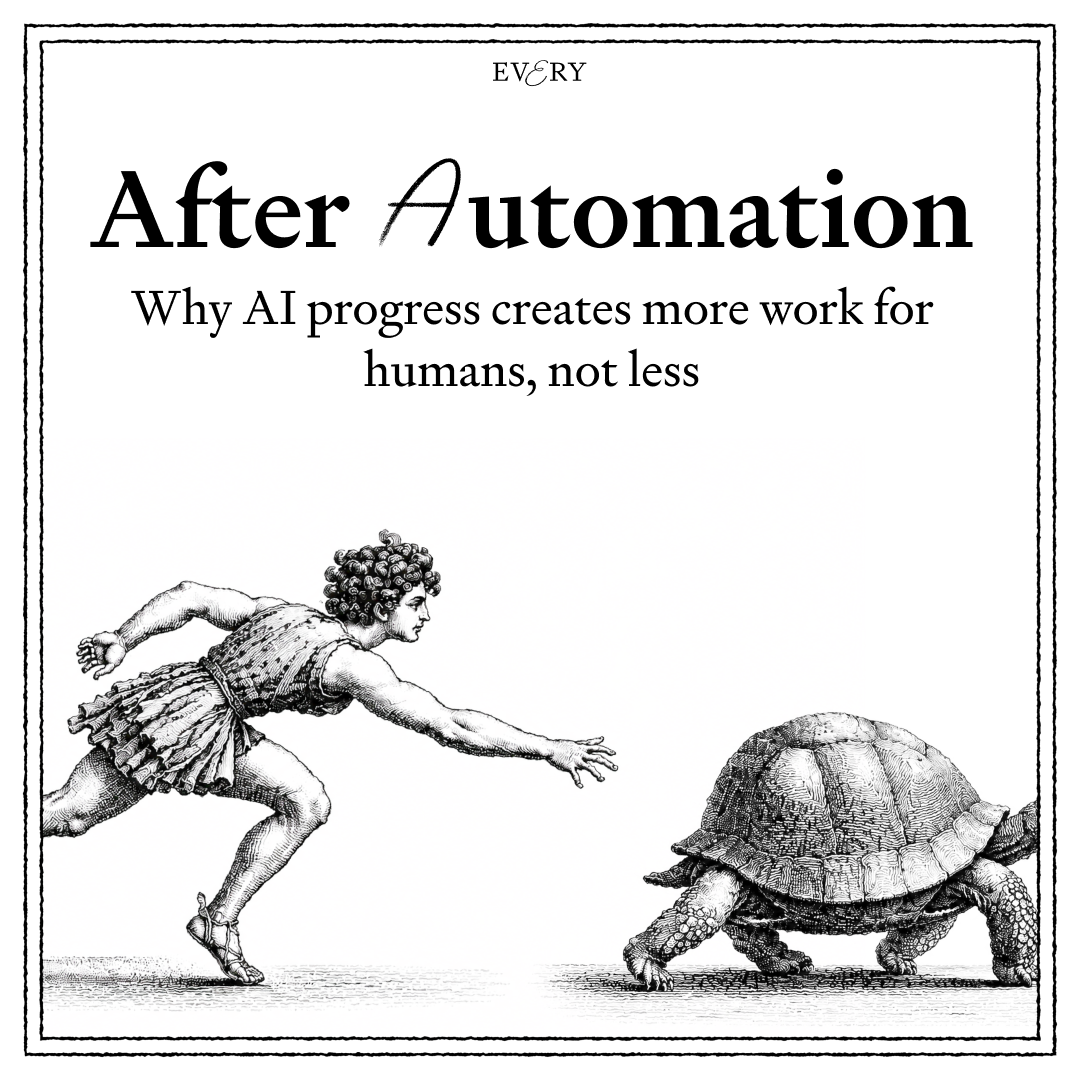
Against the bloodbath narrative, Dan Shipper's 'After Automation' and 'The AI Paradox' essays argue the opposite is happening inside teams that actually ship: AI commoditizes drafts, which raises the marginal value of humans with taste [7]. Product managers, Shipper claims, are about to thrive because the bottleneck shifts from 'who can write the PRD' to 'who can decide what's worth building'; full-stack designers become 'superheroes' because the cost of producing variants collapses to near zero, so the differentiator becomes the judgment to pick the right one; and 'forward-deployed engineers' — people who sit with a customer, watch them work, and wire AI into the gaps — become the highest-leverage hire in many orgs [8].

The same dynamic shows up in writing. Tom Johnson's 'cyborg' model casts the technical writer as someone in continuous back-and-forth with the model, owning verification and information architecture instead of first-draft prose [9]. Julie Hackett, more bluntly: 'Generating words and creating meaningful writing are not the same thing' — meaning, brand voice, and trust are the moat [10]. None of this contradicts the entry-level cliff; it suggests that within the surviving roles, the work is moving up the value chain toward judgment, taste, and verification — the things AI is still bad at.

We are flying blind, and that itself is the policy story

Across the credible voices in this cluster — McEntarfer, Deming, Gudell, Sonnenfeld — there is an unusually consistent meta-complaint: the instruments we have cannot see the thing we are trying to measure. Harvard's David Deming says it directly: 'We're sort of flying blind' [3]. Indeed's Svenja Gudell argues executives are 'overestimating the speed at which we're going to see this transformation' but probably underestimating the long-run effect [11]. Anthropic's own Economic Index — a scoreboard of theoretical AI capability versus observed Claude usage by occupation — exists precisely because no government dataset offers an occupation-by-occupation read on automation in flight [12].

Anthropic's scenario work warns unemployment in AI-exposed occupations could rise from roughly 3% to 6%, with the most exposed cohort being older, better-paid, more credentialed workers — 16 percentage points more likely to be female, earning 47% more on average, holding graduate degrees nearly 4x more often than the labor force overall [12]. Combined with the entry-level cliff, the picture is a barbell of risk that traditional BLS occupation codes don't resolve. The honest take for 2026: the alarmists are wrong about the timing, the skeptics are right about the macro, and both are arguing about a labor market that nobody is yet equipped to actually measure.

Historical Context

2022-11-30
ChatGPT launches; becomes the baseline economists now use to measure AI-attributable hiring slowdowns in coding and entry-level white-collar roles.
2025-05-28
Amodei first warns of an AI-driven 'white-collar bloodbath,' setting the displacement narrative that anchors the 2025-2026 debate.
2026-02
February 2026 jobs report shows 92,000 jobs shed and unemployment ticking up to 4.4%, fueling debate about AI's role.
2026-03-06
Anthropic publishes a mapping of theoretical AI capability versus observed Claude usage by occupation, warning a 'Great Recession for white-collar workers' is possible if usage catches up to capability.
2026-05-05
At an Anthropic financial-services briefing, Amodei pivots to citing Jevons Paradox while maintaining that AI is moving faster than prior technology waves.
2026-05-20
Chief economist Svenja Gudell publicly counters executive narratives that AI is rapidly transforming the labor market.
2026-05-26
'A reality check on the AI jobs hysteria' aggregates BLS, Stanford, and Harvard data to argue the large-scale AI disruption has not yet materialized.

Power Map

Key Players
Subject

AI Impact on White-Collar Jobs and Knowledge Work

AN

Anthropic / Dario Amodei

Lab CEO who anchored the 'white-collar bloodbath' warning; now hedges with Jevons Paradox but still flags deployment speed as the core risk and ships the Anthropic Economic Index to track Claude usage by occupation.

ME

Meta

Cut 8,000 jobs and closed 6,000 open roles in 2026, redirecting budget toward AI infrastructure spend.

CI

Cisco

Cutting nearly 4,000 jobs as part of the 2026 wave of big-tech reorganizations explicitly tied to AI-driven spend reallocation.

CO

Coinbase

Cut 700 jobs (14% of workforce), one of the most-cited 2026 layoff episodes invoked as evidence of AI-driven white-collar disruption.

DA

Dan Shipper / Every

Co-founder and CEO publishing the contrarian 'After Automation' / 'AI Paradox' thesis: PMs thrive, full-stack designers become superheroes, forward-deployed engineer becomes the essential new role.

CH

Challenger, Gray & Christmas

Outplacement firm whose monthly job-cuts report is the canonical scoreboard cited by media to track AI-attributed layoffs.

IN

Indeed

Labor-market platform whose chief economist publicly disputes executives' speed estimates for AI workforce transformation.

Fact Check

12 cited
  1. [1] Dario Amodei on Jevons Paradox and white-collar AI displacement
  2. [2] Challenger report on April 2026 AI-attributed layoffs
  3. [3] A reality check on the AI jobs hysteria
  4. [4] Yale SOM: The real job destruction from AI is hitting before careers can start
  5. [5] Built In: AI washing and the language of layoffs
  6. [6] 2026 tech layoffs and AI workforce reduction tracker
  7. [7] Every: After Automation
  8. [8] Lenny's Newsletter: The AI Paradox with Dan Shipper
  9. [9] I'd Rather Be Writing: The emerging cyborg model for technical writers
  10. [10] Writer's Ink: The real reason AI won't replace human writers
  11. [11] Fortune: Indeed chief economist on execs overestimating AI's labor transformation speed
  12. [12] Fortune: Anthropic research warns of a 'Great Recession for white-collar workers'

Source Articles

Top 5

THE SIGNAL.

Analysts

"AI could eliminate roughly half of entry-level white-collar knowledge work within years; the deployment pace exceeds prior tech waves."

Dario Amodei
CEO, Anthropic

"Available data does not yet support claims of large-scale AI-driven labor market disruption — 'It could be disruptive, but the data is telling us right now that disruption is not yet here, and we have time to plan.'"

Erika McEntarfer
Former BLS Commissioner; Fellow, Stanford Institute for Economic Policy Research

"Existing data infrastructure cannot adequately measure AI's labor market impact; policymakers are 'sort of flying blind.'"

David Deming
Professor of Economics, Harvard University

"Executives are overestimating the near-term speed of AI's labor market transformation but underestimating its long-term impact."

Svenja Gudell
Chief Economist, Indeed

"Even when AI doesn't directly replace a worker, the budget for those roles is being redirected into AI investment."

Andy Challenger
Chief Revenue Officer, Challenger, Gray & Christmas

"AI is the 'least bad' justification companies can give for layoffs; corporate AI claims often outrun real implementation — 'there's a huge gap between the ease of saying something and the difficulty of making it happen.'"

Peter Cohan
Associate Professor, Babson College

"The AI job apocalypse is not happening; 'automation is a lie' — paradoxically it generates more human work. PMs thrive, full-stack designers become superheroes, and forward-deployed engineer is the most essential new role."

Dan Shipper
Co-founder & CEO, Every

"Technical writers are evolving into 'cyborg' practitioners who steer AI through conversation; 'the writer and machine engage in a continuous back-and-forth—a partnership.'"

Tom Johnson
Author, 'I'd Rather Be Writing' blog

"AI generates words but cannot manufacture meaning, brand voice, or human trust — 'generating words and creating meaningful writing are not the same thing.'"

Julie Hackett
Founder, Writer's Ink

"AI's clearest near-term harm is blocking the entry rungs of the career ladder, not mass mid-career layoffs — 'AI helps engineers do their jobs more effectively rather than replacing them.'"

Jeffrey A. Sonnenfeld
Senior Associate Dean for Leadership Studies, Yale School of Management
The Crowd

"THE AI JOB BLOODBATH HAS STARTED 🚨 Goldman Sachs says AI is already destroying around 16,000 US jobs every single month. The biggest losers are Gen Z workers as companies rapidly automate entry level white collar jobs with AI."

@@cryptorover1052

"JASON CALACANIS WARNED AI COULD REPLACE MILLIONS OF JOBS BEFORE 2030. "AMAZON WILL BE 100% ROBOTIC." "EVERY AMAZON WORKER. UPS, GONE. FEDEX, GONE." THE AI DISRUPTION IS COMING FAST 👀"

@@Vivek4real_317

"OpenAI CEO Sam Altman said the rapid development and adoption of AI would not lead to a global 'jobs apocalypse' and the technology had not claimed as many white-collar jobs as he had feared"

@@Reuters57

"American Jobs with AI Exposure Really Are Starting to Disappear, Data Show"

@u/Gari_3052100
Broadcast
How AI is Causing a White Collar Bloodbath

How AI is Causing a White Collar Bloodbath

How AI is Causing a White Collar Purge

How AI is Causing a White Collar Purge

AI Disruption Kills a Million Jobs in the US | Vantage with Palki Sharma

AI Disruption Kills a Million Jobs in the US | Vantage with Palki Sharma