AMD Helios rack-scale AI system launch
TECH

AMD Helios rack-scale AI system launch

43+
Signals

Strategic Overview

  • 01.
    AMD launched Helios, its first complete rack-scale AI system, and named Microsoft as a new customer alongside Meta, OpenAI, and Oracle - a direct challenge to Nvidia's dominance of rack-scale AI infrastructure.
  • 02.
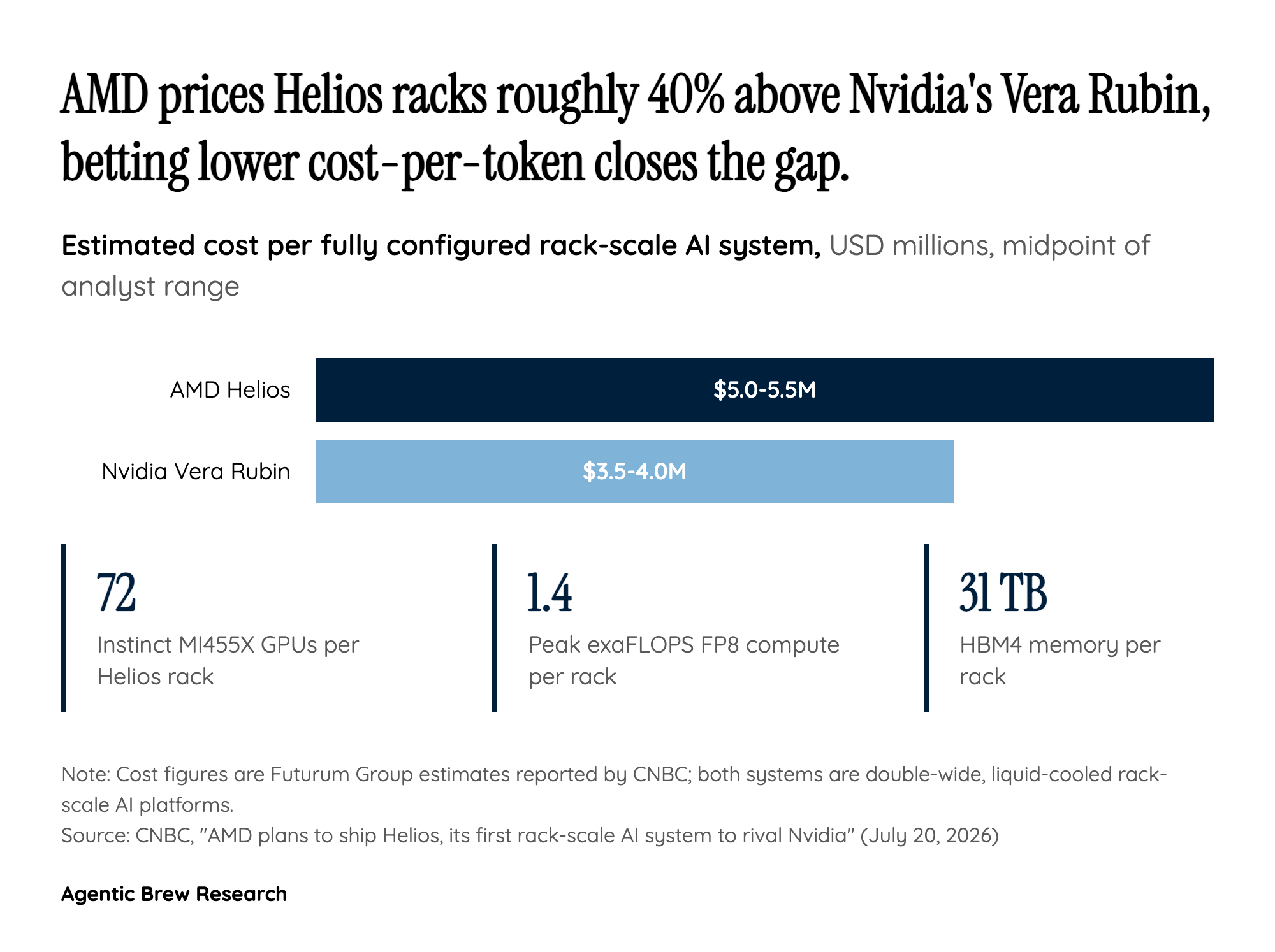
    A full Helios rack integrates 72 Instinct MI455X GPUs, EPYC 'Venice' CPUs, and Pensando 'Vulcano' networking over UALink, delivering up to 1.4 exaFLOPS of FP8 compute (2.9 exaFLOPS FP4) and 31 TB of HBM4 memory.
  • 03.
    The system is a double-wide rack built on Meta's Open Rack Wide (ORW) design, submitted to the Open Compute Project as an open reference standard rather than a closed proprietary chassis.
  • 04.
    Each of Helios' 18 compute trays pairs four Instinct GPUs with a single EPYC CPU; AMD is now sharing the reference design with partners, with volume deployments expected in the second half of 2026.
  • 05.
    Microsoft will deploy Helios through a new Azure VM series, ND MI455X v7, for production AI inference, alongside two EPYC 'Venice'-based families - HDv2 for data and agentic workloads, and HXv2 for chip-design and technical computing.
  • 06.
    Futurum Group estimates a full Helios rack will cost $5 million to $5.5 million, versus $3.5 million to $4 million for Nvidia's Vera Rubin rack-scale system - a premium AMD is betting customers will accept for lower total cost of ownership.
  • 07.
    Online reaction has been bullish: AMD used its own X account to spotlight its expanded Meta partnership (up to 6 gigawatts of Instinct GPUs, including a custom MI450-derived chip for Meta) and to tout Helios rack specs via an HPE-built system, while independent commentators framed the Supermicro-built Helios rack as a direct rival to Nvidia's Vera Rubin NVL72.

Microsoft's Yes Is the Headline - and the Numbers Behind It

The story here isn't just another AMD press release - it's Microsoft signing on as a Helios customer alongside Meta, OpenAI, and Oracle, which turns AMD from a spec-sheet challenger into a hyperscaler-validated alternative to Nvidia [1]. A full Helios rack packs 72 Instinct MI455X GPUs, EPYC 'Venice' CPUs, and Pensando networking into a chassis rated for up to 1.4 exaFLOPS of FP8 compute (2.9 exaFLOPS at FP4) and 31 TB of HBM4 memory [1]. Microsoft isn't just buying racks - it's building a new Azure VM series, ND MI455X v7, specifically to put Helios in front of production AI inference customers, alongside HDv2 and HXv2 VM families running on AMD's EPYC 'Venice' CPUs for agentic-AI data workloads and chip-design/EDA compute respectively [2]. That's a meaningfully deeper commitment than a single benchmark win - it's Azure building durable product lines around AMD silicon.
AMD Isn't Trying to Out-Spec Nvidia - It's Selling Cost Per Token

AMD Isn't Trying to Out-Spec Nvidia - It's Selling Cost Per Token
AMD Helios racks cost an estimated $5.0-5.5M versus $3.5-4.0M for Nvidia's Vera Rubin, per Futurum Group.

AMD's own data-center chief, Forrest Norrod, has been explicit that Helios's pitch is total cost of ownership and cost-per-token, not winning a raw FLOPS contest chip-for-chip against Nvidia's Vera Rubin [3]. That framing matters because Helios isn't actually cheaper on paper - Futurum Group pegs a full rack at $5 million to $5.5 million, versus $3.5 million to $4 million for Vera Rubin [1]. The bet is that better memory bandwidth and inference economics offset the higher sticker price over a system's operating life. Futurum's Daniel Newman goes further, arguing AMD has a credible path to 20-25% of the data-center GPU market - up from roughly 4.5% today - which would represent hundreds of billions of dollars in revenue if it plays out [3].

The Real Moat Play Is an Open Chassis, Not a Faster Chip

Helios is built on Meta's Open Rack Wide (ORW) design, submitted to the Open Compute Project as a shared industry standard rather than a closed AMD-only reference architecture [4]. That's a deliberate contrast with Nvidia's more proprietary rack integration, and it has already pulled in a wide bench of manufacturing partners - HPE, Supermicro, Celestica, and Cirrascale are all building and shipping Helios-based systems [5]. Opening the chassis design lets AMD scale supply through partners faster than it could alone, and gives customers like Meta co-ownership of the standard they are deploying on - a structural advantage that's easy to miss next to the exaFLOPS headline numbers.

The Market Has Already Priced In an AMD Win - That's the Risk

AMD stock is up roughly 141% year-to-date against Nvidia's 10% gain, and the Microsoft news alone pushed shares up several percent on the day, with AMD's market cap sitting within about 11% of $1 trillion [6]. Analysts frame AMD as the 'second turbine' every hyperscaler wants so it isn't fully dependent on a single GPU vendor controlling over 95% of the data-center market [6]. Oracle is reportedly building a 50,000-GPU Helios supercomputer, and OpenAI's Helios relationship could see further news at AMD's Advancing AI event this week [7]. But the counterweight is real: Counterpoint's Neil Shah argues AMD's chips are now competitive on hardware, but Nvidia's CUDA software ecosystem remains the bigger moat [1], and analysts separately note AMD still trails Nvidia and Broadcom on a fully optimized, scalable AI networking fabric [8]. With that much optimism already in the share price, a slower-than-expected Helios ramp - or customers simply staying inside CUDA - is the scenario that would hurt the most.

Historical Context

2025-06-12
AMD first previewed the Instinct MI400 GPU and the Helios rack-scale platform, detailing specs like 432GB HBM4 memory per GPU and 2.9 exaFLOPS FP4 rack compute.
2025-10-14
AMD showcased the Helios rack-scale platform built on the Open Compute Project's Open Rack Wide standard introduced by Meta.
2025-12
HPE announced it would accelerate AI deployments with the first AMD Helios AI rack-scale architecture, using open scale-up networking built with Broadcom.
2026-01-05
At CES 2026, Lisa Su detailed Helios as the blueprint for 'yotta-scale computing,' delivering up to 3 AI exaflops per rack, alongside the new Instinct MI440X and a preview of MI500 for 2027.
2026-02-15
AMD and Tata Consultancy Services announced a partnership to bring Helios rack-scale AI infrastructure to TCS's enterprise customers.
2026-03-16
AMD and Celestica announced a collaboration to advance Helios rack-scale AI platform manufacturing and deployment.
2026-06-03
Supermicro launched an AMD Helios rack platform at Computex 2026 to challenge Nvidia.
2026-07-20
AMD formally launched Helios with Microsoft as its newest disclosed customer, and Microsoft published details of the ND MI455X v7, HDv2, and HXv2 Azure VM families built on Helios and EPYC Venice.

Power Map

Key Players
Subject

AMD Helios rack-scale AI system launch

MI

Microsoft / Azure

Newest and highest-profile Helios customer, deploying it into Azure via the ND MI455X v7 VM series for frontier-model inference and Azure AI services, plus HDv2/HXv2 EPYC Venice VMs for agentic AI and chip-design workloads.

ME

Meta

Early Helios customer and co-designer of the underlying Open Rack Wide (ORW) standard the chassis is built on; committed to deploying up to six gigawatts of AMD GPUs across multiple generations, with Helios deployment in H2 2026.

OP

OpenAI

Early Helios customer described as a core AMD partnership; analysts flagged the possibility of further OpenAI/AMD news at AMD's Advancing AI event (July 22-23, 2026).

OR

Oracle

Early Helios customer building a 50,000-GPU Helios-based supercomputer.

TA

Tata Consultancy Services (TCS)

India's largest IT company; committed to deploying Helios rack-scale AI infrastructure for its enterprise customers, including a blueprint for a 200 MW AI-ready facility as AMD targets an India rollout in the second half of 2026.

NV

Nvidia

Incumbent competitor controlling over 95% of the data-center GPU market; Helios is positioned directly against Nvidia's Vera Rubin (and Grace Blackwell) rack-scale systems.

HP

HPE, Supermicro, Celestica, Cirrascale

Hardware and systems partners building and shipping Helios-based rack-scale infrastructure on AMD's open reference design.

Fact Check

8 cited
  1. [1] AMD plans to ship Helios, its first rack-scale AI system, with Microsoft as a customer, to rival Nvidia
  2. [2] Microsoft expands Azure AI and HPC infrastructure with AMD
  3. [3] AMD Helios rack AI system: a real Microsoft-backed Nvidia competitor?
  4. [4] AMD Showcases Helios Rack-Scale Platform Built on Open Compute Project Standard
  5. [5] HPE Accelerates AI Deployments With First AMD Helios AI Rack-Scale Architecture
  6. [6] AMD's Helios push could turn it into Nvidia's true 'second turbine'
  7. [7] AMD Stock Rises After Microsoft Helios Win: Is Nvidia Finally Facing Real Competition?
  8. [8] AMD Helios rack platform puts pressure on Nvidia's networking edge

Source Articles

Top 5

THE SIGNAL.

Analysts

"Says AMD's Helios chips are now competitively matched to Nvidia's hardware, but that AMD's real disadvantage remains software ecosystem maturity: "With CUDA, Nvidia has a bigger ecosystem.""

Neil Shah
Analyst, Counterpoint Research

"Believes AMD has a credible path to capturing 20-25% of the data-center GPU market on the strength of Helios, representing hundreds of billions of dollars in potential revenue: "I think it is entirely possible for AMD to do very well and capture a 20% to 25% share.""

Daniel Newman
Analyst and CEO, Futurum Group

"Frames Helios's competitive edge around total cost of ownership and cost-per-token rather than matching Nvidia chip-for-chip on raw specs: "We are very focused on delivering the best TCO and achieving the lowest cost per token. Customers are telling us that we have done it.""

Forrest Norrod
Head of AMD's data center business

"Calls the Microsoft deployment a major milestone in an expanding partnership, arguing Helios has "significant benefits" over Nvidia's rack-scale systems on inference and memory bandwidth/capabilities."

Lisa Su
AMD Chair and CEO

"Positions the AMD partnership as a response to AI infrastructure scaling faster than any single vendor can support, justifying a multi-vendor Azure strategy: "AI workloads are scaling faster than any single infrastructure approach can support.""

Scott Guthrie
EVP, Cloud + AI, Microsoft

"Highlights the HXv2 chip-design VM family as strategically important for scaling EDA workloads: "Azure HX is an important platform for scaling complex EDA workloads, and we're excited about Azure HXv2.""

Mark Papermaster
AMD EVP and CTO

"Frames Helios as the shift from customers 'deploying GPUs' to 'building AI factories,' positioning it for high-volume inference, frontier-model training, fine-tuning, sovereign AI, and agentic AI workloads."

Andrew Dieckmann
CVP and GM, Data Center Business Unit, AMD
The Crowd

"A definitive agreement: AMD and @Meta are expanding our existing partnership, aligning roadmaps across silicon, systems and software to deliver AI platforms purpose-built for Meta’s workloads. ✅ 6GW of AMD Instinct GPUs ✅ Custom AMD Instinct GPU derived from MI450 for Meta"

@@AMD1851

"$SMCI showcased $AMD Helios rack-scale AI platform at Computex built around 72 AMD Instinct MI455X GPUs in a double-width rack. This is AMD moving toward a full rack-level AI system to compete more directly with $NVDA Vera Rubin NVL72 architecture."

@@StockSavvyShay381

"72 GPUs per rack. 260 TB/s bandwidth. Up to 2.9 exaFLOPS FP4. Meet the new AMD Helios rack via @HPE Hewlett Packard Enterprise. Full Story from @TheRegister"

@@AMD366
Broadcast
FULL REMARKS: AMD CEO Lisa Su Unveils MI455X AI Chip and Helios Rack at CES 2026 | AI1B

FULL REMARKS: AMD CEO Lisa Su Unveils MI455X AI Chip and Helios Rack at CES 2026 | AI1B

AMD Helios Rackscale Solution: Open AI Infrastructure for the AI Factory Era

AMD Helios Rackscale Solution: Open AI Infrastructure for the AI Factory Era

AMD Helios vs Nvidia in India - 2.9 Exaflops Challenge 80% Market Share

AMD Helios vs Nvidia in India - 2.9 Exaflops Challenge 80% Market Share