SK Hynix's record $26.5B Nasdaq debut
TECH

SK Hynix's record $26.5B Nasdaq debut

34+
Signals

Strategic Overview

  • 01.
    SK Hynix raised $26.5 billion (KRW 40 trillion) in its US IPO, the largest-ever US debut by a non-American company, topping Alibaba's $25 billion 2014 listing.
  • 02.
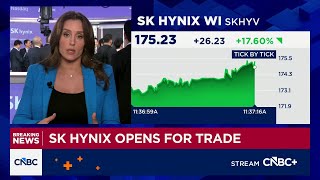
    The company sold 177.9 million American depositary shares at $149 each and began trading on the Nasdaq on July 10, 2026, opening about 14% above its IPO price and closing roughly 13% higher near $168.
  • 03.
    The offering was more than seven times oversubscribed, drawing roughly $171 billion in orders, and was priced at a 2.7% premium to the three-day average of SK Hynix's Seoul-listed shares.
  • 04.
    Proceeds are earmarked for capacity expansion, including a new fab in South Korea, a new packaging facility, and EUV scanners, while US Commerce Secretary Howard Lutnick is reportedly in talks with SK Hynix and Samsung about building new US factories.

Deep Analysis

The Trillion-Dollar Bet on Never-Ending Demand

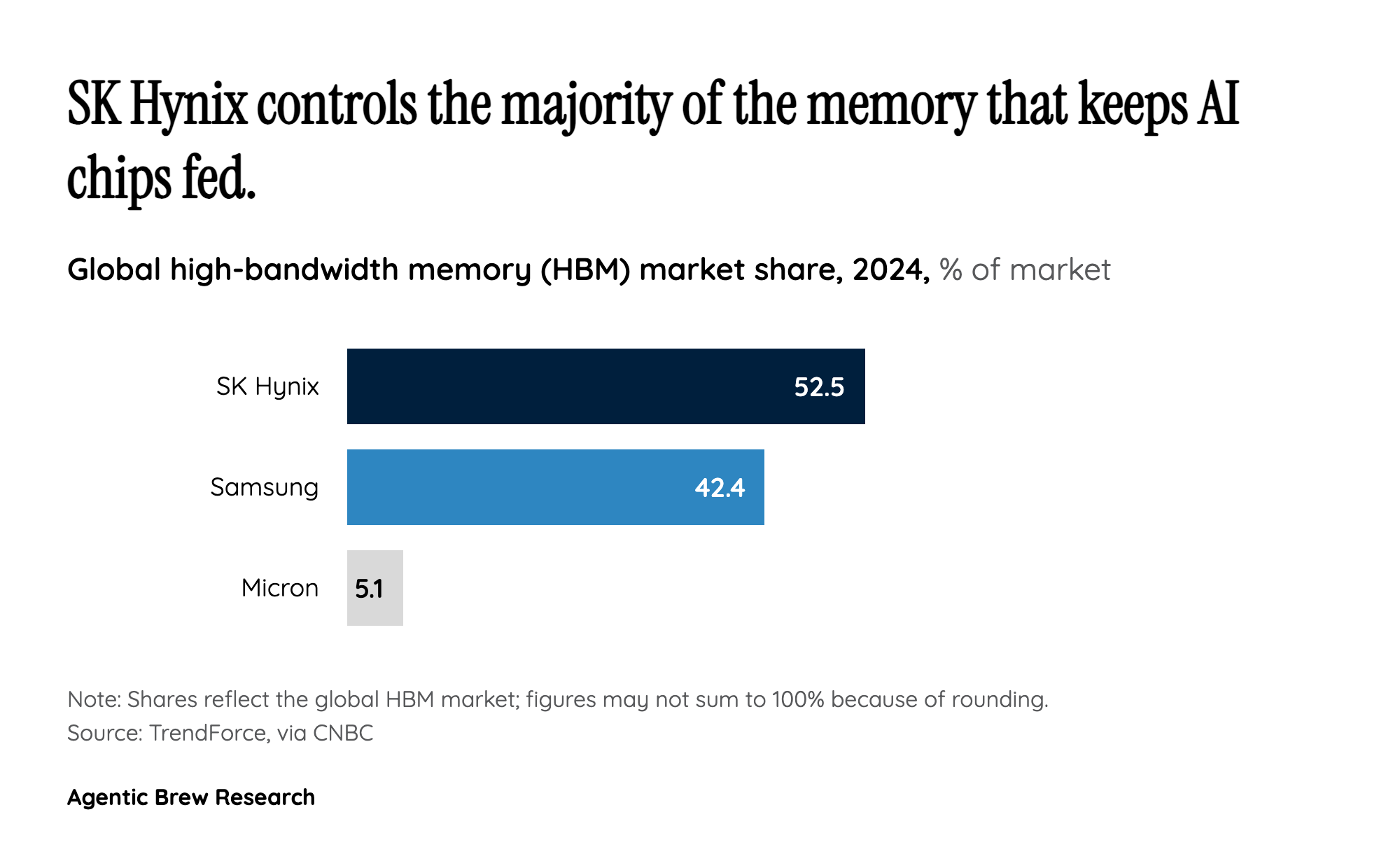
Strip away the record-book framing and SK Hynix's Nasdaq debut is really a single wager: that artificial intelligence has permanently rewired the memory business. For four decades, memory chips have run on a brutal cycle - demand spikes, everyone builds capacity, oversupply crashes prices, factories idle, repeat. The premise behind this listing, as Bloomberg framed it, is that AI has broken that cycle for good [1]. The evidence investors are leaning on is the product SK Hynix dominates: high-bandwidth memory, or HBM, the specialized stacked-DRAM that sits next to Nvidia's AI GPUs and feeds them data fast enough to keep the chips busy. Without enough HBM, an AI accelerator starves. SK Hynix supplied roughly 52.5% of that market in 2024 [2], which effectively makes it a chokepoint for the entire AI buildout.

The most striking part is that the company's own chief executive is not selling a soft landing - he is selling scarcity. Kwak Noh-jung said on debut week that 2027 will be 'the worst year in the industry's history from the supply perspective' and that demand will outrun capacity even beyond 2030 [3]. That is an unusual pitch: raise tens of billions to expand, then warn that even the expansion will not be enough. For bulls, the shortage forecast is the whole thesis - it implies pricing power and fat margins for years. The debut, in other words, is not priced as a chipmaker. It is priced as the toll road for AI compute.
By The Numbers: Anatomy of a Record

By The Numbers: Anatomy of a Record
SK Hynix led the global HBM market with 52.5% share in 2024, ahead of Samsung (42.4%) and Micron (5.1%).

The scale is what makes this debut historic rather than routine. SK Hynix raised $26.5 billion (KRW 40 trillion), the largest US IPO ever by a foreign company, edging past Alibaba's $25 billion mark from 2014 [4]. It did so by selling 177.9 million American depositary shares at $149 apiece [4], then watching the stock open about 14% higher and close near $168 on July 10 [5]. Demand dwarfed supply: the book was more than seven times oversubscribed, pulling in roughly $171 billion in orders [6], and the shares were priced at a 2.7% premium to the three-day average of SK Hynix's Seoul-listed stock rather than at the usual IPO discount [4].

The valuation context is just as stark. SK Hynix's market value had already crossed $1 trillion in May 2026, and its Seoul-listed shares were up roughly 229% since the start of the year [6]. Its lead in HBM - 52.5% versus Samsung's 42.4% and Micron's 5.1% in 2024 [2]- is what underwrites those numbers. Put together, this is not a company going public to find validation; it is a company monetizing a run that has already happened, at a premium, into the strongest demand book of any foreign US listing on record.

The Ghost of AT&T Wireless

Not everyone reading the order book sees vindication. The loudest contrarian voice came out of Wall Street's retail trenches, where the sharpest thread drew a pointed historical parallel: SK Hynix's debut, one widely-shared r/wallstreetbets post argued, looks like the April 2000 AT&T Wireless IPO - then the largest ever, which landed roughly six weeks after the Nasdaq peak and 'soaked up the last of the marginal liquidity' before the dot-com collapse. The underlying worry is elegant: memory always looks cheapest on peak earnings, because peak earnings arrive exactly when the cycle is about to turn. Selling shares at the top of a memory cycle to fund capex, the skeptics say, is the oldest trap in the industry. Commenters pushed back hard, noting that SK Hynix is a profit machine posting roughly $34 billion in quarterly revenue and 70%-plus margins, not a fading telecom - but the nervousness was real, and it clustered around the idea of buying at a cycle peak.

That retail anxiety has a credentialed echo. Morningstar's Jing Jie Yu warned that fresh capacity takes two to three years to come online and 'often leads to oversupply in tail years as peak capacity is brought up at the moment demand tapers off' [7]. The tension is the whole story: the CEO forecasts shortage past 2030 [3], the analysts forecast the classic glut, and the debut is a $26.5 billion vote on which side is right. On X the mood ran the other way - celebratory, fixated on the record scale and the sold-through-2028 HBM narrative - while on Reddit much of the energy went into a more technical debate about what investors were even buying, which is its own revealing signal.

Who Pays for the Shortage

A memory shortage is not an abstraction confined to data centers - it shows up in the price of things people buy. Rising memory prices driven by the AI boom have already been blamed for more expensive consumer electronics, including Apple Macs and iPads [2]. When hyperscalers bid up HBM and DRAM to feed AI clusters, the same components that go into laptops and phones get scarcer and dearer, and that cost eventually lands on ordinary buyers. The shortage the CEO is forecasting, in other words, is partly a transfer: capacity that might have cooled consumer prices is being routed to AI infrastructure instead.

The second bill is geopolitical. Even as SK Hynix earmarks its proceeds for a new South Korean fab, a packaging facility, and EUV scanners [4], Washington wants some of that capacity on American soil. US Commerce Secretary Howard Lutnick is reportedly already in talks with SK Hynix and Samsung about building domestic factories [4], and rival Micron has committed to $250 billion in new US manufacturing [4]. That sets up a genuine strategic squeeze for SK Hynix: it must expand fast enough to satisfy a shortage it says will worsen, defend its HBM lead against a Samsung spending aggressively to close the gap [4], and navigate US pressure to onshore - all while its newly public shareholders expect the AI-breaks-the-cycle thesis to hold. The record raise bought the capital. It did not settle the argument.

Historical Context

1983
SK Hynix was founded as Hyundai Electronics, a DRAM and SDRAM maker under the Hyundai conglomerate.
2012
SK Group acquired a 21.05% stake in Hynix, which separated from Hyundai and became SK Hynix.
2013
SK Hynix built the first HBM (high-bandwidth memory) chip.
2014-09
Alibaba's $25 billion New York IPO set the prior record for a foreign US listing, now surpassed by SK Hynix.
2022-06
SK Hynix began mass-producing HBM3, supplying Nvidia systems that shipped from the third quarter of 2022.
2024
SK Hynix commanded 52.5% of the global HBM market, ahead of Samsung at 42.4% and Micron at 5.1%, per TrendForce.

Power Map

Key Players
Subject

SK Hynix's record $26.5B Nasdaq debut

SK

SK Hynix

The issuer and world's leading high-bandwidth-memory supplier, holding about 52.5% of the HBM market in 2024; its Nasdaq listing raised $26.5 billion to fund a supply crunch it says will worsen.

NV

Nvidia

The primary customer whose AI GPUs rely on SK Hynix as a main HBM supplier, making Nvidia's chip demand the engine behind the listing's valuation.

AP

Apple

A downstream consumer-electronics maker; rising memory prices tied to the AI boom have been blamed for higher prices on products like Macs and iPads.

HO

Howard Lutnick

US Commerce Secretary pressuring SK Hynix and Samsung to build domestic US fabs, using trade and policy leverage to onshore memory production.

SA

Samsung

SK Hynix's chief HBM rival, spending aggressively to close the gap and, like SK Hynix, under US pressure to build American factories.

MI

Micron

A rival memory maker that has announced plans to invest $250 billion in new US manufacturing, intensifying the domestic capacity race.

Fact Check

7 cited
  1. [1] SK Hynix Debut Is a Bet That AI Breaks Boom-and-Bust Chip Cycle
  2. [2] Meet SK Hynix, the trillion-dollar chipmaker debuting on US markets
  3. [3] SK Hynix CEO sees worst-ever memory supply shortage in 2027, says demand to outstrip supply beyond 2030
  4. [4] SK Hynix raises $26.5B in the biggest foreign IPO in US history, is urged to build new US fabs
  5. [5] SK Hynix (SKHY) stock debuts on Nasdaq
  6. [6] South Korea's SK Hynix raises $26.5bn in record-breaking US IPO
  7. [7] SK Hynix Just Raised $26.5 Billion in the Biggest US IPO by a Foreign Company

Source Articles

Top 5

THE SIGNAL.

Analysts

"Forecasts the worst-ever memory supply shortage in 2027, with demand outstripping supply even beyond 2030 despite capacity expansion. In his words: 'We forecast that next year will be the worst year in the industry's history from the supply perspective.'"

Kwak Noh-jung
Chief Executive, SK Hynix

"Skeptical the shortage is permanent, warning of the classic boom-and-bust pattern: 'Demand outpaces supply initially as fresh capacity takes two to three years at the minimum to come online but often leads to oversupply in tail years as peak capacity is brought up at the moment demand tapers off.'"

Jing Jie Yu
Analyst, Morningstar

"Highlighted the exceptional appetite for the deal: 'Seven times oversubscribed, about $171bn in orders for a $24-28bn deal.'"

Dilin Wu
Research Strategist, Pepperstone

"Sees global investors racing for exposure to the AI memory boom: 'Investors around the world are scrambling to find ways to profit from it.'"

Cameron Robertson
Portfolio Manager, Platinum Asset Management
The Crowd

"BREAKING: SK Hynix stock, South Korea's second most valuable company, officially debuts on the Nasdaq and surges +14% at the open, now worth over $1 trillion. The company's ADRs were priced at $149/share, raising $26.5 billion."

@@KobeissiLetter2745

"Today marks a new milestone for @SKhynix. @SKhynix celebrated the listing of its ADRs on #NASDAQ with an Opening Bell ceremony. This milestone reinforces our commitment to driving the future of AI memory as a Core AI Partner. https://news.skhynix.com/skhynix-lists-adrs-on-nasdaq/ #SKhynix #OpeningBell"

@@SKhynix1109

"SK Hynix Launches Historic U.S. Listing SK Hynix sold 177.9 million ADRs at $149 each, raising $26.5 billion in one of the largest U.S. equity offerings ever. The deal is more than 7x oversubscribed, highlighting massive institutional demand for AI semiconductors."

@@BullTheoryio352

"SK Hynix US Offering Is More Than 7 Times Oversubscribed - Bloomberg"

@u/SnooHedgehogs5162789
Broadcast
Memory Chipmaker SK Hynix Kicks Off $28 Billion US Listing

Memory Chipmaker SK Hynix Kicks Off $28 Billion US Listing

SK Hynix U.S. IPO: Where it Fits in Greater AI Trade as Memory Demand Surges

SK Hynix U.S. IPO: Where it Fits in Greater AI Trade as Memory Demand Surges

SK Hynix ADR shares open for trade at $170

SK Hynix ADR shares open for trade at $170