Google's Gemini 3.8 Flash Launch
TECH

Google's Gemini 3.8 Flash Launch

39+
Signals

Strategic Overview

  • 01.
    Google rolled out Gemini 3.8 Flash on September 2, 2026, three weeks after Gemini 3.7 Flash - its third Flash release in about six weeks - describing it as its best reasoning and coding model yet at the same speed and price as 3.7.
  • 02.
    Alongside the general model, Google launched Gemini 3.8 Flash Cyber, a specialized variant for autonomous vulnerability discovery and patching, available only through the new Fairwind Program for vetted governments and infrastructure partners.
  • 03.
    Google also shipped agentic video understanding across the Flash line, cutting token usage on long-form video analysis by up to 88% while improving accuracy.
  • 04.
    Gemini 3.8 Flash is priced at $0.75 per million input tokens and $3.75 per million output tokens through the end of 2026 - roughly 5-7x cheaper than Claude Opus 5 and GPT-5.6 Sol - while matching or beating both on several agentic benchmarks.

The Six-Week Cadence: Why Google Keeps Shipping Flash

Gemini 3.8 Flash is Google's third Flash-family release in about six weeks, following 3.6 Flash on July 21 and 3.7 Flash on August 13 [8]. Rather than training an entirely new base model each time, Google has been iterating algorithmically - 3.7 Flash was explicitly described as a refinement rather than a new base model, and 3.8 Flash keeps the same price and speed as its predecessor while asking the model to "work harder": running additional internal reasoning steps and calling tools iteratively on complex requests [1][2]. Internally, engineers testing a pre-release version on Google's Jetski developer platform reportedly preferred it head-to-head over Anthropic's Claude Opus for coding tasks, though outside reporting cautioned that a single release is unlikely to return Google to the very top of the model race [5]. The cadence itself is arguably the real headline here: three ships in six weeks is a direct response to competitive pressure from Claude Opus 5 and GPT-5.6 Sol rather than a single scientific breakthrough [5].

Flash Cyber's Defensive-First Bet

The more unusual release is Gemini 3.8 Flash Cyber, a specialized model tuned for autonomous vulnerability discovery and patching that Google says it deliberately built with stronger patching capability than exploitation capability, so defenders gain an edge rather than equipping potential attackers [3]. The model posted a CWE-Bench pass@1 of 47.2%, nearly matching an unnamed leading frontier model's 47.8% [1], and Google's own Cloud Vulnerability Research team used it to uncover a critical foundational vulnerability in under two hours - a task that would normally take months [3]. Third-party validation came from Wiz, which independently benchmarked Flash Cyber against its internal penetration-testing suite and found meaningfully higher recall at a fraction of the cost of leading frontier models [1]. Because a model this capable at finding vulnerabilities could just as easily be weaponized, Google isn't putting it in the general API - it's gated behind the new Fairwind Program, which pairs Flash Cyber with Google's CodeMender patch-generation harness for vetted governments, critical-infrastructure operators (healthcare, telecom, energy, finance), and maintainers of widely used software platforms [4][9]. Patches are generated inside an organization's own secure cloud environment rather than by exposing code externally [4].

Benchmarks vs Skepticism: Reading the Numbers Critically

Benchmarks vs Skepticism: Reading the Numbers Critically
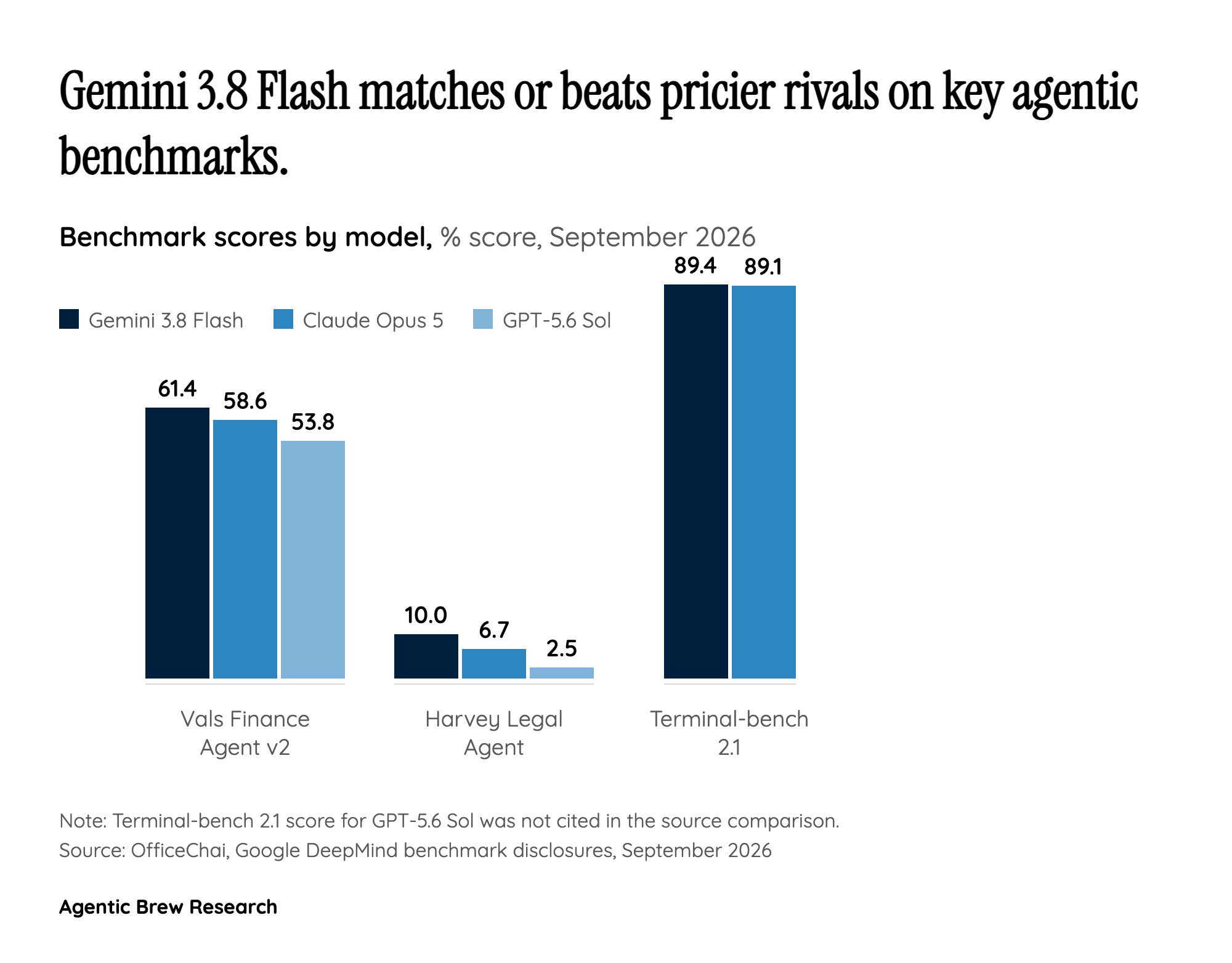
Gemini 3.8 Flash benchmark scores vs Claude Opus 5 and GPT-5.6 Sol across Vals Finance Agent v2, Harvey Legal Agent, and Terminal-bench 2.1.

On paper, Gemini 3.8 Flash looks like a genuine leap: it edges out Claude Opus 5 on Terminal-bench 2.1 (89.4% vs 89.1%) and CharXiv Reasoning (86.2% vs 83.7%), beats both Opus 5 and GPT-5.6 Sol on the Vals Finance Agent v2 and Harvey Legal Agent benchmarks, and does it all at roughly a fifth to a seventh of Opus 5's and Sol's per-token price [6]. But reception beyond Google's own materials was more skeptical than the scorecard suggests. A recurring complaint was that a key agentic-coding benchmark chart was published only shortly before the comparisons went out, prompting accusations that the model had been tuned specifically to that test - so-called "benchmaxxing" - rather than demonstrating broad capability gains, alongside concern that 3.8 Flash may simply be spending more tokens per task than 3.7 to inflate its apparent scores. A second, quieter tension concerns where the model actually feels good in practice: several users reported that the consumer-facing Gemini app and Flash-Lite surface remain unreliable and prone to hallucination unless an "Extended" thinking mode is explicitly turned on, while the same underlying model performs noticeably better inside Google's Antigravity IDE - suggesting the identical weights can feel like two different products depending on where you access them.

Cheap Models, Not Chart-Topping Ones: Google's Real Strategy

The more interesting story than any single benchmark may be Google's broader bet: it doesn't need to win every frontier-model headline if cheap models, massive distribution, and its existing ad business give it better unit economics than standalone labs chasing pure capability. Token prices across the industry have fallen sharply from their summer peak, and Gemini 3.8 Flash's $0.75/$3.75 per-million-token pricing - held through the end of 2026 [1]- pushes that price war further, undercutting Claude Opus 5's $5/$25 rate by roughly 6.7x and GPT-5.6 Sol's $4/$20 rate by roughly 5.3x [6]. Markets read the move as competitively meaningful rather than transformative: Alphabet shares rose a modest 0.6-0.7% in after-hours trading on pre-launch reporting, with Wall Street holding a consensus Strong Buy rating and further upside still priced into the stock [5]. Notably, this pricing-and-cadence strategy is unfolding while Google's more ambitious roadmap items lag: Gemini 3.5 Pro still had not shipped as of this release despite an earlier promise from Google leadership, even as the company maintains that pretraining for Gemini 4 remains on track for the calendar year - a reminder that the Flash line's rapid iteration is partly compensating for slower progress at the true frontier end of Google's lineup.

Historical Context

2025-12
Gemini 3 Flash was originally introduced, the base of the current Flash lineage.
2026-07-21
Gemini 3.6 Flash launched as part of a July 2026 release wave that also included Gemini 3.5 Flash-Lite and Gemini 3.5 Flash Cyber.
2026-08-13
Gemini 3.7 Flash launched three weeks after 3.6 Flash as an algorithmic refinement (not a new base model), improving coding, agent workflows, and document comprehension at half the cost of 3.6 Flash.
2026-09-01
Google introduced agentic video understanding for Gemini 3.7 Flash, 3.6 Flash, and 3.5 Flash-Lite, cutting long-video token usage by up to 88% and cost by up to 66%.
2026-09-02
Gemini 3.8 Flash and Gemini 3.8 Flash Cyber launched, three weeks after 3.7 Flash, alongside the new Fairwind Program for government and infrastructure cyber-defense access.

Power Map

Key Players
Subject

Google's Gemini 3.8 Flash Launch

GO

Google DeepMind

Developer of Gemini 3.8 Flash and 3.8 Flash Cyber; the launch announcement was co-authored by Tulsee Doshi (Senior Director, Product Management) and Raluca Ada Popa (Gemini Security Lead).

GO

Google Chrome Security team

Early internal adopter of Flash Cyber, reporting 2.6x more correct vulnerability patches than larger commercial models - used as the model's headline real-world validation.

GO

Google Cloud Vulnerability Research team

Used Flash Cyber to discover a critical foundational vulnerability in under two hours, a task normally taking months.

WI

Wiz

Independent security firm that benchmarked Flash Cyber against its internal penetration-testing suite, finding higher recall at a fraction of the cost of leading frontier models - third-party validation of Google's efficiency claims.

AN

Anthropic (Claude Opus 5)

Primary benchmark rival; Gemini 3.8 Flash is priced roughly 6-7x cheaper than Opus 5 while beating or nearly matching it on several agentic benchmarks.

OP

OpenAI (GPT-5.6 Sol)

Competing frontier lab whose model trails Gemini 3.8 Flash on several cited benchmarks while being priced higher.

Fact Check

9 cited
  1. [1] Gemini 3.8 Flash and Gemini 3.8 Flash Cyber: Google's latest Flash model launch
  2. [2] Google rolls out Gemini 3.8 Flash, its third Flash update in three months
  3. [3] Gemini 3.8 Flash Cyber: Google's new model for finding and fixing vulnerabilities
  4. [4] Introducing the Fairwind Program for cyber defense
  5. [5] GOOGL stock gains as Google readies 3.8 Flash model to compete in AI coding race
  6. [6] Google releases Gemini 3.8 Flash, beats Opus 5, GPT 5.6 Sol on some benchmarks at a fraction of the price
  7. [7] Google's agentic video understanding cuts token usage by up to 88% in AI Studio
  8. [8] Google launches Gemini 3.7 Flash three weeks after 3.6 Flash
  9. [9] Google unveils its most intelligent Gemini 3.8 Flash model, announces Fairwind Program

Source Articles

Top 5

THE SIGNAL.

Analysts

Co-authored the official launch announcement, framing 3.8 Flash as Google's most intelligent workhorse model with gains in software engineering, agentic tasks, and multi-step reasoning.

Tulsee Doshi
Senior Director, Product Management, Google DeepMind

Reported that engineers internally preferred the pre-release 3.8 Flash model over Anthropic's Claude Opus in head-to-head coding tests on Google's Jetski platform, but cautioned the launch alone would not immediately return Google to the top of the AI model race.

Wall Street Journal (via secondary reporting)
Financial press, citing unnamed Google employees
The Crowd

Introducing Gemini 3.8, our best reasoning & coding model yet. By leveraging long-running agentic loops, we're building on the momentum of 3.7 Flash from just three weeks ago to release two new 3.8 variants: Meet Gemini 3.8 Flash and Gemini 3.8 Flash Cyber 🧵

@@Google7073

Today we're launching Gemini 3.8 Flash Cyber and Gemini 3.8 Flash. ⚡️🛡️ 3.8 Flash Cyber is our most capable cybersecurity model for finding and fixing vulnerabilities. It sits on the Pareto Frontier on CWE-Bench for patching. Available to trusted defenders through our new [program]

@@koraykv573

3.8 Flash is the same price as 3.7, is ~the same speed, and is available via the Gemini API, in AI Studio, Antigravity, Gemini App, and more! Read more: [blog link] So incredible to see the progress and hard work from the team. Pushing hard to be at the frontier.

@@OfficialLoganK420

3.8 Flash coming out today

@u/DigSignificant1419722
Broadcast
Google's new coding model

Google's new coding model

Gemini 3.8 Flash - Benchmark and Pricing | Beats Claude Opus 5?

Gemini 3.8 Flash - Benchmark and Pricing | Beats Claude Opus 5?

Gemini 3.8 Flash Releases Today & Claude Fable 5.1 + Mythos 5.1 Just Dropped

Gemini 3.8 Flash Releases Today & Claude Fable 5.1 + Mythos 5.1 Just Dropped