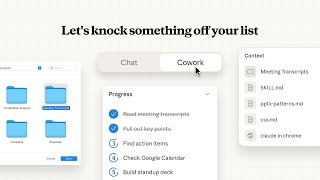
Claude Cowork expands to web and mobile with cloud-backed background execution
TECH

Claude Cowork expands to web and mobile with cloud-backed background execution

29+
Signals

Strategic Overview

  • 01.
    On July 7, 2026, Anthropic expanded Claude Cowork, its Claude Code-style agent for general knowledge work, beyond the desktop app to web and mobile on iOS and Android.
  • 02.
    Cowork can now keep running scheduled tasks in the cloud even after the user closes their laptop, removing the previous requirement for a live, connected device.
  • 03.
    Sessions sync across devices so a user can start a task at their desk, get status updates and approve next steps from a phone, and pick up the finished output later - and nothing is finalized until the user reviews and approves it.
  • 04.
    The beta is rolling out to Claude Max subscribers first starting July 7, 2026, with other plans to follow over the coming weeks, and Cowork usage limits were doubled through August 5, 2026.

Cutting the Cord: How Cowork Left the Live Device Behind

The headline feature is deceptively mundane and technically significant: you can close your laptop and Claude keeps going. Until this update, Cowork ran on your machine, which meant a task that needed twenty minutes of uninterrupted execution also needed twenty minutes of an awake, connected device [1]. The July 7 change moves scheduled tasks into the cloud, so execution is no longer hostage to your Wi-Fi, your battery, or whether you shut the lid to catch a train [2].

The more interesting design choice is how the human stays in the loop without staying at the desk. When Claude reaches a point where only a person can make the call - a permission, a judgment, an ambiguous fork - it surfaces that question to the user's phone and waits [3]. Everything else runs unattended, but nothing ships until the user reviews and approves it [4]. That turns the phone from a second screen into a control surface: you start a job at your desk, glance at progress from a browser, tap approve on a decision from your pocket, and collect the finished output later [1]. The agent became ambient; the oversight stayed synchronous.

Why Now: 1.2 Million Sessions Say Cowork Was Never Really About Code

The timing is not accidental. Anthropic analyzed 1.2 million anonymized Cowork sessions drawn from more than 600,000 organizations, sampled between May 11 and 31, 2026 [5]. The finding that reframes the whole product: more than 90% of Cowork usage is everyday knowledge work rather than software development [2].

That data explains the strategic pivot. A macOS-only agent aimed at power users made sense when you thought Cowork was Claude Code for developers. But if nine in ten sessions are business operators drafting reports and running repeatable processes, then a desktop-tethered, engineer-shaped tool is leaving its actual audience stranded. Moving to phones and browsers with cloud execution meets those users where they are. As one publication put it, the coding agent wars are spilling into the rest of the office [1], and Anthropic is repositioning Cowork from a coder's utility into a general-worker platform. The parallel to OpenAI is explicit: Codex also started as a coding tool and is increasingly used by non-developers, and for both companies the wager is that winning depends less on the best chatbot and more on owning the space where work actually gets done [1].

By The Numbers: What People Actually Do With Cowork

By The Numbers: What People Actually Do With Cowork
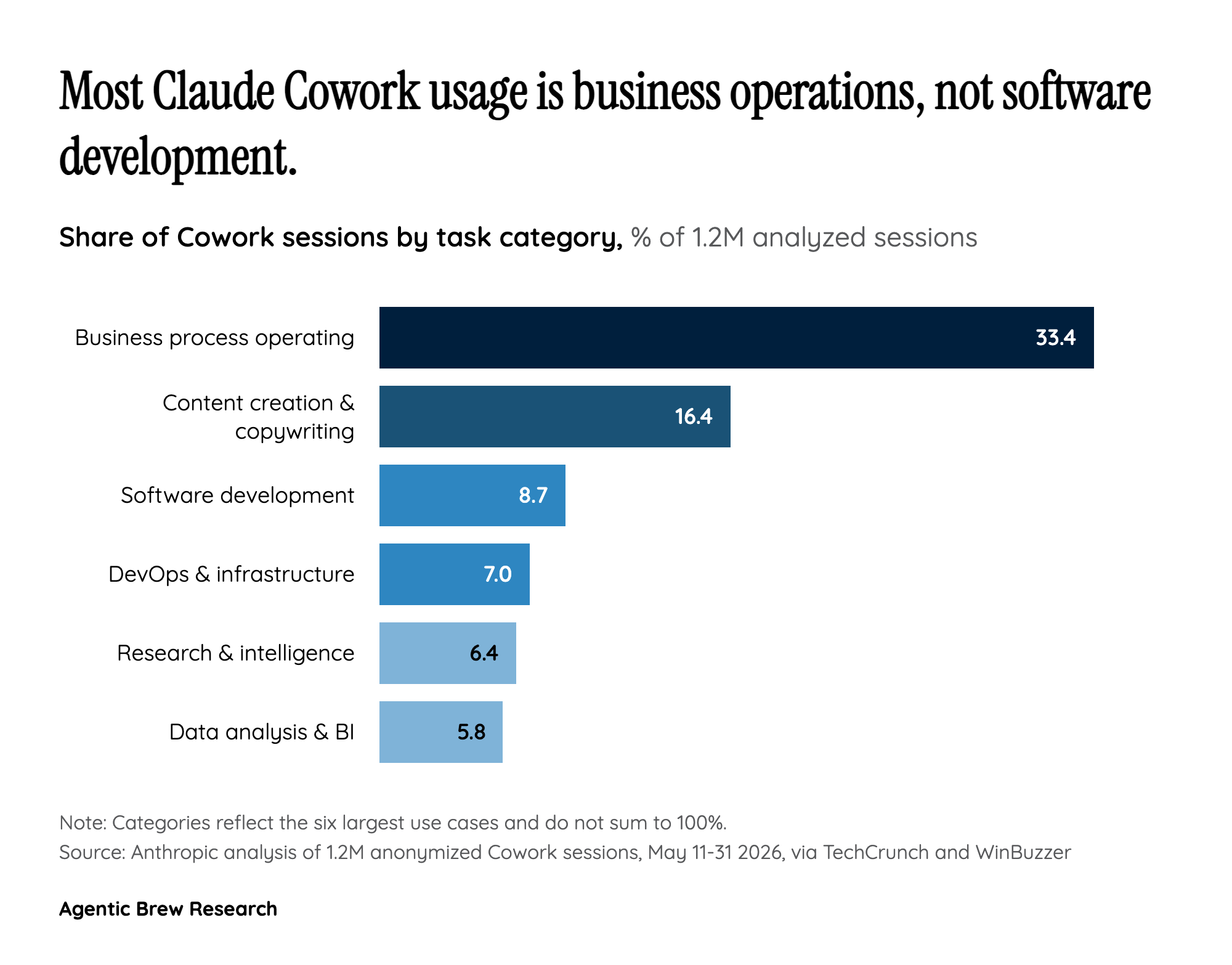
Business process work dominates Cowork usage at 33.4%, while software development is just 8.7% - the empirical basis for repositioning Cowork as a general-worker platform.

The session study makes the non-coding reality concrete. Business process operating was the single largest category at 33.4% of usage, followed by content creation and copywriting at 16.4% [1]. Software development - the thing Cowork's lineage would suggest it is for - came in at just 8.7%, behind or near DevOps and infrastructure at 7%, research and intelligence at 6.4%, and data analysis and business intelligence at 5.8% [6].

Read as a whole, the breakdown shows an agent whose center of gravity sits in administrative and knowledge work, not engineering. That is the empirical basis for every product decision in this release: the cloud-backed scheduling, the phone approval loop, and the beta's framing around documents, presentations, and repeatable business tasks all follow from a usage curve where the developer use case is a minority slice, not the main event.

The Governance Bill Comes Due: Always-On Agents, Wider Attack Surface

An agent you can no longer see - running in the cloud while your laptop sleeps - is a productivity win and a security liability in the same motion. Bhupendra Chopra of Kanerika frames the upside as a role change: employees will increasingly shift from executing tasks to supervising AI-generated outputs, reviewing exceptions, and applying business judgment. But he pairs it with a warning that persistent agents expand the attack surface because they continuously access enterprise systems and data [7].

The context makes that concern hard to wave away. Chopra cited Gravitee research surveying 445 IT and security leaders in which 88% reported confirmed or suspected AI-agent security incidents over the past year, while only about 14% said their agents were deployed with full security and IT approval [8]. That gap - near-universal incidents against a sliver of governed deployments - is the quiet counterweight to the demo-friendly nap metaphor. Pareekh Jain of Pareekh Consulting sees genuine operational value in letting teams keep business processes moving while away from their desks and reducing delays [7], but the same always-on posture that delivers that value is exactly what widens the exposure. Cowork's human approval gate is a real mitigation; whether it scales to background agents running across hundreds of thousands of organizations is the open question.

The Contrarian Read: Why Bother, When Claude Code Already Exists?

Not everyone is convinced. Among developers, the sharpest pushback is a blunt one - why use Cowork at all when Claude Code exists and, in their view, strictly dominates for engineering work? The complaints are specific: no mid-session model switching, no rewind, no slash commands, weaker document output. From an engineer's chair, Cowork can look like a downgrade wearing a friendlier interface.

That critique is real but it targets the wrong yardstick. The session data already showed developers are a minority of Cowork's users, so a feature set that underwhelms Claude Code power users is not the failure it looks like - it is the product finding its actual audience. The community's own enthusiasm points the same direction: the use cases people keep singling out as the killer application are scheduled personal-assistant tasks - daily briefings, email triage, recurring job scans - which is precisely what cloud-backed background execution unlocks and what Claude Code, a terminal-bound coding tool, was never meant to do. Meanwhile users have started noticing Cowork being folded into the main chat interface, matching Anthropic's apparent direction toward a single agentic surface where you can converse and delegate computer tasks in one place [3]. The developer skeptics are measuring a delegation tool against a coding tool - and the roadmap is quietly resolving the confusion by merging the two.

Historical Context

2026-01-13
Claude Cowork launched as a macOS desktop research preview for Claude Max subscribers, positioned internally as Claude Code for the rest of your work.
2026-06
Microsoft made Copilot Cowork generally available, positioned around long-running, multi-tool tasks inside Microsoft 365.
2026-07-07
Anthropic announced Cowork's expansion to web and mobile with cloud-backed background execution, beginning the beta rollout to Max subscribers.

Power Map

Key Players
Subject

Claude Cowork expands to web and mobile with cloud-backed background execution

AN

Anthropic

Maker of Claude Cowork; the July 7, 2026 expansion turns a desktop-only agent into a cross-device, cloud-backed platform, deepening its push into general enterprise knowledge work rather than coding alone.

CL

Claude Max subscribers

First cohort to receive the web and mobile beta; their usage shapes how Anthropic tunes the always-on model before opening it to other plans in the coming weeks.

OP

OpenAI (Codex)

Chief rival; Codex began as a coding tool but is increasingly used by non-developers, mirroring Cowork's trajectory - both firms are betting on owning where work gets done rather than shipping the best chatbot.

MI

Microsoft (Copilot Cowork)

Competitor that made Copilot Cowork generally available in June 2026, positioned around long-running, multi-tool tasks bound inside Microsoft 365 - a narrower footprint than Anthropic's cross-device play.

Fact Check

8 cited
  1. [1] The coding agent wars are spilling into the rest of the office: Claude Cowork
  2. [2] Claude Cowork can now keep working after you close your laptop
  3. [3] Anthropic's Claude Cowork AI agent is now available on mobile and web
  4. [4] Now you can direct Anthropic Claude Cowork AI from your phone
  5. [5] Anthropic brings Claude Cowork to mobile and web as usage data shows most users aren't coding
  6. [6] Anthropic Opens Claude Cowork Beta to Mobile and Web
  7. [7] Anthropic expands Claude Code beyond developer tasks with Cowork
  8. [8] 88% of companies have already seen AI agent security failures

Source Articles

Top 5

THE SIGNAL.

Analysts

"Argues the untethered model lets teams monitor long-running tasks, respond to exceptions, and keep business processes moving even when away from their desks, reducing operational delays while improving AI adoption."

Pareekh Jain
Principal, Pareekh Consulting

"Predicts employees will shift from executing tasks to supervising AI-generated outputs, reviewing exceptions, and applying business judgment - but warns that always-on agents expand the attack surface because they continuously access enterprise systems and data."

Bhupendra Chopra
Chief Revenue Officer, Kanerika

"Frames the release as the coding agent wars spilling into the rest of the office, arguing the real bet is on owning the workspace rather than winning on the best chatbot."

TechCrunch
Technology publication

"Notes Cowork is not being used only as a coding assistant - much of the sampled activity involves administrative processes, documents, presentations, reports, and repeatable knowledge-work tasks - and that keeping the desktop app as the bridge to local files differentiates it from Microsoft's Microsoft 365-bound Copilot Cowork."

WinBuzzer
Technology publication
The Crowd

"Claude Cowork is coming to mobile and web. Hand Claude a task at your desk and pick up the finished work from your phone. Close the laptop and Claude keeps going. Beta is rolling out over the next several weeks starting with the Max plan, with more plans to follow."

@@claudeai18833

"ANTHROPIC: Claude Cowork for mobile and web is now rolling out to Claude Max subscribers! Other plans will get it within the coming weeks. Cowork on mobile and web will let users trigger and follow up on Cowork tasks. Scheduled Cowork tasks will also be supported."

@@testingcatalog321

"Claude Cowork keeps your work moving even after you close your laptop. Everything stays in sync across devices, and 2x Cowork usage has been extended until Aug. 5. A great time to explore bigger AI workflows. #ClaudeAI #AI #AgenticAI #Automation #EnterpriseAI #Productivity"

@@askraaai0

"What's the point of Cowork when you have Claude Code?"

@u/pespito10278
Broadcast
Learn 80% of Claude Cowork in Under 20 Minutes

Learn 80% of Claude Cowork in Under 20 Minutes

Introducing Cowork: Claude Code for the rest of your work

Introducing Cowork: Claude Code for the rest of your work

Claude Cowork: coming to mobile and web

Claude Cowork: coming to mobile and web