OpenAI ChatGPT voice upgrade with GPT-Bidi-1
TECH

OpenAI ChatGPT voice upgrade with GPT-Bidi-1

23+
Signals

Strategic Overview

  • 01.
    OpenAI is preparing a major ChatGPT voice-mode upgrade powered by a next-generation bidirectional audio model tentatively named GPT-Bidi-1.
  • 02.
    The bidirectional architecture lets the assistant listen and speak at the same time, absorb interruptions, and adjust mid-sentence rather than freezing during turn-taking.
  • 03.
    The new voice model exposes three intelligence tiers — High, Medium, and Instant — mirroring the text side so users can trade reasoning depth for lower latency, and would sit alongside the current Advanced Voice Mode via a toggle.
  • 04.
    The technology is not yet production-ready: the prototype tends to start glitching or speaking in abnormal-sounding voices after a few minutes of conversation, and the name may change before launch.

Deep Analysis

The Architecture That Lets a Machine Be Interrupted

The headline isn't that ChatGPT will sound nicer — it's that the model will work in a fundamentally different way. Today's Advanced Voice Mode is, underneath, a turn-taking system: you speak, it listens, then it speaks, and trying to cut in tends to make the assistant freeze or talk over you. GPT-Bidi-1's 'Bidi' stands for bidirectional, an architecture that lets the assistant listen and speak at the same time, absorb a user's interruption, and adjust mid-sentence instead of stalling [1]. Reporting describes a model designed to continuously process the speaker's voice so it can immediately change course the instant it is interrupted — the difference between a walkie-talkie and a real phone call [2].

The second piece is a control surface borrowed from the text side. The new voice stack reportedly exposes three intelligence tiers — High, Medium, and Instant — letting users explicitly trade reasoning depth for lower latency, the same dial that already governs how hard the text models think before answering [1]. Rather than force a migration, ChatGPT would let people toggle between a new 'Bidi (Latest)' mode and the existing Advanced Voice Mode, with signs of the feature now appearing across both web and mobile clients. That combination — full-duplex turn-taking plus an explicit speed-versus-smarts knob — is what would let voice finally behave like a conversation rather than a series of dictated exchanges.

A Defensive Move Dressed as an Upgrade

A Defensive Move Dressed as an Upgrade
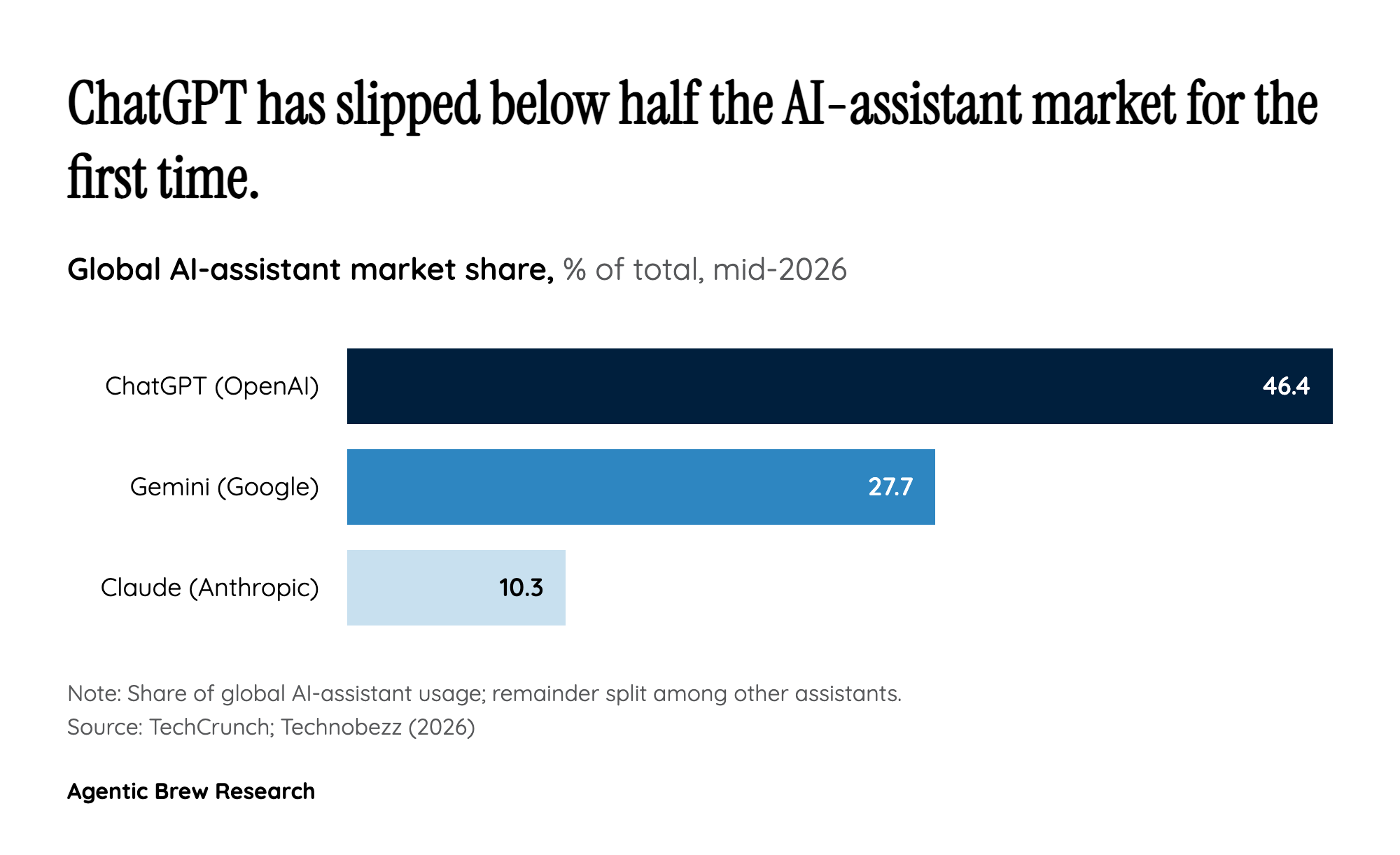
ChatGPT's AI-assistant market share has dropped below 50% for the first time, with Gemini and Claude trailing.

It is tempting to read GPT-Bidi-1 as a confident victory lap. The numbers suggest something closer to a defensive crouch. ChatGPT's share of the global AI-assistant market recently slipped to 46.4% — below 50% for the first time, down from above half at the start of the year — while Google's Gemini sat at 27.7% and Anthropic's Claude at 10.3% over the same period [3]. Crucially, Gemini already ships a Live API for real-time bidirectional audio streaming, meaning OpenAI is racing to match a capability a key rival has been shipping rather than inventing a category [4].

That context reframes the whole effort. The voice push aligns with OpenAI's larger wager that speech, not text, becomes the main way people reach AI — the same thesis behind its planned audio-first hardware and voice-based support tooling [5]. Voice has also simply lagged: the text models marched to a newer generation while the audio stack stayed a step behind, leaving spoken conversation noticeably less capable than the assistant's writing. GPT-Bidi-1 is the move to close both gaps at once — the internal quality gap against its own text models, and the external feature gap against a competitor that is, for now, taking share.

Why a Working Demo Still Isn't Shipping

The gap between 'spotted in the code' and 'in your app' is where this story gets honest. The prototype, by the accounts that surfaced it, is not production-ready: after a few minutes of conversation it tends to start glitching or speaking in abnormal-sounding voices, the kind of failure that is fine in a demo and disqualifying in a consumer product [2]. The codename itself is flagged as tentative and likely to change before any launch [1]. Even an original target window, per the reporting, may slip from its first projection to later in the year.

The more interesting question the community keeps raising is whether the holdup is capability at all. A recurring, skeptical read among practitioners is that a model good enough to sound this human is expensive to serve at scale, and that adoption will be gated less by naturalness than by cost and rate limits — the worry being a feature so good it 'blows through' a subscription's usage in minutes. Others flag a subtler tension: that voice may still trail the flagship text models in raw reasoning, leaving users talking to what one framed as 'the dumber cousin' of the smartest model. Whether GPT-Bidi-1 ships on time will say as much about OpenAI's serving economics as about its research.

What the Crowd Actually Wants from 'Her'

The reaction across developer and enthusiast communities has been strongly anticipatory, and it clarifies what people are actually waiting for. The complaint is not that the current voice sounds robotic — it is that the clunky turn-taking breaks the illusion of conversation. The freezing on interruptions and the inability to handle natural backchannels like an 'mm-hm' are repeatedly named as the real obstacle to a 'Her'-like experience, which is precisely what a full-duplex model is built to fix. Sentiment is high enough that the leak drew widespread mockery of the codename itself, with riffs like 'gpt-skibidi' doing the rounds.

There is a sharper benchmark lurking in that enthusiasm. In the same conversations, Sesame is repeatedly cited as still setting the bar for natural-sounding AI voices, with ElevenLabs judged decent and Gemini's bidirectional streaming praised for clean end-of-turn detection but not for naturalness. The implication is that OpenAI is not chasing a blank field but a moving target with a recognized leader — and the bar for 'human' has already been set by someone else. The optimism, in other words, is conditional: the community wants the interruption problem solved, wants it to match the best voices people have already heard, and wants it without a price tag that turns the most natural-sounding assistant into the one nobody can afford to keep talking to.

Historical Context

2024-05-13
Advanced Voice Mode was demoed alongside the launch of GPT-4o.
2024-09-01
Advanced Voice Mode rolled out to ChatGPT Plus and Team subscribers, months after the initial demo.
2024-10-01
The Realtime API was introduced for developers building voice applications.
2024-12-12
Advanced Voice Mode gained live video and screen-share, seven months after the capability was first demoed.
2026-06-16
Leak-trackers spotted the 'gpt-bidi-1' model string across ChatGPT web and mobile, signaling a near-term consumer rollout.

Power Map

Key Players
Subject

OpenAI ChatGPT voice upgrade with GPT-Bidi-1

OP

OpenAI

Developer of GPT-Bidi-1, betting that speech becomes the primary way people reach AI — a wager tied to its planned audio-first hardware and voice-based support tools.

GO

Google (Gemini)

Chief competitor; already ships a Live API for real-time bidirectional audio streaming and strong multilingual voice, and has been gaining market share against ChatGPT.

TH

The Information

Original reporting outlet that surfaced the prototype's stability issues and the model's projected timeline.

Fact Check

5 cited
  1. [1] OpenAI prepares major ChatGPT voice upgrade with GPT-Bidi-1
  2. [2] ChatGPT's voice mode to get smoother with new realtime model, report says
  3. [3] ChatGPT's market share slips below 50% for first time
  4. [4] OpenAI readies bidirectional GPT-Bidi voice model to rival Gemini Live
  5. [5] OpenAI readies bidirectional voice upgrade with new GPT-Bidi architecture

Source Articles

Top 3

THE SIGNAL.

Analysts

"Per leaked product copy surfaced by trackers, OpenAI frames the work as 'the next generation of Voice,' promising 'more natural conversations, powered by our next-generation voice model' — positioning the bidirectional stack as the centerpiece of its speech strategy."

OpenAI
Model developer

"Reporting holds that the realtime model would make ChatGPT's voice mode noticeably smoother by continuously processing the speaker so it can adjust the moment it is interrupted, but cautions the prototype is not yet stable enough to ship, with its original target potentially slipping."

The Information
Original reporting outlet
The Crowd

"OpenAI's new voice mode sounds way bigger than a voice upgrade. If GPT Bidi 1 is really bidirectional and full duplex, ChatGPT will finally be able to listen and talk at the same time. Add agents, Codex, and computer use, and the interface changes completely. Soon you won't"

@@VraserX308

"New OpenAI voice model "GPT-Bidi-1" Coming soon with a "major leap in intelligence" - The next generation of Voice - More natural conversations, powered by our next-generation voice model"

@@M1Astra233

"OpenAI is set to release GPT-Bidi-1 soon - a new voice model designed to sound genuinely natural. The codename may change before launch. We first reported it in our Dev Mode server on the new early-news channel that you should really be following:"

@@koltregaskes154

"OpenAI plans to release GPT-Bidi-1, its next-generation voice model"

@u/BuildwithVignesh388
Broadcast
ChatGPTの音声がもうすぐ激変する|目撃された新モデル gpt-bidi-1 の正体

ChatGPTの音声がもうすぐ激変する|目撃された新モデル gpt-bidi-1 の正体