Google launches Gemini 3.5 Transcribe speech-to-text model
TECH

Google launches Gemini 3.5 Transcribe speech-to-text model

29+
Signals

Strategic Overview

  • 01.
    Google announced Gemini 3.5 Transcribe on August 26, 2026, describing it as its most precise speech-to-text model yet, available in public preview via the Gemini API, Google AI Studio, and the Gemini Enterprise Agent Platform.
  • 02.
    The model ships through two distinct endpoints: a Live API for sub-second-latency continuous streaming and voice agents, and an Interactions (unary) API for pre-recorded audio with speaker attribution and word-level timestamps.
  • 03.
    It automatically detects and transcribes over 85 languages, including mid-sentence code-switching and regional accents, and supports speaker diarization, word-level timestamps, and custom vocabulary biasing for up to 1,000 terms.
  • 04.
    A 'Smart transcription' mode strips filler words and self-corrections and auto-formats the output, but cannot be combined with timestamps or diarization, and the model is not available through Batch API, Flex inference, or Priority inference.

One Model Replaces a Whole Pipeline

The headline technical shift is architectural, not just accuracy on a leaderboard. Gemini 3.5 Transcribe is built on an LLM rather than a classic acoustic-model ASR stack, which is why it can absorb tasks that used to require separately chained models - noise removal, filler-word cleanup, and speaker separation - inside a single pass instead of stitching several models together. That framing showed up directly in social chatter around the launch, where developers described the release as collapsing a multi-model audio pipeline into one call rather than simply shipping a faster transcriber. Because the model reasons over language rather than just matching acoustic patterns, it also handles structured content like alphanumeric strings, emails, phone numbers, and unit conversions more reliably than prior-generation engines, and it correctly renders mid-sentence language switches (for example, recognizing a German phrase for 'one trillion' inside an English sentence) rather than transliterating them phonetically.
Google's Ambient-Dictation Bet Puts Wispr Flow on Notice

The most consequential business angle is competitive, not technical. By pairing a high-accuracy, low-latency transcription model with wide distribution - Gboard's Rambler feature on Pixel 11, the Gemini app on macOS, and a forthcoming Chrome integration - Google is normalizing 'ambient dictation' as a default input mode rather than a niche add-on [3]. One analyst framed this bluntly: making the model available to any developer via API means Wispr Flow, previously one of the few products offering this level of accuracy, is about to face a flurry of competition [3]. The strategic logic is straightforward - a transcription engine embedded for free in operating-system-level surfaces is a harder product to compete against than a standalone paid app, regardless of who has the marginally better model on any given day.

The Marketing Number and the Real Number Don't Match

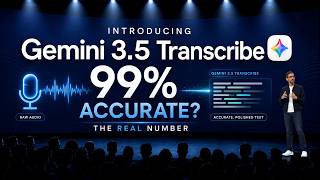
Google and outlet coverage cite a 2.6% average word error rate on non-streaming audio and 4.0% on streaming audio, per third-party benchmarking from Artificial Analysis [1][2]. Some downstream coverage and creator commentary rounded that up into '99% accurate' framing, which independent review pushed back on directly, clarifying that the real claimed figure is 2.6% WER on pre-recorded audio and that per-language accuracy still varies meaningfully. The gap between the two-and-a-half-percent error rate and 'basically perfect' marketing shorthand matters because it obscures real constraints: the Live streaming API cannot combine diarization with word-level timestamps, and the filler-stripping 'Smart transcription' mode is incompatible with both [2]. On top of that, unary requests cap at one hour of audio (thirty minutes if diarization or timestamps are enabled), and live sessions cap at ten minutes per session, meaning developers building on the accurate-sounding headline number still have to design around a fairly constrained feature matrix [4].

Early Adopters Are Already Finding the Seams

Community reaction split across two separate threads rather than forming one consensus. In one r/Bard discussion, one user reported the model beating Whisper and OpenAI's gpt-transcribe on a particularly hard Finnish test set, though another commenter in the same thread said AssemblyAI still wins for their use case - a reminder that a 'best overall' claim doesn't hold up outside the specific language or dataset being tested. A separate r/singularity thread, not framed as a head-to-head benchmark, carried more general praise for the model's handling of non-English accents, including Czech and French speakers. The same discussions surfaced friction points that don't show up in benchmark tables: one heavily-upvoted complaint described hitting the Gemini Pro usage cap in Google AI Studio after only about five transcription requests, developers weighing it for professional live-captioning were skeptical that a streaming tier without speaker diarization is genuinely useful without speaker labeling, users testing custom vocabulary found the model still splits unusual compound proper nouns it hasn't seen before (one commenter cited a company literally named 'Doorknob' getting split apart), and at least one commenter asked whether the model can reliably handle two-hour real-time recordings at all. That combination - narrowly-scoped but genuinely strong accuracy claims paired with strict free-tier limits and rough edges on edge-case vocabulary and long-session support - suggests the gap between 'impressive demo' and 'reliable production dependency' is still being worked out by early adopters rather than closed by the launch itself.

Historical Context

2025
Chirp 3 was Google's prior-generation transcription engine, measured at roughly 7.32% WER in one comparison; Gemini 3.5 Transcribe supersedes it with a reported 70% faster time-to-final-transcription.
2026-08-26
Gemini 3.5 Transcribe launched in public preview via the Gemini API, Google AI Studio, and the Gemini Enterprise Agent Platform, alongside integration into Gboard Rambler on Pixel 11 and the Gemini app for macOS, with Chrome integration announced as forthcoming.

Power Map

Key Players
Subject

Google launches Gemini 3.5 Transcribe speech-to-text model

GO

Google DeepMind / Google Gemini team

Developer and publisher of Gemini 3.5 Transcribe

WI

Wispr Flow

Competing voice-dictation product facing new competitive pressure from a broadly available, API-accessible transcription model

GO

Google Pixel 11 / Gboard Rambler

Consumer Android product already powered by the model

GE

Gemini app for macOS

Consumer product already using the model for transcription features

GO

Google Chrome

Browser product where the model's dictation feature is announced as coming soon

TH

Third-party developer platforms (LiveKit, Pipecat, Agora, Fishjam, Vercel, Vision Agents)

Pre-integrated partners exposing Gemini 3.5 Transcribe to their own developer bases

AR

Artificial Analysis

Third-party benchmark provider that measured the WER figures Google and others cite

Fact Check

4 cited
  1. [1] Gemini 3.5 Transcribe: Google's Most Precise Speech-to-Text Model
  2. [2] Google's Gemini 3.5 Transcribe Turns Speech to Text in 85 Languages While Auto-Correcting Your Verbal Stumbles
  3. [3] Why Google's Rambler Could Come to Every Device
  4. [4] Gemini 3.5 Transcribe Model Documentation

Source Articles

Top 5

THE SIGNAL.

Analysts

Opening Gemini 3.5 Transcribe to developers via API will intensify competition in the speech-to-text and dictation space and pressure incumbents like Wispr Flow.

The Deep View
Industry/market analyst

The model already works better than everything else other than Wispr Flow, which is exactly why it's something to look forward to.

The Deep View
Industry/market analyst
The Crowd

English ➡️ Spanish ➡️ Hindi ➡️ Mandarin Gemini 3.5 Transcribe can accurately turn speech into text across 85+ languages for building intelligent audio experiences. Watch the model seamlessly switch across 4 different languages while accurately transcribing complex numbers: https://t.co/ls7N8BCcMo

@@googledevs211

Google just replaced whole multi-model audio pipelines with one. Gemini 3.5 Transcribe turns raw speech into clean, formatted text without stitching together separate models for noise removal, filler cleanup, and speaker separation. Every voice product built on a stacked https://t.co/jTKZ0MbebV

@@rryssf15

GOOGLE JUST MADE VOICE TYPING 70% FASTER — AND THAT’S NOT EVEN THE BEST PART. Gemini 3.5 Transcribe doesn’t just write down what you say. It understands what you meant. The numbers: → 2.6% word error rate on recorded audio → 4% word error rate on live streaming → 70% faster than the previous engine

@@JulianGoldieSEO13

Introducing Gemini 3.5 Transcribe

@u/Stoneonn236
Broadcast
How to build with Gemini 3.5 Transcribe

How to build with Gemini 3.5 Transcribe

New Gemini 3.5 Transcribe Is WILD!

New Gemini 3.5 Transcribe Is WILD!

Gemini Transcribe Explained: Is It Really 99% Accurate?

Gemini Transcribe Explained: Is It Really 99% Accurate?

Google launches Gemini 3.5 Transcribe speech-to-text model — AI News | Agentic Brew