Situational Awareness hedge fund collapse and Citadel sale
TECH

Situational Awareness hedge fund collapse and Citadel sale

38+
Signals

Strategic Overview

  • 01.
    Situational Awareness LP, the AI-focused hedge fund founded by ex-OpenAI researcher Leopold Aschenbrenner, sold the bulk of its public equity portfolio to Ken Griffin's Citadel after margin calls forced a distressed liquidation.
  • 02.
    The fund's assets under management peaked at roughly $45 billion before collapsing to about $10 billion following the forced sale.
  • 03.
    Situational Awareness retained its private stakes, including a roughly $5 billion position in Anthropic, even after selling off its public stock portfolio.
  • 04.
    The fund ran leverage as high as 400% on its public stock bets, posting a 439% net return in the first half of 2026 before declining roughly 67% in July.

Deep Analysis

How 4x Leverage Turned a 439% Gain Into a $35 Billion Wipeout
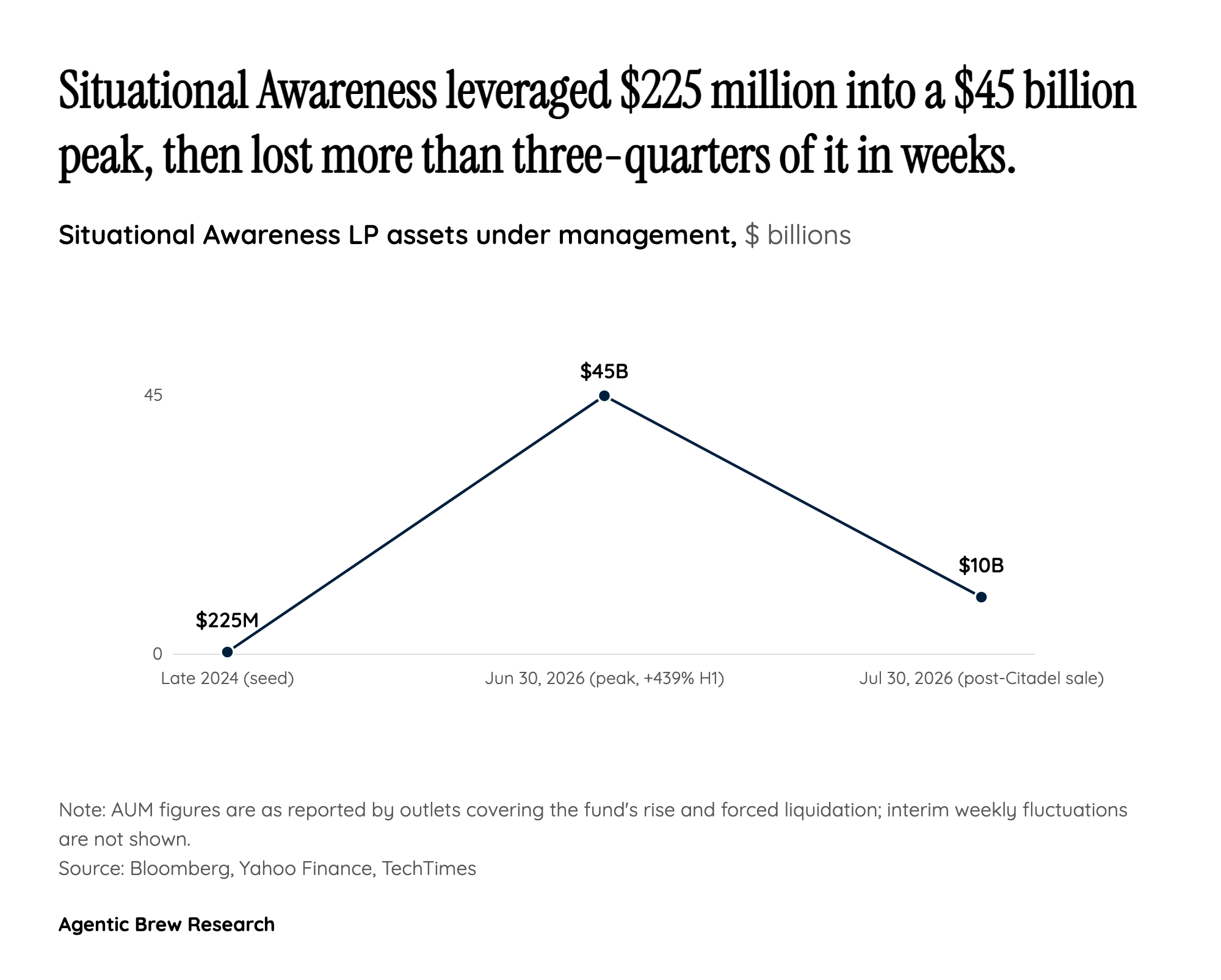
How 4x Leverage Turned a 439% Gain Into a $35 Billion Wipeout
Situational Awareness's AUM trajectory: from roughly a few hundred million dollars in seed capital to a $45 billion peak to about $10 billion after the forced Citadel sale, alongside the 439% H1 2026 return versus the 67% July decline.

At its peak, Situational Awareness had grown from a few hundred million dollars in seed capital to roughly $45 billion in assets under management, built almost entirely on leveraged bets on AI infrastructure names like SK Hynix [2], CoreWeave [1], and Sandisk and Nebius [9]. The fund reportedly ran leverage as high as 400% - four dollars of exposure for every dollar of capital - on that concentrated long book [1]. That leverage is exactly what produced the fund's headline number: a 439% net return in the first half of 2026 [3].

Leverage cuts both ways, though, and in July it cut hard. As AI infrastructure holdings reversed, the same 4x multiplier that had amplified gains began amplifying losses, and the fund's net asset value fell roughly 67% in a matter of weeks [3]. Because the positions were financed with borrowed money, falling prices didn't just erode paper gains - they shrank the collateral cushion prime brokers required, triggering margin calls. Meeting those calls meant selling more of the very assets that were falling, which pushed prices down further and generated more losses: a classic forced-deleveraging spiral [4]. By the time the dust settled, assets had fallen from $45 billion to about $10 billion [2].
The Hedge That Wasn't: Why the Adobe Short Made Things Worse, Not Better

Situational Awareness didn't just run a leveraged long book - it paired those AI infrastructure bets with a short position in Adobe, built on the thesis that agentic AI tools would erode software companies' subscription pricing power. In theory, that short was supposed to act as a hedge: if the AI trade turned sour, the software short would rise in value and cushion the blow. In practice, the opposite happened [5]. The Adobe short moved against the fund at the same time its AI infrastructure longs were falling, meaning both halves of the portfolio lost money simultaneously instead of one offsetting the other [5]. Rather than dampening the drawdown, the short became a second, independent engine of losses - a reminder that a hedge only works if the correlation it depends on actually holds when the pressure is on.

Who Profits: Citadel's Discount Bet From a Firm That Called AI 'Garbage'

The forced seller on one side of this trade created an unusually good buyer's market on the other. Ken Griffin's Citadel won a bidding war for the bulk of Situational Awareness's public equity book, acquiring positions reportedly worth $16 billion to $20 billion at their peak for a fraction of that value [7]. The irony is pointed: Griffin has previously been skeptical of the AI trade, at one point calling some AI technology 'garbage' and questioning whether generative AI had actually delivered market-beating hedge fund returns - yet the deal made Citadel one of the largest holders of AI stocks in the market [6].

The market read the deal as a relief valve, not a warning sign. Removing a large forced seller sent AI-adjacent stocks sharply higher: the iShares Semiconductor ETF jumped 8.5%, several of the fund's former holdings rallied more than 20% in a single session, Microsoft added roughly $400 billion in market value, and the Nasdaq Composite rose 2.8% [7]. Goldman Sachs, JPMorgan Chase, Bank of America and Citigroup - the prime brokers that issued the original margin calls - helped structure the sale, giving Citadel a negotiated path to the position rather than a chaotic public liquidation [8].

Manipulation Theory vs. Ordinary Opportunism - and a Sign of Broader AI Leverage Risk

Not everyone reads the Citadel deal as simple opportunism. A theory circulating in retail-investor communities holds that Citadel benefited from - or even helped stoke - fear of a Federal Reserve rate hike that hit speculative AI names hardest, then scooped up the resulting fire sale at a discount. Other, more measured voices in the same communities push back on that framing, arguing this looks like ordinary hedge-fund behavior during a systemic deleveraging event rather than a targeted attack, and noting that Aschenbrenner likely still retains a substantial personal position even after the losses. Social-media reaction split along similar lines: chatter on X.com leaned toward mockery and schadenfreude at Aschenbrenner's expense, in contrast with a more admiring tone toward Griffin as the shrewd winner of the standoff.

The more verifiable evidence points toward the second reading. Asia-focused hedge funds - many exposed to the same AI infrastructure trade - averaged losses of 18.6% in July 2026 alone [3], suggesting the reversal in AI infrastructure stocks hit leveraged players broadly, not just one fund. Other details circulating in that same online discussion add texture to the unwind: YouTube commentary noted Aschenbrenner had also been running roughly $9 billion in puts against Nvidia alongside his AI-infrastructure longs, a short position tied to Nvidia's unusual debt raise, while Reddit threads pointed out that Millennium Management reportedly also bid on the distressed portfolio before Citadel ultimately won it. Financial Times coverage framed the episode in textbook terms: borrowing to magnify returns works until markets reverse, at which point the same borrowing magnifies the losses [8]. One investing commentator went further, arguing the volatility exposes how dominated the AI trade has become by short-term, sentiment-driven traders whose price action has detached from company fundamentals [7]. Whether or not Citadel played any active role in the selloff, the broader lesson - that leverage on a crowded AI trade can unwind violently and fast - applies well beyond Situational Awareness.

Historical Context

2024-04
Fired from OpenAI's Superalignment team over an alleged internal information leak, which he disputes.
2024
Published a 165-page essay, "Situational Awareness: The Decade Ahead," predicting an unprecedented global race to build AI infrastructure.
2024
Launched with a few hundred million dollars, backed by Stripe's Collison brothers, Nat Friedman, Daniel Gross and Jane Street, and grew to roughly $20 billion within under two years.
2026-06-30
Reported a 439% net return for the first half of 2026 and reached a peak AUM of about $45 billion.
2026-07
AI infrastructure holdings fell over 30% while its Adobe short also moved against it, triggering margin calls from Goldman Sachs, JPMorgan, Bank of America and Citigroup.
2026-07-30
Citadel won a bidding war and acquired the bulk of Situational Awareness's public equity book at a discount; Situational Awareness kept its private stakes, including Anthropic, MatX and Fluidstack.

Power Map

Key Players
Subject

Situational Awareness hedge fund collapse and Citadel sale

LE

Leopold Aschenbrenner

Founder, CIO and managing partner of Situational Awareness LP; former OpenAI Superalignment researcher fired in April 2024, who ran the fund at up to 400% leverage on AI infrastructure longs paired with software shorts.

CI

Citadel / Ken Griffin

Bought the bulk of Situational Awareness's public equity portfolio at a deep discount, becoming one of the largest holders of AI stocks despite Griffin's prior public skepticism of generative AI.

GO

Goldman Sachs, JPMorgan Chase, Bank of America, Citigroup

Prime brokers that issued margin calls against Situational Awareness's leveraged positions and helped structure the sale to Citadel.

EA

Early investors (Patrick and John Collison, Nat Friedman, Daniel Gross, Jane Street)

Backed Situational Awareness LP from its 2024 launch; Jane Street's participation was notable because the firm rarely backs external managers.

AN

Anthropic

Retained private position (roughly $5 billion, about half of the fund's remaining assets); itself valued at $965 billion in a May 2026 Series H round, with an IPO expected as early as October 2026.

AD

Adobe

Target of Situational Awareness's short thesis that agentic AI tools would erode SaaS pricing power; the short moved against the fund and became a second, independent source of losses rather than a hedge.

Fact Check

9 cited
  1. [1] Citadel Buys Situational Awareness Portfolio After 4x Leverage Ends AI Fund's 1000% Run
  2. [2] Situational Awareness Assets Fall to $10 Billion After Losses
  3. [3] Citadel Buys Most of Situational Awareness's Stock Portfolio
  4. [4] Situational Awareness Hedge Fund Margin Call Triggers Citadel Fire Sale
  5. [5] Why Leopold Aschenbrenner's Situational Awareness Hedge Fund Imploded
  6. [6] Did Ken Griffin Just Save the AI Trade?
  7. [7] Did Ken Griffin Just Save the AI Trade With This $10 Billion Move?
  8. [8] Can the Situational Awareness Hedge Fund Raise Capital After Its 439% H1 Gain?
  9. [9] AI hedge fund Situational Awareness may have sold its public portfolio, but it still has its Anthropic shares

Source Articles

Top 5

THE SIGNAL.

Analysts

Argues the AI-stock volatility around the Situational Awareness unwind shows sentiment-driven, momentum trading has become detached from company fundamentals.

The Motley Fool
Investing analysis

Frames the collapse as a textbook leverage-amplification story: borrowing to boost returns works until markets reverse, at which point the same leverage magnifies losses.

Financial Times
Reporting/analysis, cited via Disruption Banking

Says the fund's blowup exposes hidden risks of leverage in the AI trade more broadly.

Jim Cramer
CNBC commentator
The Crowd

BREAKING - it's been revealed that Citadel was the buyer of Situational Awareness's public book. Leopold Aschenbrenner has been beaten by Ken Griffin.

@@WallStRollup527

Citadel has bought most of the roughly $16 billion public-stock portfolio of Leopold Aschenbrenner's AI hedge fund, Situational Awareness, after its leveraged tech bets suffered heavy losses. Citadel did not buy Aschenbrenner or the entire fund. Situational Awareness is keeping its private stakes.

@@Kenjatina_og438

If you haven't realized by now, Ken Griffin is a genius and the Situational Awareness deal is proof of a pattern that started decades ago (Save this). Griffin started Citadel out of a Harvard dorm room in 1987 with just $265,000 raised from friends and family.

@@MelvinInvests359

Citadel Buys Situational Awareness's Stock Portfolio After Big Losses in AI

@u/Capital-Row6633924
Broadcast
How Leopold Aschenbrenner Lost $45 Billion in 3 Days

How Leopold Aschenbrenner Lost $45 Billion in 3 Days

The 24-Year-Old Betting $9Billion Against the AI Boom (Leopold Aschenbrenner)

The 24-Year-Old Betting $9Billion Against the AI Boom (Leopold Aschenbrenner)

Leopold Aschenbrenner says "No More Stocks!"

Leopold Aschenbrenner says "No More Stocks!"

Situational Awareness hedge fund collapse and Citadel sale — AI News | Agentic Brew