SpaceX's push into AI compute infrastructure
TECH

SpaceX's push into AI compute infrastructure

36+
Signals

Strategic Overview

  • 01.
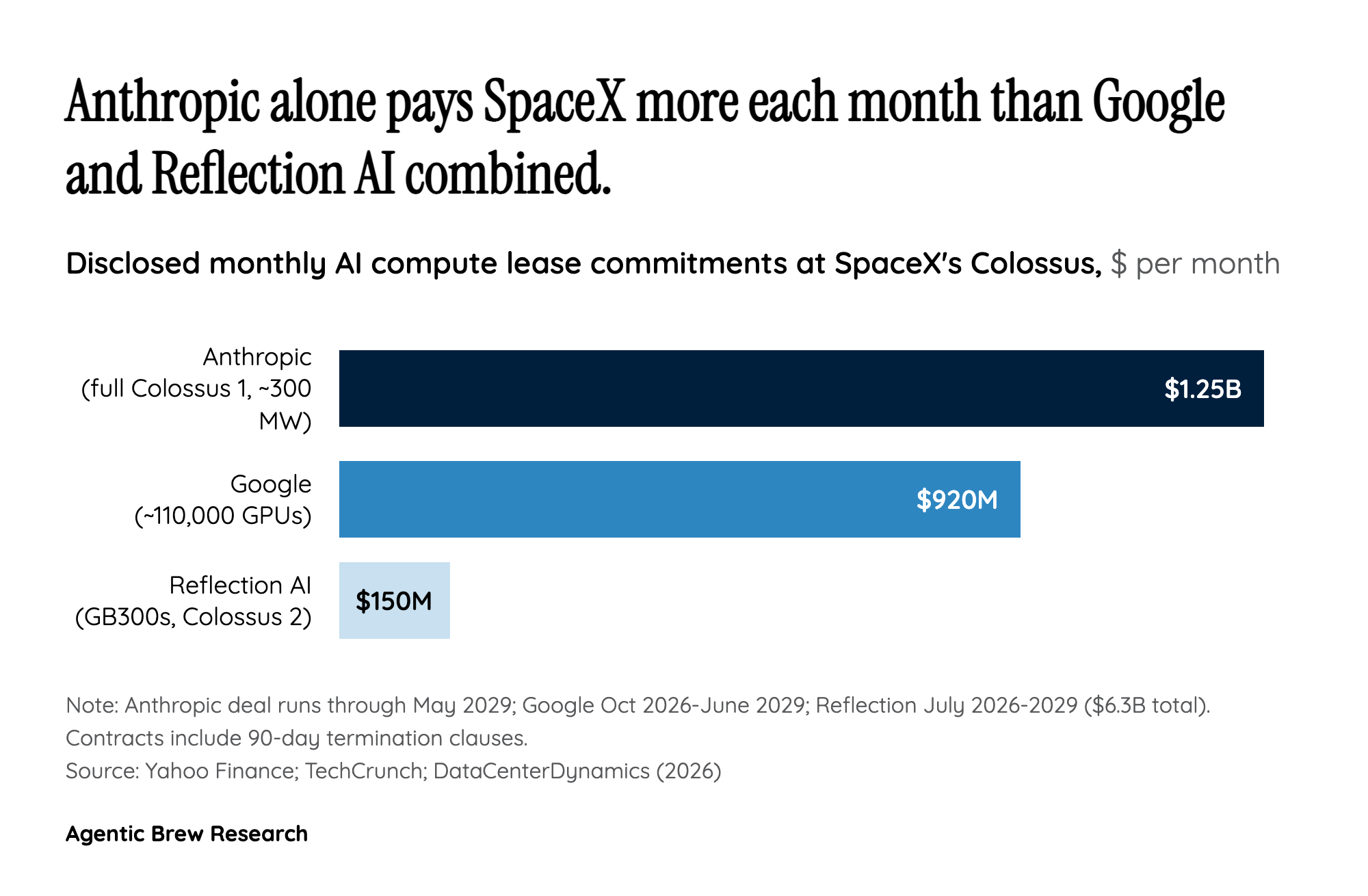
    SpaceX signed a compute deal worth up to $6.3 billion with open-source AI lab Reflection AI, which will pay $150 million per month from July 2026 through 2029 for access to Nvidia GB300 chips at its Colossus 2 data center near Memphis.
  • 02.
    Anthropic agreed to lease the full ~300 megawatts of SpaceX's Colossus 1 data center at about $1.25 billion per month through May 2029, while Google committed to pay $920 million per month from October 2026 through June 2029 for roughly 110,000 Nvidia GPUs.
  • 03.
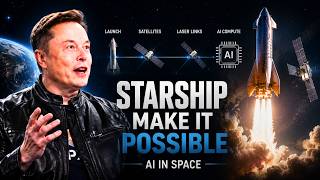
    Elon Musk confirmed SpaceX's planned orbital AI satellite constellation is named Starmind, a system of up to one million solar-powered satellites that each act as an in-orbit server running AI compute, with two AI1 prototypes scheduled to launch in early 2027.
  • 04.
    Analysts project AI compute could become SpaceX's primary revenue driver, with one Evercore ISI estimate seeing AI reach 74% of revenue by 2031 while space revenue falls to roughly 1%.

Deep Analysis

Musk's Rivals Are Quietly Funding His Compute Empire

The most striking feature of SpaceX's compute business is who is paying for it. Anthropic, a direct competitor of Musk's own xAI, has agreed to lease the entire ~300 megawatts of the Colossus 1 data center for roughly $1.25 billion per month through May 2029 [2]. Google, another AI rival, committed $920 million per month from October 2026 through June 2029 for about 110,000 Nvidia GPUs [3]. The latest entrant, the Nvidia-backed open-source lab Reflection AI, signed on for up to $6.3 billion, paying $150 million per month for GB300 access at Colossus 2 [1].

The irony runs deeper than competitors writing checks to Musk. Reflection is itself backed by Nvidia, which invested in the lab; Reflection then rents GB300 chips that SpaceX bought from Nvidia — a tight circular loop that analysts and YouTube commentators have flagged as the defining financial pattern of this AI buildout. On X, the reaction to the Reflection deal was broadly bullish, with the VanEck analyst framing Reflection as America's open-source answer to DeepSeek and several voices dissecting the Nvidia financing circularity rather than the rocketry. The takeaway: SpaceX has positioned itself as neutral infrastructure that even its fiercest model-layer rivals depend on.

By The Numbers: How AI Compute Is Overtaking Rockets

By The Numbers: How AI Compute Is Overtaking Rockets
Anthropic's roughly $1.25 billion-per-month lease exceeds Google's $920 million and Reflection AI's $150 million combined.

The scale of the leasing business now rivals SpaceX's core launch revenue. Stacked together, the three disclosed contracts represent enormous recurring monthly cash flows: Anthropic at roughly $1.25 billion per month [2], Google at $920 million per month [3], and Reflection at $150 million per month toward a $6.3 billion total [1]. The underlying asset is dense — Colossus houses on the order of 555,000 Nvidia GPUs across about 2 gigawatts.

The trajectory is what makes this a structural shift rather than a side business. One Evercore ISI projection cited in analysis of SpaceX's pivot sees AI reaching 74% of company revenue by 2031, with space revenue shrinking to roughly 1% [8]. That would invert the identity of a company still best known for reusable rockets. The terrestrial leasing book, not the speculative orbital vision, is what could make AI compute SpaceX's largest revenue driver as soon as next year.

Why SpaceX Became a Landlord: The Latency Problem It Couldn't Solve

SpaceX did not set out to be a compute landlord — it backed into the role. Reporting on the Anthropic arrangement indicates SpaceX rented out Colossus 1 partly because it could not make the Memphis site work for its own Grok and xAI models, hitting latency issues connecting the campus to two other sites more than ten miles away [4]. Rather than leave expensive GPUs underused, SpaceX converted inherited capacity from the xAI merger into a commercial, cloud-style platform with recurring monthly leases [1].

This origin story reframes the headline deals. What looks like a bold strategic land grab is, at the asset level, monetization of surplus and partly stranded capacity. That has implications for durability: a business built on reselling capacity the owner couldn't fully use itself is a strong cash engine, but it is a different proposition than purpose-built, vertically integrated AI infrastructure.

The Orbital Economics Debate: Opportunity of the Century or a Tennis Court Per Rack

The Starmind vision — up to one million solar-powered AI satellites, each operating as an in-orbit server rather than a relay, with two AI1 prototypes targeted for early 2027 [6]— splits experts sharply. Optimists at satellite-industry firms call it feasible: one CEO framed it as "the opportunity of the century," and another argued the engineering is "a known known" gated only by time and capital [5]. The bull case rests on continuous solar power and vacuum radiator cooling that sidesteps Earth's water and grid constraints [7].

Reddit, even within pro-SpaceX communities, is far more cynical, and its objections sharpen the skeptics' case. The most-discussed thread argues a single AI1 satellite is essentially one ~120-150 kW GPU rack rather than a data center, implying roughly 6,700 satellites per gigawatt; that vacuum thermal limits force radiators on the order of a tennis court per rack; and that GPUs going obsolete every few years would mean rebuilding and relaunching the entire fleet each chip cycle. That maps directly onto the strongest expert critique: one security analyst notes Nvidia interconnects a single GPU at about 7.2 terabits per second, one to two orders of magnitude beyond what space links can provide [5]. The split is clean — terrestrial leasing is a present-tense business, while orbital compute remains a physics-and-economics argument.

The Risk Hidden in the Fine Print: 90-Day Exits and Inflated Capacity

Beneath the eye-catching totals sit terms that make the revenue less certain than it looks. Either party can terminate the Reflection contract on 90 days' notice after the first three months [1], a clause that turns a headline $6.3 billion figure into a stream that can be switched off quickly. With a handful of large customers concentrated on a few campuses, that flexibility creates real revenue-volatility risk.

There are also questions about whether stated capacity matches reality: reporting noted that Colossus 2 came online but that satellite imagery suggested cooling capable of around 350 MW rather than the claimed gigawatt scale [1]. The skeptical read surfaced on r/wallstreetbets captured the market's ambivalence — the Reflection deal was framed as SpaceX reselling underused capacity, with commenters pointing to the cancellation clause and noting the stock barely moved. For a company leaning on these contracts in its IPO narrative, the gap between announced commitments and cancellable, possibly overstated capacity is the quiet risk.

Historical Context

2024-06
xAI announced plans to build the Colossus supercomputer in Memphis with the Greater Memphis Chamber.
2024-12
Colossus went fully operational after roughly 122 days of construction.
2026-01-30
SpaceX filed an FCC application to launch up to one million solar-powered AI satellite data centers into low Earth orbit.
2026-02-02
SpaceX acquired xAI in an all-stock deal valuing the combined company at roughly $1.25 trillion, described as the biggest merger of all time.
2026-06-05
Google agreed to pay SpaceX $920 million per month for roughly 110,000 GPUs.
2026-06-22
SpaceX signed its third major Colossus compute deal, worth up to $6.3 billion, with Reflection AI.

Power Map

Key Players
Subject

SpaceX's push into AI compute infrastructure

SP

SpaceX

Owner of the Colossus data centers and the Starmind orbital program and lessor of AI compute; after acquiring xAI in February 2026 it controls both the hardware and the customer pipeline, making it a central gatekeeper of large-scale AI capacity.

RE

Reflection AI

Open-source AI lab backed by Nvidia that signed the up-to-$6.3B lease for GB300s at Colossus 2; its commitment validates SpaceX's commercial cloud model for second-tier labs, not just hyperscalers.

AN

Anthropic

SpaceX's largest single compute customer, leasing all ~300 MW of Colossus 1 at roughly $1.25 billion per month; a direct rival of Musk's xAI now funding his infrastructure buildout.

GO

Google

Pays SpaceX $920 million per month for roughly 110,000 GPUs from October 2026 through June 2029, anchoring SpaceX's compute revenue with a hyperscaler-scale commitment.

XA

xAI

Original builder of the Colossus supercomputer; became a SpaceX subsidiary after the February 2026 all-stock merger, supplying the underlying compute asset SpaceX now leases out.

NV

Nvidia

Supplies the GB300 chips used across Colossus and is also a backer of Reflection AI, sitting at both ends of a circular financing loop that funds SpaceX's compute leases.

Fact Check

8 cited
  1. [1] SpaceX secures $6.3bn compute capacity deal from AI startup Reflection
  2. [2] Anthropic to rent all AI capacity at SpaceX's Colossus data center
  3. [3] Google will pay SpaceX $920M per month for compute
  4. [4] SpaceX Colossus 1 technical problems, rented to Anthropic
  5. [5] Are orbital data centers the next frontier of AI infrastructure?
  6. [6] SpaceX Starmind AI satellite vs Starlink
  7. [7] Musk confirms Starmind AI satellite plan
  8. [8] SpaceX is quietly becoming an AI compute and orbital infrastructure company

Source Articles

Top 5

THE SIGNAL.

Analysts

"Skeptical of orbital data center physics on bandwidth grounds: "Nvidia connects a single GPU into a training cluster at approximately 7.2 terabits per second — one to two orders of magnitude more than space links can provide.""

Brandon Karpf
International Security Partnerships, NTT

"Considers orbital compute achievable, with the hard problems being power, thermal, and economics rather than fundamental science: "There's no need for [new] physics here…so it is technically feasible.""

James Mason
Chief Space Officer, Planet

"Strongly bullish on orbital data centers: "I think it's the opportunity of the century.""

Avi Shabtai
CEO, Ramon.Space

"Frames the build as an execution challenge, not a research one: "The constraints are just time and capital. The engineering is a known known.""

Chris Stott
Founder & Executive Chairman, Lonestar Data Holdings

"Points to orbital advantages in power and cooling: "Space is rather vast, unlimited power via solar, and the water factor goes away when you think about cooling via radiator.""

Austin Litteral
Alpha Funds
The Crowd

"Elon Musk just confirmed that 'Starmind' will be the official name of the SpaceX AI satellite constellation"

@@iam_smx6153

"BREAKING: SpaceX signs $6.3 billion compute deal with Reflection for GB300s access at Colossus II. $150M/month from July 1 through 2029. Nvidia invested $800M in Reflection and Reflection now rents GB300s that SpaceX bought from Nvidia btw"

@@ns123abc669

"$SPCX signs $6.3B compute deal with AI startup Reflection; $150M/month through 2029 for capacity at Colossus 2 in Memphis. Reflection is America's open-source answer to Deepseek (model weights are open for researchers and developers, but training data and the full training stack are not)."

@@matthew_sigel194

"SpaceX signs computing power deal with open-source AI startup Reflection worth up to $6.3 billion"

@u/Boston-Bets1900
Broadcast
Elon Musk explains how SpaceX could build AI data centers in space

Elon Musk explains how SpaceX could build AI data centers in space

Elon Musk Just Revealed the Future of Starship and AI

Elon Musk Just Revealed the Future of Starship and AI

Anthropic AI and SpaceX Datacenter Deal - 220,000 GPU's Show AI Compute Constraint is a Lie

Anthropic AI and SpaceX Datacenter Deal - 220,000 GPU's Show AI Compute Constraint is a Lie