Apple raises Mac and iPad prices amid AI-driven memory shortage
TECH

Apple raises Mac and iPad prices amid AI-driven memory shortage

32+
Signals

Strategic Overview

  • 01.
    Apple raised prices on Macs, iPads, and several home products worldwide, blaming a surge in memory and storage component costs driven by AI data center demand, while leaving iPhone prices unchanged for now.
  • 02.
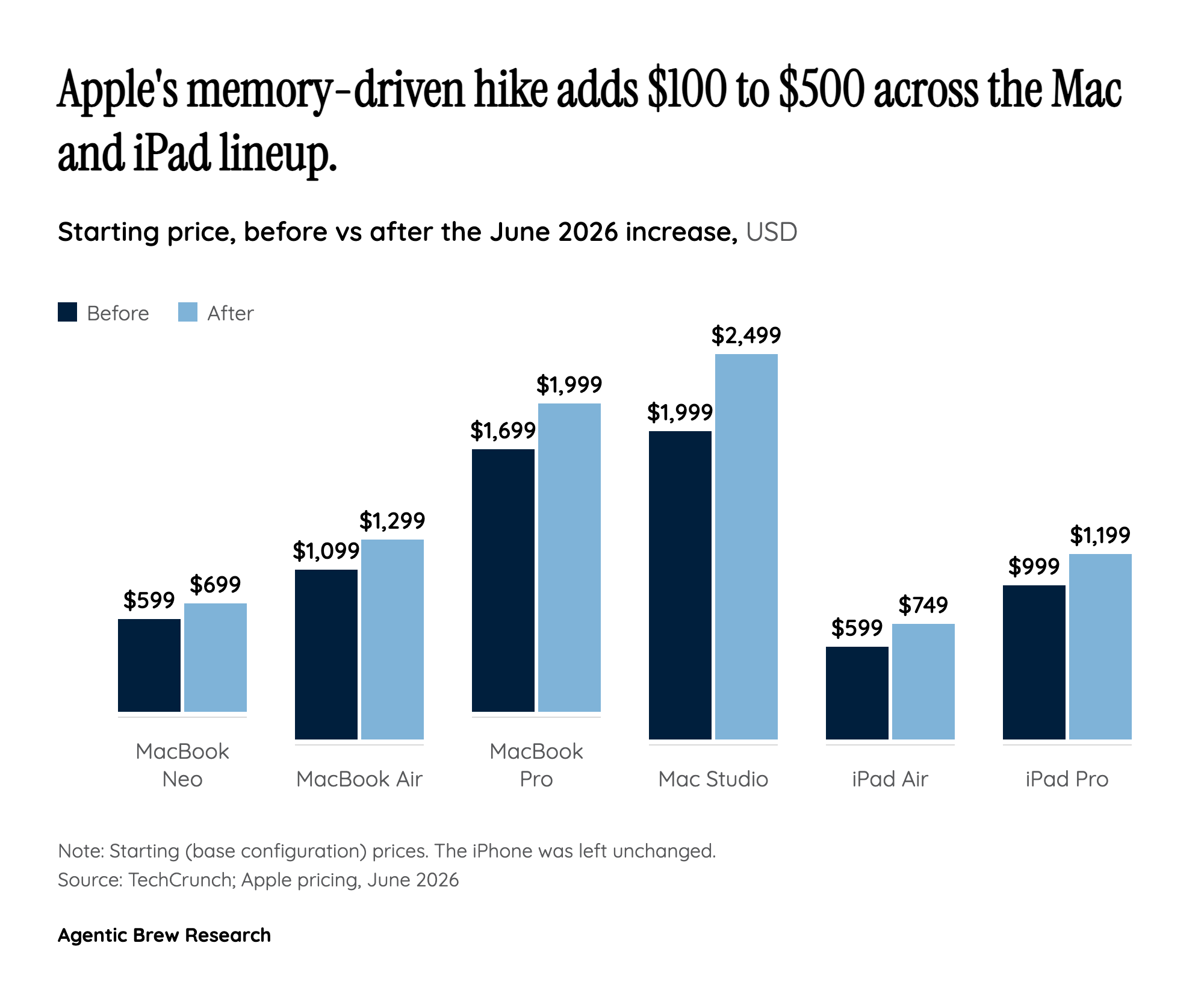
    The entry-level MacBook Neo rose to $699 from $599, with steeper increases up the lineup - the Mac Studio jumped to $2,499 from $1,999 and the iPad Air to $749 from $599.
  • 03.
    Apple shares fell roughly 6 percent to around $275.15 on the day of the announcement, their worst single day in more than a year, on fears of demand destruction.
  • 04.
    CEO Tim Cook said Apple had shielded customers from rising costs for months but that the situation had become unsustainable, calling the increases unavoidable.

The AI boom just sent its first bill to consumers
The AI boom just sent its first bill to consumers
Starting prices before vs after the June 2026 increase across the Mac and iPad lineup.

For two years the cost of the AI buildout was an abstraction - capex line items, GPU shortages, hyperscaler earnings calls. Apple's price hike is the moment it became personal. The mechanism is brutally simple: the rapid expansion of AI data centers has created an extraordinary surge in demand for memory and storage, and data centers now consume roughly 70 percent of all memory chips produced worldwide [1]. The same DRAM dies that go into a MacBook compete directly with the high-bandwidth memory feeding AI accelerators, and there is only so much wafer capacity to go around. When the cloud bids higher, your laptop pays. Apple framed the increase as unprecedented in pace and magnitude, with executives saying they had 'never seen a component price increase this much, this quickly' [2]. The headline number understates it: the MacBook Neo's jump from $599 to $699 is the floor, while the Mac Studio climbed $500 and the iPad Air $150 [3]. This is AI-flation - infrastructure spending reaching into ordinary wallets through the supply chain rather than the showroom.

Sparing the iPhone is the most revealing decision Apple made

What Apple chose not to raise is as strategic as what it did. The iPhone, Apple's highest-volume and most price-sensitive product, was left untouched while Macs, iPads, and even the Vision Pro absorbed increases [3]. The bet is on demand elasticity: Mac and iPad buyers are deeper inside the ecosystem and less likely to walk, whereas an iPhone price bump risks ceding share at the most competitive price points. Wall Street split on whether the bet is sound. Gene Munster called the roughly 5 percent drop an overreaction, noting a $200 increase adds just $3.70 a month over a Mac's 4.5-year life [4], and Wedbush's Dan Ives held an Outperform rating with a $400 target [5]. The bears' worry is demand destruction - that aggressive $100-$500 jumps, more than expected, finally push buyers to the used market or to delay. Evercore's Amit Daryanani flagged the surprise as much in the timing as the magnitude, having assumed Apple would wait for the next product cycle [5]. The 6 percent slide suggests the market is not yet convinced the iPhone firewall will hold.

This is an industry repricing, not an Apple story

Apple is the loudest name to blink, but it is following Microsoft, not leading. The 2026 Surface Pro and Surface Laptop already launched at $1,499 and $1,599, up $500-$600 over their predecessors, citing the same shortage [6]. The root cause sits with three companies: Samsung, SK Hynix, and Micron control more than 95 percent of global DRAM, and all three have steered capacity toward high-bandwidth memory for AI, with SK Hynix reporting HBM, DRAM, and NAND essentially sold out for 2026 [7]. Micron has reportedly exited the consumer memory market entirely [7]. The price signal is already visible upstream: Samsung lifted 32GB DDR5 module prices to $239 from $149, a 60 percent jump, with contract DDR5 pricing surging over 100 percent [8]. And the supply side offers no quick relief - Samsung and SK Hynix have warned the shortage could last through at least 2027 and beyond, with customers reserving supply years ahead [7]. The historical rhyme is the 2017-2018 supercycle, which minted record memory-maker revenue before prices collapsed by mid-2019 [9]- but that cycle was about phones and early cloud, not a structural AI demand floor.

The community read it as a turning point, not a blip

Across X, YouTube, and Reddit the reaction was less shock than grim recognition - the long-anticipated shoe finally dropping, tagged with coinages like 'RAMageddon' and the 'Memory Inflation Tax.' Notably, almost no one disputed Apple's stated cause; the argument was over blame, not facts. On the enthusiast forums sentiment ran overwhelmingly negative with a heavy anti-AI undercurrent, a sense that consumer tech may now appreciate in value rather than get cheaper, and reports of buyers cancelling MacBook Pro orders and pivoting to used machines. A contrarian camp accepted the hike as unavoidable and industry-wide, echoing Tim Cook's framing that the cost situation had become unsustainable [4]. The most useful thread running through the discussion was practical rather than emotional: third-party retailers had not yet adjusted their pricing, turning the announcement into a narrow window of arbitrage for anyone who moves quickly.

Historical Context

2017-01-01
The 2017-2018 memory supercycle, driven by smartphone storage upgrades and early cloud buildout, is the most-cited analogue to today's shortage; Micron revenue surged 64 percent to $20.3B in 2017 and 50 percent to $30.4B in 2018 before prices crashed by mid-2019.
2025-09-30
Record-low memory inventories signaled an emerging supercycle likely to peak by 2027, roughly seven years after the prior cycle.
2026-04-14
Microsoft raised prices across all Surface PCs amid the same AI-driven memory shortage, preceding Apple's June hike and signaling an industry-wide pattern.

Power Map

Key Players
Subject

Apple raises Mac and iPad prices amid AI-driven memory shortage

AP

Apple

Hardware maker passing through component cost increases; raised Mac, iPad, and home product prices while sparing the iPhone, betting on inelastic demand within its ecosystem.

SA

Samsung, SK Hynix, Micron

Control over 95 percent of global DRAM production and have reallocated capacity toward high-bandwidth memory for AI accelerators, leaving consumer-grade DRAM critically short and pricier.

MI

Micron

Reportedly exited the consumer memory market entirely to focus on enterprise and AI customers, tightening consumer supply further.

MI

Microsoft

Also raised hardware prices amid the same shortage; its 2026 Surface Pro and Surface Laptop launched at $1,499 and $1,599, up $500-$600 from predecessors.

AI

AI data center operators

Cloud providers, model trainers, and data-center operators consuming an outsized share of global DRAM and HBM, driving the consumer shortage.

Fact Check

9 cited
  1. [1] Memory chip shortage 2026: how AI is squeezing consumer electronics
  2. [2] Apple Raises Mac and iPad Prices Worldwide as AI-Driven Memory Shortage Pushes Up Component Costs
  3. [3] Apple raises Mac and iPad prices, spares iPhone for now
  4. [4] AAPL slides 6% on Mac, iPad price hikes - why Gene Munster calls it an overreaction
  5. [5] AAPL stock slides over 6% after Apple raises Mac and iPad prices
  6. [6] Microsoft raises Surface PC prices amid memory shortage
  7. [7] Samsung and SK Hynix warn AI-driven memory shortages could last until 2027 and beyond as HBM demand explodes
  8. [8] Samsung warns of memory shortages driving industry-wide price surge in 2026
  9. [9] Memory Mania: how a once-in-four-decades cycle is unfolding

Source Articles

Top 5

THE SIGNAL.

Analysts

"Called the stock drop an overreaction, arguing Apple's demand is largely inelastic. He wrote that '$AAPL trading down 5% on the news of an average Mac weighted price increase of about 17% (factoring in mix) feels like an overreaction on fears of demand destruction,' and framed it in cost-of-ownership terms: 'Average life of a Mac is 4.5 years before it's traded in which means a $200 increase adds $3.70 a month to the cost of ownership.'"

Gene Munster
Managing Partner, Deepwater Asset Management

"Maintained an Outperform rating and a $400 price target on Apple despite the price hikes and the market reaction."

Dan Ives
Analyst, Wedbush

"Said the timing was a surprise: 'The price hikes across the select products come as a surprise, as we were under the impression that Apple would wait until the next product cycle before raising prices.'"

Amit Daryanani
Analyst, Evercore ISI

"Warned that significant memory shortages are expected to persist through at least 2027 as HBM demand for AI continues to outstrip supply."

Kim Jaejune
Memory chief, Samsung
The Crowd

"Memory price hikes have finally started hitting Apple. Today, they raised some base prices: Macbook Neo: $599 -> $699 Macbook Air: $1099 -> $1299 Macbook Pro: $1699 -> $1999 Mac Studio: $1999 -> $2499 iPad Air $599 - $749 iPad Pro: $999 -> $1199"

@@MKBHD38366

"Breaking: Apple raised the cost of a MacBook Pro by $300 after CEO Tim Cook said soaring chip costs made it “unavoidable.” Here are the new price tags for Apple products."

@@WSJ108

"🚨 Apple raises prices of iPads and Macs due to memory chip costs. (CNBC)"

@@IndianTechGuide2323

"Apple Raises Prices on Macs, iPads by $200 or More on Some Models"

@u/franco847321800
Broadcast
Apple Just Raised Prices on EVERYTHING & it's WORSE Than We Thought!

Apple Just Raised Prices on EVERYTHING & it's WORSE Than We Thought!

Apple Raises Prices on Macs, iPads, Home Devices

Apple Raises Prices on Macs, iPads, Home Devices

Apple Products Are About To Get More Expensive… 🚨

Apple Products Are About To Get More Expensive… 🚨