Anthropic Model Hardware Standard
TECH

Anthropic Model Hardware Standard

32+
Signals

Strategic Overview

  • 01.
    Anthropic launched the research preview of the Model Hardware Standard (MHS) on August 27, 2026 - a shared specification letting AI agents safely operate physical equipment such as microscopes, liquid handlers, and robotic arms in scientific labs and manufacturing facilities.
  • 02.
    MHS exposes each device through simple `read` and `write` primitives plus natural-language tags describing what the device can do, is model-agnostic, and can be reached by any agent harness through standard protocols such as the Model Context Protocol.
  • 03.
    Anthropic says MHS cuts hardware-integration work that normally takes weeks or months down to hours or minutes.
  • 04.
    Anthropic plans to open-source MHS once the research-preview period ends, using the interim to build safety evaluations and best practices alongside launch partners.

The Mechanism: What MCP Did for Software, MHS Does for Atoms

Model Hardware Standard is built as a driver layer, not a new model: it exposes each device, such as a microscope, liquid handler, or robot arm, through simple read (for example, get temperature) and write (for example, set temperature) primitives, wrapped in natural-language tags describing what a device can do [2]. Because MHS works with any device that has a programmable interface and is model-agnostic, any agent harness can reach it through standard protocols such as the Model Context Protocol, the software-tool standard Anthropic introduced in 2024 [3][6]. Anthropic's own framing makes the lineage explicit: as Alek Kemeny, a member of Anthropic's technical staff, put it, MHS is meant to do for hardware what MCP did for software [4]. The standard also bakes in device-level guardrails, such as capping a robotic arm's allowed speeds and angles, because Anthropic acknowledges that Claude's spatial and physical reasoning, learned only from text and images, still needs expert oversight [1].
Proof Points: From a Zebrafish Microscope to a 99.3 Percent Success Rate

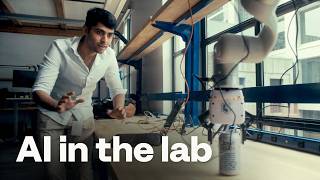
Unlike a typical framework announcement, MHS shipped with real before-and-after numbers from partners who had already used it. At HHMI Janelia, a researcher used MHS to unify seven separate vendor programs controlling a two-photon microscopy rig into a single interface, with Claude aligning beams and adjusting imaging parameters live during zebrafish imaging [1]. Genentech used MHS to automate a BCA protein assay across liquid handlers, robotic arms, and plate readers, running a drug-discovery experiment with real-time error handling [1]. Carnegie Mellon University ran serial-dilution experiments three times faster by using MHS to bridge lab equipment that previously could not talk to each other [1]. The sharpest number comes from quantum-computing partner QuEra Computing, which used MHS-integrated AI for laser relock and stabilization and saw its success rate jump from 58 percent with custom scripts to 99.3 percent [2].

The Business Case: Ending Vendor Lock-In While Racing OpenAI and Amazon

Anthropic's pitch is explicitly economic. Jonah Cool, the company's head of partnerships and deployment for science, says scientific equipment today suffers from proprietary solutions that are brittle and often fail scientists' needs, and that Anthropic built MHS to avoid vendor lock-in [2][5]. That pain point is concrete: labs and factories typically spend weeks or months integrating hardware because most devices cannot communicate with each other, requiring specialists to hand-build one-off, brittle integrations that MHS claims to collapse into hours or minutes [1][3]. The launch also reads as a competitive move: rivals including OpenAI and Amazon have already poured significant spending into AI-native devices and manufacturing tools, and MHS marks Anthropic's own entry into physical AI so it does not cede that frontier [2].

The Contrarian View: MCP Rebrand, or a Real Bottleneck for Real-Time Control?

The loudest pushback did not come from competitors but from technically literate onlookers online, where reaction to the launch was mostly enthusiastic but included a pointed skeptical minority. One recurring objection was novelty: some questioned whether MHS truly enables anything beyond standardizing a protocol, comparing it to older hardware standardization efforts and to MCP itself. A more substantive critique argued MHS is poorly suited to real-time, embedded, time-critical industrial processes, which need deterministic, low-latency control that queued agent commands cannot guarantee, dismissing the demoed laser-relock example as effectively a simple control loop rather than genuine intelligence. Defenders countered that the target use case is not single-loop real-time control but multi-device research chains and bio-lab automation, exactly the kind of orchestration work behind QuEra's stabilization jump and Janelia's unified microscope rig. That divide, whether MHS is a genuine unlock for lab and factory orchestration or a thin wrapper around problems better solved with deterministic engineering, is likely to shape how seriously industrial users take it.

Timing: A Regulatory Clock Is Already Ticking Toward Open Source

Anthropic says it plans to open-source MHS once the research-preview period ends, using the interim to build safety evaluations and best practices with launch partners rather than shipping the standard fully open on day one [2]. That staged rollout collides with an approaching deadline: the European Union's Machinery Regulation 2023/1230 takes full effect on January 20, 2027, and for the first time covers AI-based safety functions in machinery, meaning MHS-defined limits on things like robot-arm speed and angle could become regulated safety components once MHS-equipped devices operate in the EU [4]. Anthropic's own safety caveat, that Claude's physical and spatial reasoning still requires expert oversight, reads less like boilerplate and more like a hedge against exactly that regulatory exposure [1].

Historical Context

2024-11
Anthropic introduced the Model Context Protocol (MCP), the open standard for connecting AI models to software tools and data sources that MHS is built on and now extends into the physical/hardware domain.
2026-08-27
Anthropic publicly launched the first phase of the MHS research preview, opening it to an initial group of scientific labs and advanced manufacturers.
2027-01-20
The EU's Machinery Regulation 2023/1230 takes full effect, covering AI-based safety functions in machinery for the first time - a regulatory backdrop that will affect MHS-defined safety limits once devices operate in the EU.

Power Map

Key Players
Subject

Anthropic Model Hardware Standard

HH

HHMI Janelia Research Campus

Co-development partner from the start; researcher Virginie Ruetten used MHS to unify seven vendor programs controlling a two-photon microscopy rig into one interface, with Claude aligning beams and adapting imaging parameters live.

GE

Genentech

Early tester that used MHS to automate a BCA protein assay across liquid handlers, robotic arms, and plate readers, running a drug-discovery experiment with real-time error handling.

QU

QuEra Computing

Quantum-computing partner that used MHS for laser relock and stabilization, raising success rate from a 58 percent custom-script baseline to 99.3 percent.

AN

Anthropic (Jonah Cool, head of partnerships and deployment of science)

Frames MHS as removing vendor lock-in for scientists by replacing brittle proprietary hardware-integration solutions with a common interface.

HU

Hugging Face, Raspberry Pi, Amazon Web Services

Ecosystem partners building MHS drivers, including Hugging Face's LeRobot library, a Raspberry Pi Camera MHS Driver, and AWS's Strands Robots support, extending MHS into consumer and robotics hardware.

UN

Universal Robots, Danaher, Doosan Robotics, Automata, Tecan, QIAGEN, MBF Bioscience

Industrial and lab-equipment manufacturers building or supporting MHS integrations for their robotic arms, liquid handlers, and lab instruments.

Fact Check

6 cited
  1. [1] Previewing the Model Hardware Standard
  2. [2] Anthropic's Model Hardware Standard Lets Claude Control Lab Robots Overnight
  3. [3] Anthropic Opens Research Preview for AI Hardware Standard
  4. [4] Anthropic's Model Hardware Standard Faces EU Machinery Regulation in 2027
  5. [5] Anthropic makes first move into physical AI with new way for scientists, manufacturers to bring equipment to life
  6. [6] Introducing the Model Context Protocol

Source Articles

Top 5

THE SIGNAL.

Analysts

Scientific equipment is hampered by brittle proprietary solutions that fail scientists' needs; MHS is designed to avoid vendor lock-in.

Jonah Cool
Head of partnerships and deployment of science, Anthropic

Positions MHS as the hardware-world equivalent of MCP, extending Anthropic's standards strategy from software integration into physical devices.

Alek Kemeny
Member of technical staff, Anthropic
The Crowd

Today, we're kicking off the first phase of the research preview for Model Hardware Standard (MHS): a new standard for AI agents to safely operate physical equipment in scientific research and advanced manufacturing. Read more: anthropic.com/news/model-hardware-standard-research-preview

@@AnthropicAI5716

Anthropic announces MCP for hardware: > Model Hardware Standard (MHS) It allows any AI agent (not just Claude) to connect to lab hardware. It's like giving your lab tools a brain, allowing AI to reach into the world of atoms. One step closer to the cancer cure.

@@daniel_mac8271

Claude can now operate hardware in the lab with the Model Hardware Standard (MHS). MHS is a new standard for AI to safely use equipment, run experiments for scientific research, and perform advanced manufacturing. This is a research preview that will help us improve Claude's

@@nc_frey44

Anthropic established the Model Hardware Standard for interfacing equipment, reducing the duration of scientific experiments from weeks to just a few days

@u/Distinct-Question-16228
Broadcast
AI models can now help run physical science experiments

AI models can now help run physical science experiments

Model Hardware Standard: AI operating physical equipment

Model Hardware Standard: AI operating physical equipment

Model Hardware Standard at Janelia

Model Hardware Standard at Janelia