Claude Code Auto Mode Default and Cross-Session Messaging
TECH

Claude Code Auto Mode Default and Cross-Session Messaging

21+
Signals

Strategic Overview

  • 01.
    Starting August 14, 2026, new Claude Code sessions on Pro, Max, and Team plans will run in Auto Mode by default, replacing manual permission approval as the standard workflow.
  • 02.
    Auto Mode replaces repeated approval prompts with a separate classifier model that screens each tool call for irreversible, destructive, or out-of-bounds actions before it runs.
  • 03.
    Claude Code's new cross-session messaging lets one session send a plain-text message to another of a user's sessions via ListAgents and SendMessage tools, without sharing conversation history or files.
  • 04.
    Auto Mode remains opt-in for Claude Enterprise, the Claude API, and cloud partner platforms including AWS, Bedrock, Google Cloud's Agent Platform, and Microsoft Foundry, with Anthropic planning to default it there within the coming month.

Deep Analysis

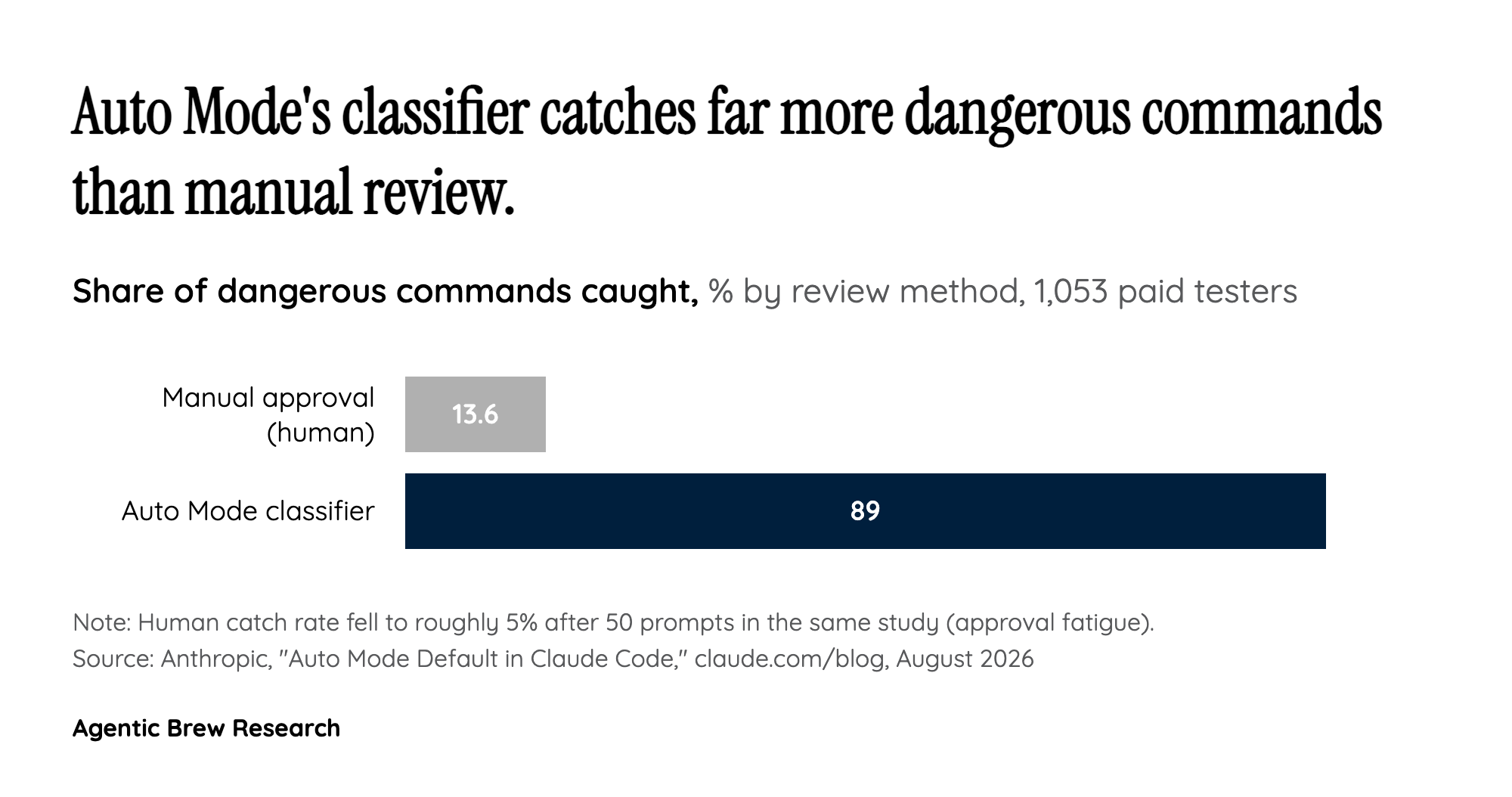
The 89 vs 13.6 Split That Made the Case
The 89 vs 13.6 Split That Made the Case
Auto Mode's classifier caught 89% of dangerous commands in Anthropic's study, versus 13.6% for manual human approval.

Anthropic didn't flip Auto Mode to default on a hunch. In a controlled study of 1,053 paid testers, human reviewers caught just 13.6% of dangerous commands under manual approval, a rate that fell to roughly 5% once a session had accumulated 50 prompts - the classic approval-fatigue curve. The separate classifier that now screens every risky tool call caught 89% of the same commands [1].

That gap sits next to a habit Anthropic's own telemetry surfaces: users approve 97% of permission prompts regardless of content, which makes the old safeguard closer to a formality than a real check [1]. An independent developer analysis made a blunter version of the same point months earlier, arguing the human-in-the-loop had effectively vanished before Auto Mode existed because manual prompts were routinely clicked through without scrutiny [2].

Anthropic frames the flip in outcome terms too: the share of sessions containing an unrequested harmful action fell from 6.3% under manual approval to 2.4% under Auto Mode, and Team and Enterprise customers running Auto Mode ship about 25% more pull requests than those who don't [1]. Trade press coverage corroborated the timeline and the headline classifier numbers ahead of the August 14 switch [3].
A Classifier That Never Sees Claude's Reasoning

The mechanism behind Auto Mode isn't Claude grading its own homework. Anthropic describes the classifier as a separate model that reviews only the user's messages and Claude's proposed tool calls - never Claude's internal reasoning - specifically watching for a proposed action that reaches further than what the user actually asked for. Not every action reaches the classifier: read-only or easily reversible steps skip review entirely, while shell commands, external network calls, and other higher-risk moves get screened first.

A second, independent layer scans any web page or file Claude fetches for hidden prompt-injection instructions before that content ever enters Claude's context window. Anthropic reports zero successful prompt-injection attacks against Claude models running with both layers active in its own testing, against a 5.83% success rate for a comparison model [1]. The guardrails extend past the classifier itself: Auto Mode ships with more than 20 built-in block rules covering force pushes, mass cloud-resource deletion, credential exfiltration, production deploys, and permission-escalation attempts [4].

The Same Exploit, Four Models, Two Vendors

The same window Anthropic published its safety numbers, security vendor Salt Security disclosed a remote-code-execution exploit against Claude Code's Auto Mode, affecting CLI versions 2.1.116 through 2.1.199 as well as Codex CLI 0.142.4 - and it worked, unmodified, against Claude Sonnet 4.6, Sonnet 5, Opus 4.8, and GPT-5.5, spanning two vendors and four model generations [5].

Salt Security CEO Roey Eliyahu argued the reproducibility is itself the finding: 'When the same attack works unchanged across two vendors and four model generations, you are not looking at a software bug - you are looking at a structural property' [5]. That's a harder problem than a single patch, and it sits uncomfortably next to Anthropic's own acknowledgment that its classifier reduces but does not eliminate risk.

A Feature That Can't Talk to the Mode Anthropic Just Defaulted

Auto Mode's default flip lands in the same window as a second, seemingly complementary feature: cross-session messaging, which lets one Claude Code session hand a plain-text note to another of a user's sessions - a status update or a warning about a breaking change - without sharing full conversation history or files, through new ListAgents and SendMessage tools [6].

Anthropic's own documentation draws a hard line around it: a message from another session can never substitute for user consent, cannot change permission settings or CLAUDE.md, and inbound messages are held or refused by default whenever the receiving session is running with permission prompts bypassed - a safeguard against one already-bypassed session directing another [6].

A related tension already shows up elsewhere in Claude Code's broader session-messaging ecosystem. Developer discussion on Reddit describes a separate, Desktop-native tool set - list_sessions, search_session_transcripts, send_message, archive_session - that requires Ask Permission or Accept Edits mode with a manual click to approve every single message, and explicitly does not work in Auto or Bypass mode. The tool names differ from the newly documented ListAgents/SendMessage pair, so it isn't clear the two are the same mechanism, but the pattern is instructive either way: session-to-session coordination features in Claude Code have a track record of assuming a human is present to click approve, the exact assumption Auto Mode is built to remove.

Enterprise Gets to Watch First

Anthropic isn't flipping the switch everywhere at once. The August 14 default applies only to Pro, Max, and Team plan sessions; Claude Enterprise, the Claude API, and cloud-partner platforms - AWS's Claude Platform, Amazon Bedrock, Google Cloud's Agent Platform, and Microsoft Foundry - keep Auto Mode as opt-in for now, with Anthropic saying it plans to make it the default there too within the coming month [1].

Anyone who had already pinned a different permission mode as their personal default gets, at most, a one-time prompt asking whether they want to switch; if a default is already pinned, nothing changes automatically [1]. The staggered rollout reads as a tacit acknowledgment that regulated and infrastructure-heavy environments warrant a longer review window before the default extends to them.

Historical Context

2026-03-24
Auto Mode for Claude Code launched as a research preview available only to the Team plan.
2026-07-10
Auto Mode reached general availability for all Claude Code users.
2026-08-07
Anthropic announced Auto Mode becoming the default permission mode for Pro, Max, and Team plans starting August 14, and dropped the classifier's token surcharge for those users.

Power Map

Key Players
Subject

Claude Code Auto Mode Default and Cross-Session Messaging

AN

Anthropic

Sets Claude Code's default behavior for all Pro/Max/Team users, built the classifier and cross-session messaging systems, and is absorbing the classifier's extra token cost for those plans - giving it direct control over both the safety tradeoff and its price.

PR

Pro, Max, and Team plan users

The first cohort moved onto Auto Mode by default starting August 14, 2026; anyone who hadn't already pinned a different permission mode inherits the new behavior with at most a one-time confirmation prompt.

CL

Claude Enterprise, API, and cloud-partner admins (AWS, Bedrock, Google Cloud Agent Platform, Microsoft Foundry)

Retain the ability to opt in or stay out of Auto Mode for now, giving regulated and infrastructure-heavy customers a review window before Anthropic extends the default there.

SA

Salt Security

Disclosed the remote-code-execution exploit against Claude Code's Auto Mode and is shaping the public security debate by arguing the flaw is structural rather than a single fixable bug.

Fact Check

6 cited
  1. [1] Auto Mode Default in Claude Code
  2. [2] Claude Code Auto Mode: The Absent Human
  3. [3] PSA: Claude Code Enabling Auto Mode as Default Next Week, Anthropic Says
  4. [4] Auto Mode
  5. [5] Developers Face RCE via Claude Code Auto Mode Exploit
  6. [6] Cross-Session Messaging

Source Articles

Top 1

THE SIGNAL.

Analysts

'When the same attack works unchanged across two vendors and four model generations, you are not looking at a software bug - you are looking at a structural property,' arguing any agent with credential or filesystem access carries the same risk.

Roey Eliyahu
CEO, Salt Security

Publicly endorsed Auto Mode as the team's own default workflow: 'The team and I use Auto mode exclusively, and have been for many months. I couldn't imagine going back to permission prompts!'

Boris Cherny
Engineering Lead, Claude Code, Anthropic

Welcomes Auto Mode for removing the need to babysit long-running coding sessions: 'You can now run Claude and actually walk away. Coffee break. Actual walk.'

Sid Chaudhary
Head of Product, Intempt

Frames Auto Mode as a shift in Claude's role from actor to approver of its own actions: 'With Auto Mode on, the AI is now the approver, not just the actor.'

Mykola Kondratiuk
Director, Playtika

Warns that the added autonomy and resilience Auto Mode introduces creates new security exposure: 'This is where resilience turns into a security problem.'

Mayank Agrawal
Lead Engineer, Zethra OS
The Crowd

Starting August 14, auto mode will be the default permission mode in Claude Code for Pro, Max, and Team users. Auto mode reviews shell commands and actions with a separate classifier. In testing, it caught 89% of dangerous commands. Manual approval caught 14%.

@@ClaudeDevs8265

New in Claude Code: your sessions can now message each other. Instead of having to re-explain yourself in another session, you can now tell Claude to do it. It sends a summary (not your history or files), and the other session picks it up mid-task.

@@ClaudeDevs28194

The team and I use Auto mode exclusively, and have been for many months. I couldn't imagine going back to permission prompts! Really excited to get this out to everyone.

@@bcherny1584

How do you get two claude code sessions to talk to each other?

@u/RoutineNet428340
Broadcast
How auto mode works with Claude Code

How auto mode works with Claude Code

Claude Code + iMessage is Finally Here.

Claude Code + iMessage is Finally Here.

Auto Claude: NEW Claude Auto-Mode is INSANE!

Auto Claude: NEW Claude Auto-Mode is INSANE!

Claude Code Auto Mode Default and Cross-Session Messaging — AI News | Agentic Brew