Perplexity's Portable Computer Local AI Agent Comes to Windows RTX PCs
TECH

Perplexity's Portable Computer Local AI Agent Comes to Windows RTX PCs

26+
Signals

Strategic Overview

  • 01.
    Perplexity's Portable Computer, the on-device version of its agentic Computer platform, is now available on Windows for compatible NVIDIA GeForce RTX PCs and RTX PRO Workstations.
  • 02.
    The feature originally launched on Linux and NVIDIA DGX Spark systems in August 2026, with Windows support following in September 2026.
  • 03.
    Windows RTX GPUs need a minimum of 24GB of VRAM to run Portable Computer, covering cards like the RTX 3090, RTX 4090, RTX 5090, and RTX PRO Blackwell workstation GPUs.
  • 04.
    Portable Computer is available to Perplexity Pro and Max subscribers, as well as Enterprise Pro and Enterprise Max plans, inside the existing Windows app via the Microsoft Store.

Local-First, Not Local-Only: How Portable Computer Routes Every Step

Portable Computer is the on-device version of Perplexity's agentic Computer platform, and its defining decision is where each step of a task actually executes. By default, every task starts on the device, using an NVIDIA GPU-accelerated local model to plan, retrieve files, and carry out multistep work without leaving the machine [1]. Work completed locally draws down zero Perplexity Computer billing credits, and the system only sends an individual step to a more powerful cloud model after the user explicitly grants permission for that step [2].

Perplexity's VP of Engineering for Infrastructure and Enterprise, Nate Kupp, says the local app 'carries the exact same UI as the original Computer platform and includes every feature needed for local inferencing' [4]- the goal being to remove the historical friction of standing up a local AI stack rather than ship a stripped-down companion app. That parity extends to the agent's reach: Portable Computer adds local MCP server support so it can drive other installed desktop apps on-device, plus a new scheduler that runs recurring tasks on the PC while the user is away, with out-of-the-box connectors for Google Drive, Gmail, Slack, GitHub, Outlook, OneDrive, Word, and PowerPoint [3]. That connector list continues a build-out Perplexity started months earlier, when Computer first shipped inside Microsoft Teams and then gained native add-in side panels for Word, Excel, PowerPoint, and Outlook [5].

Reception outside the official channels echoed that same emphasis on step-level routing rather than raw model quality: independent commentary on X.com zeroed in on the local/cloud step split as the notable design choice, while early hands-on reaction on YouTube was immediately enthusiastic about trying the on-device agent - though as with any day-one launch, that reaction is still first impressions rather than settled judgment.

Beats Rival Local Harnesses, Still Trails the Cloud

Beats Rival Local Harnesses, Still Trails the Cloud
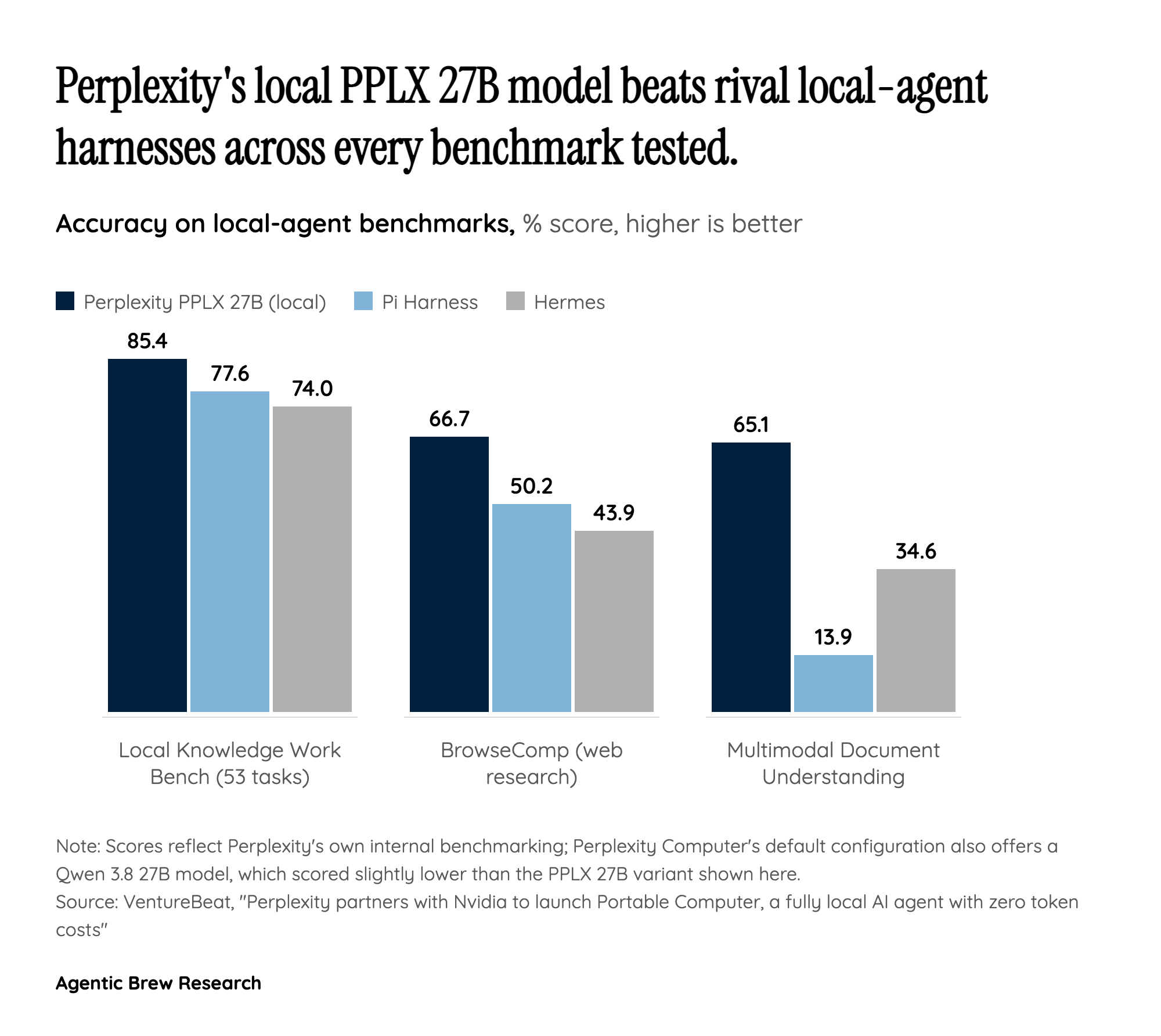
Perplexity's local PPLX 27B model beats rival local-agent harnesses across every benchmark tested.

Perplexity's own benchmarking positions Portable Computer as the strongest fully local agent harness available today, not merely a privacy-friendly downgrade. On a 53-task Local Knowledge Work Bench, Computer running Qwen 3.8 27B scored 82.6% versus 77.6% for Pi Harness and 74.0% for Hermes, and Perplexity's own post-trained PPLX 27B model pushed that to 85.4% [2]. On BrowseComp, a web-research benchmark, Portable Computer hit 66.7% accuracy against Pi Harness's 50.2% and Hermes's 43.9% - while using 51% less wall time and 70% fewer tokens than Pi [2]. A multimodal document-understanding test showed an even wider gap: 65.1% for Computer versus 34.6% for Hermes and just 13.9% for Pi [2].

The trade-off shows up clearly on harder, more agentic tasks. On Terminal Bench 2.1, a coding benchmark, the fully local Qwen configuration scored 59.6% at zero marginal cost; escalating to a cloud frontier model on the harder steps raised the score to 73.0%, but at roughly $0.415 per task [6]. That gap is the real product of Portable Computer's local-first routing - it isn't that local models are broadly competitive with frontier cloud models, it's that Perplexity's harness lets users buy back most of the capability gap selectively, task by task, instead of paying token costs on every single step.

Consent Isn't Control: Why Security Teams Aren't Convinced Yet

Enterprise security specialists reviewing Portable Computer's cloud-escalation design are not taking Perplexity's permission-prompt model at face value. Aman Mahapatra, Chief Strategy Officer at Tribeca Softtech, argues that running the control plane locally does shift the escalation decision on-device, but says the current mechanism is 'consent, not control' - it lacks egress proxies, DLP inspection, deterministic classification, and immutable audit logging that enterprises typically require before trusting an agent with sensitive data [7]. Justin Greis, CEO of Acceligence, frames the risk as a branding problem as much as a technical one, warning that 'local-first should not be confused with local-only' and that the distinction 'is going to matter tremendously' for organizations that assume the product never touches the cloud [7].

Perplexity disputes the sharpest version of that critique. Communications manager Beejoli Shah says content sitting in a local document 'can't authorize an escalation by itself, nor can it override product controls,' and that any escalation requires an explicit, single-use approval from the user [7]. Mike Wilkes, enterprise CISO at Aikido Security, complicates the picture further by noting that the obvious blunt fix - simply blocking the agent's network access - would defeat the product's usefulness, since he 'would not expect either the agents or their users to be particularly happy' with that trade-off [7]. The unresolved question is less about whether Portable Computer can be secured and more about whether a consumer-grade permission prompt is the right control surface for regulated enterprise data at all.

Who's Actually Paying for 'Free' Local AI

Portable Computer's zero-token-cost pitch obscures a real upfront bill. The minimum spec is a GPU with 24GB or more VRAM - RTX 3090, RTX 3090 Ti, RTX 4090, RTX 5090, or an RTX PRO Blackwell workstation card [8]- and NVIDIA's own DGX Spark, the system Portable Computer first launched on, costs roughly $4,699 [9]. Gartner VP analyst Nader Henein sums up the market skepticism bluntly: 'until we see the price, it's going to be hard to get excited about this' [7], while LexisNexis Risk Solutions Group CISO Flavio Villanustre points out that 'the hardware demands are quite steep, especially with the current hardware costs including RAM, GPU' [7].

That tension is already visible among people who cleared the hardware bar. Early adopters running the DGX Spark version report the app pulling in roughly 100GB of unified memory just to load a 30GB inference container and a 27GB local model - a serious commitment even on hardware built for the job - while others in the same community pushed back on the fact that work running entirely on a device they already purchased is still gated by a Perplexity subscription and credit allotment. NVIDIA is the clearest winner in that arrangement regardless of how the credit debate resolves: Portable Computer is a flagship reason to buy a high-VRAM RTX or RTX PRO card, converting Perplexity's local-AI pitch directly into GPU demand.

Historical Context

2025-07-09
Perplexity launched Comet, its AI-native Chromium browser, for Windows and macOS.
2025-10-02
Comet browser was made free worldwide, alongside a new background assistant for Max users.
2026-05-04
Perplexity first launched its Computer super-agent inside Microsoft Teams, letting users initiate projects within communication channels.
2026-05-28
Perplexity expanded Computer with native add-in side panels for Word, Excel, PowerPoint, and Outlook.
2026-08-25
Portable Computer launched for Linux and NVIDIA DGX Spark systems, offering fully local agentic AI with zero token costs for Pro/Max/Enterprise subscribers.
2026-09-14
Portable Computer expanded to Windows, supporting NVIDIA GeForce RTX and RTX PRO GPUs with 24GB or more VRAM.

Power Map

Key Players
Subject

Perplexity's Portable Computer Local AI Agent Comes to Windows RTX PCs

PE

Perplexity AI

Product owner and developer of Portable Computer and the underlying Computer agent platform; ships the Windows/Linux app and the PPLX 27B model, and controls the credit/subscription gate that governs cloud escalation.

NV

NVIDIA

Hardware and co-development partner supplying the GeForce RTX / RTX PRO GPUs, DGX Spark systems, and the upcoming Nemotron 3.5 Lightning model that Portable Computer runs on - a direct incentive to sell more high-VRAM GPUs.

EN

Enterprise security and compliance teams

Gate whether Portable Computer can be deployed on sensitive workflows; multiple CISOs and analysts have publicly challenged whether its permission-prompt escalation model meets enterprise control requirements.

PR

Pro/Max/Enterprise subscribers who already own qualifying hardware

End users who gain a lower-cost, higher-privacy way to run multistep agentic workflows without per-token cloud costs on hardware they already own.

Fact Check

10 cited
  1. [1] Perplexity Portable Computer Is Now Available on Windows, Powered by NVIDIA RTX
  2. [2] Perplexity partners with Nvidia to launch Portable Computer, a fully local AI agent with zero token costs
  3. [3] Perplexity Brings Portable Computer to Windows RTX PCs for Free Local AI
  4. [4] Perplexity and Nvidia Launch Portable Computer, a Local AI Agent for Nvidia GPUs
  5. [5] Perplexity's Computer Wasn't Always Planned
  6. [6] Perplexity Portable Computer Review: Local AI Agent, PPLX 27B and Real-World Performance (2026)
  7. [7] Perplexity's on-device AI offering promises data control and lower token costs
  8. [8] Nvidia Partners With Perplexity to Bring Portable Computer AI to Windows PCs on High-End RTX GPUs
  9. [9] Perplexity Portable Computer Pricing and the DGX Spark Bill
  10. [10] Perplexity Brings Its Local Portable Computer Agent to Windows PCs

Source Articles

Top 4

THE SIGNAL.

Analysts

Says the Windows app matches the cloud Computer experience exactly: it 'carries the exact same UI as the original Computer platform and includes every feature needed for local inferencing.'

Nate Kupp
VP Engineering, Infrastructure & Enterprise, Perplexity

Argues always-on local agents shouldn't be metered per token, framing the launch as a turning point: 'Local AI has reached an inflection point.'

Nader Khalil
Director, Developer Technology, NVIDIA

Skeptical the launch will generate real excitement until pricing is transparent: 'until we see the price, it's going to be hard to get excited about this.'

Nader Henein
VP Analyst, Gartner

Flags the 24GB VRAM requirement as a steep hardware barrier given current prices: 'the hardware demands are quite steep, especially with the current hardware costs including RAM, GPU.'

Flavio Villanustre
CISO, LexisNexis Risk Solutions Group

Argues the local escalation gate is 'consent, not control,' lacking egress proxies, DLP inspection, and audit logging enterprises typically require.

Aman Mahapatra
Chief Strategy Officer, Tribeca Softtech
The Crowd

Powerful AI agents are becoming easier to run right on your PC. ⚡ Together with @Perplexity_AI, we're making local AI more private, accessible and useful on @Windows NVIDIA RTX PCs. 👇

@@nvidia409

Portable Computer is now available on Windows PCs with @NVIDIA RTX GPUs. Run the harness, agents, and models locally on your PC. Work with local files and connected apps without sending tasks to the cloud. Use frontier cloud models when needed.

@@perplexity_ai530

Perplexity's Portable Computer is now available on Windows RTX PCs. The useful design choice is where each step runs. Local models can inspect files, combine information across documents and execute recurring workflows without consuming cloud credits. When a task needs stronger

@@KostyaAI5

Feedback on Perplexity Portable Computer with local inference

@u/nickinnov24
Broadcast
Portable Computer demo | Short Sessions

Portable Computer demo | Short Sessions

Why Are People Switching to Perplexity Computer All of the Sudden?

Why Are People Switching to Perplexity Computer All of the Sudden?

NEW Perplexity Portable Computer is SCARY GOOD!

NEW Perplexity Portable Computer is SCARY GOOD!