Meta's Muse Glimmer open-weight AI model release
TECH

Meta's Muse Glimmer open-weight AI model release

59+
Signals

Strategic Overview

  • 01.
    Meta released Muse Glimmer, a 30-billion-parameter open agentic AI model distilled from its flagship Muse Spark model, licensed under Apache 2.0, on August 10, 2026.
  • 02.
    The model is designed to run locally on a single consumer GPU or Mac, quantized to roughly 4-bit (under 20GB), fitting a 24-32GB memory envelope including KV cache and speculative decoding.
  • 03.
    Muse Spark 1.2 and the Muse Code agent originally launched closed-source on August 5, 2026; five days later Meta reversed course and committed to open-sourcing Muse Spark 1.2's weights alongside the Glimmer release.
  • 04.
    Mark Zuckerberg personally announced the releases, calling Glimmer 'a great 30B parameter dense model that can run locally' and confirming Muse Spark 1.2's weights would follow soon.

The Five-Day U-Turn

On August 5, Meta launched Muse Spark 1.2 and its Muse Code agent as fully closed products - proprietary binary, no open weights, and a paid API contributor tier [1]. Five days later, the company reversed course, releasing Muse Glimmer's weights under Apache 2.0 and publicly committing to open-source Muse Spark 1.2 as well [2]. The about-face lands right after Llama 4's lukewarm reception, when critics said Meta's 'open' branding no longer matched the openness of the license, denting the credibility Meta had built since Llama 2 [2]. Reading the two moves together, Muse Spark's closed launch looks less like a settled strategy and more like a five-day experiment that got walked back the moment developer backlash - and the optics of ceding open-source ground to Chinese labs - made closing the model too costly to sustain.

Winning on Memory, Not the Leaderboard

Muse Glimmer's headline spec isn't a benchmark score - it's the memory budget. Meta compresses the 30B dense model to roughly 4-bit (under 20GB) and pairs it with block-level speculative decoding so it still answers fast enough to sit inside a live agent loop, while the full-precision checkpoint runs past 55GB [3]. Published DFlash speculative-decoding numbers show a 3.1x speedup on an RTX 5090 and 1.8x on an Apple M5-Max [4], and Meta says a single GPU can push 20,000 tokens per second on Blackwell Ultra silicon [5]. Both NVIDIA and AMD moved fast to formalize that story: NVIDIA shipped NIM containers and a hosted endpoint tuned for RTX 5090, DGX Spark, and Jetson [5], while AMD published its own guide for running the 30B model on Ryzen AI Max 'Agentic PCs' and Radeon GPUs [6]. The real pitch to developers isn't that Glimmer wins every benchmark - it's that it's a rare 30B-class model built to fit a machine they already own.

The China Card

Zuckerberg didn't just ship a model - he published an argument. Alongside the Glimmer release, he wrote that American labs face training-data restrictions foreign labs don't, and that U.S. policy 'must reduce this additional friction if we want American open source models to lead over time' [8], a point he repeated across the release-day press cycle [7]. Analysts framed the releases in exactly that competitive light: Counterpoint's Neil Shah argued that if Western giants only build closed systems, 'developers and enterprise builders will naturally pivot to Chinese open-weight models' [9], while Gartner's Arun Chandrasekaran described Glimmer more modestly as 'a very lean, lightweight model that primarily runs on your desktop' [11]. The benchmarks back up the framing only partway - Meta pits Glimmer directly against Alibaba's Qwen3.6-27B and claims a win over Google's Gemma4-31B on most tests [10]- but the larger Chinese frontier models Zuckerberg is really worried about are a different weight class entirely and untouched by this release.

Where the Official Numbers and the Real World Diverge

Where the Official Numbers and the Real World Diverge
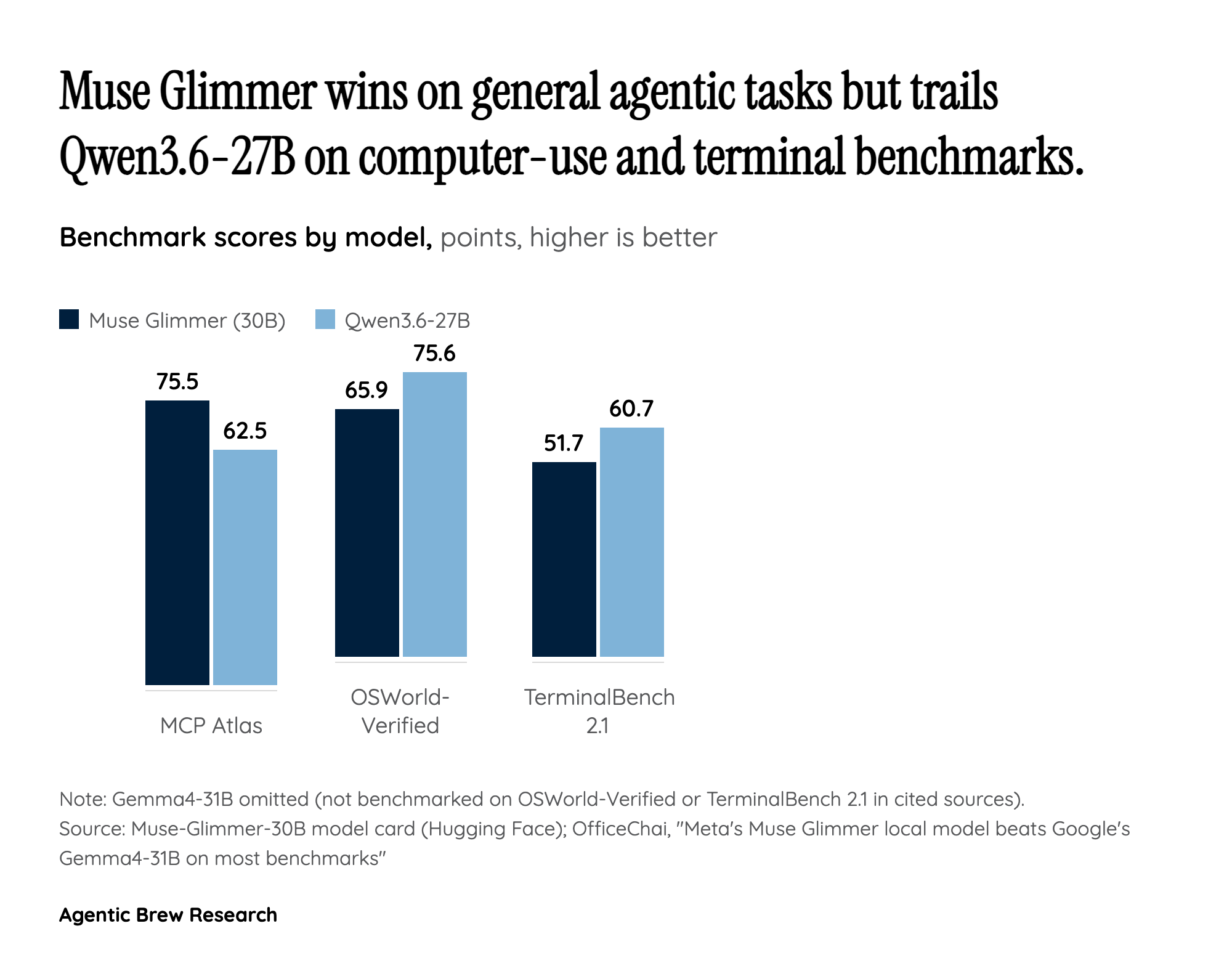
Muse Glimmer beats Qwen3.6-27B on MCP Atlas but trails it on OSWorld-Verified and TerminalBench 2.1 - the mixed benchmark picture behind the "official numbers vs real world" divide.

Meta's own scorecard is strong: MCP Atlas 75.5 against Gemma4-31B's 54.2 and Qwen3.6-27B's 62.5, plus a 76.0 on SWE-Bench Verified and 94.7 on AIME 2026 [4]. But Meta's benchmarks aren't unanimous even on paper - Qwen3.6-27B leads Glimmer on OSWorld-Verified and TerminalBench 2.1 [10]- and independent coverage has already flagged that gap as evidence the mid-size open-weight race is closer than Meta's headline chart suggests [2]. That tension shows up again once the model reaches practitioners: hands-on testing on Bijan Bowen's YouTube channel found Glimmer genuinely completing agentic coding tasks on a single consumer GPU, though with inconsistent quality, while Sam Witteveen's technical breakdown benchmarked Glimmer specifically against Qwen 3.8 and flagged uncertainty about whether Glimmer holds its edge once more Qwen 3.8 variants ship. The pattern across community testing is consistent: strong on efficiency and context length, uneven on task completion - a split no single benchmark table captures. The same split shows up on Reddit: r/LocalLLaMA user u/coder543 confirmed Glimmer's efficiency claim firsthand, fitting the full context window plus DFlash and the multimodal projector into roughly 22-23GB on a single RTX 3090 - something neither Qwen3.6-27B nor Gemma4-31B could match at comparable context lengths - even as other users in the same thread reported disappointing coding results and a CUDA-version-dependent bug. Two independent platforms, one identical fault line: real efficiency wins paired with inconsistent task completion.

Historical Context

2023-02
Meta released Llama 1, its first open(-ish) large language model, breaking from the closed-source norm set by OpenAI and Google.
2023-07-18
Meta released Llama 2 free for research and commercial use, a decision Zuckerberg made personally on the belief that openness accelerates ecosystem progress.
2024-07
Meta released Llama 3.1 405B, described by Zuckerberg as the first frontier-level open source AI model.
2025-04
Meta released Llama 4, which critics said fell short of true open-source standards and underperformed rival closed models, denting confidence in Meta's open-source commitment.
2026-07
Muse Spark launched as Meta's first fully proprietary, closed, paid-access model, marking a break from the Llama-era open strategy.
2026-08-05
Muse Spark 1.2 and the Muse Code agent launched closed-source, with a proprietary binary and paid API contributor tier.
2026-08-10
Meta released Muse Glimmer's weights under Apache 2.0 and announced it will also open-source Muse Spark 1.2, reversing course five days after Spark 1.2 launched closed.

Power Map

Key Players
Subject

Meta's Muse Glimmer open-weight AI model release

ME

Meta / Mark Zuckerberg

Publisher of Muse Glimmer and pledged publisher of Muse Spark 1.2 weights; Zuckerberg personally announced the releases and published policy arguments urging U.S. government support for American open-source AI to compete with Chinese labs.

ME

Meta Superintelligence Labs (led by Alexandr Wang)

Internal Meta research unit that built Muse Spark and Muse Glimmer; responsible for the technical distillation of Glimmer from Muse Spark and for Meta's broader model strategy pivot.

NV

NVIDIA and AMD

Hardware partners that moved quickly to formalize on-device support: NVIDIA shipped NIM containers, SGLang/vLLM inference stacks, and a hosted endpoint tuned for RTX 5090, DGX Spark, and Jetson; AMD published its own guide for Ryzen AI Max 'Agentic PCs' and Radeon GPUs.

HU

Hugging Face / Ollama / LM Studio / Unsloth / Together AI / Fireworks AI / OpenRouter

Distribution and inference partners hosting Muse Glimmer weights and quantized (GGUF) builds, enabling immediate developer access across cloud and local runtimes.

CH

Chinese AI labs (DeepSeek, Moonshot AI, Alibaba/Qwen)

Named by Zuckerberg as the competitive rationale for Meta's open-source push; Glimmer benchmarks are explicitly compared against Alibaba's Qwen3.6-27B, while larger Chinese frontier models remain out of Glimmer's weight class.

GO

Google (Gemma)

Competitor whose similarly-sized Gemma4-31B model is benchmarked against Glimmer; Meta claims Glimmer beats Gemma in most tested scenarios.

Fact Check

12 cited
  1. [1] Meta releases open-weight Muse Glimmer model, open Muse Spark 1.2 tap
  2. [2] Zuck rekindles open-weights llama drama with Muse Glimmer
  3. [3] Introducing Muse Glimmer: an open agentic model
  4. [4] Muse-Glimmer-30B model card
  5. [5] Run local agentic AI workflows with Meta's Muse Glimmer on NVIDIA
  6. [6] Run Meta Muse Glimmer 30B on AMD Ryzen AI Max and Radeon GPUs
  7. [7] Meta brandishes open source AI models again as Zuckerberg media blitz emphasizes battle against Chinese rivals
  8. [8] Meta open source AI model Muse Spark
  9. [9] Meta Muse Glimmer open weight AI
  10. [10] Meta's Muse Glimmer local model beats Google's Gemma4-31B on most benchmarks
  11. [11] Meta unveils Muse Glimmer
  12. [12] Muse Glimmer

Source Articles

Top 5

THE SIGNAL.

Analysts

Argues that if Western tech giants only build closed systems, developers will pivot to Chinese open-weight models, and that on-device small agentic models let Meta bypass cloud compute costs to outcompete Google and Microsoft on-device.

Neil Shah
Co-founder, Counterpoint Research

Characterizes Glimmer as a lean, lightweight, desktop-oriented model distinct in scale from larger Chinese frontier competitors.

Arun Chandrasekaran
Analyst, Gartner

Argues restricting access to foreign open-source models is not an effective policy response, and that U.S. policy should instead reduce restrictions on American labs so U.S. open-source models can lead globally.

Mark Zuckerberg
CEO, Meta
The Crowd

Today we're also opening the weights for Muse Glimmer, a great 30B parameter dense model that can run locally. Soon we'll also release the weights for Muse Spark 1.2, our latest foundation model. Meta is a strong supporter of open source and I'm proud of these releases. Congrats

@@finkd26056

Introducing Muse Glimmer, an open-weight 30B-parameter model optimized for local, always-on agent workflows. Muse Glimmer delivers strong performance on key agentic use cases and benchmarks compared with leading models in its size category, and is designed to run entirely on...

@@AIatMeta6888

Muse Glimmer, A 30B parameter dense model swallowing a 130,000 token context window using only 19.3 GB of VRAM (extreme efficiency). No KV cache quantization required. I just benched the new Muse Glimmer 30B (dense) on a single RTX 4090. We are pulling 3,100+ t/s prefill and 75...

@@analogalok219

Introducing Muse Glimmer: an open-weight model optimized for always-on local agent workflows

@u/AIatMeta1500
Broadcast
Meta Muse Code Is HERE – Spark 1.2 & Meta's NEW Coding Agent!

Meta Muse Code Is HERE – Spark 1.2 & Meta's NEW Coding Agent!

Meta Open Source Is BACK – Muse Glimmer First Test!

Meta Open Source Is BACK – Muse Glimmer First Test!

Meta's Open Weight - Muse Glimmer 30B

Meta's Open Weight - Muse Glimmer 30B