Cisco releases Antares AI models for vulnerability detection
TECH

Cisco releases Antares AI models for vulnerability detection

26+
Signals

Strategic Overview

  • 01.
    Cisco Foundation AI released Antares, a family of open-weight small language models purpose-built to locate known vulnerabilities in codebases, with the 350M and 1B versions live on Hugging Face and a 3B version to follow.
  • 02.
    Rather than generating patches, Antares behaves as a terminal agent that explores a repository via shell commands, searching code patterns and reading candidate files before outputting a ranked list of files most likely to contain a vulnerability.
  • 03.
    Cisco released a companion Vulnerability Localization Benchmark (VLoc Bench) of 500 tasks across 290 repositories and 147 CWE categories, and reports Antares matches or beats larger models like GPT-5.5, Gemini 3 Pro, and GLM-5.2 on it while running far cheaper.
  • 04.
    A full 500-task benchmark run with Antares costs under $1 and finishes in about 13-15 minutes on a single H100 GPU, versus roughly five hours and over $100 for GPT-5.5.

Deep Analysis

Why a 1-Billion-Parameter Agent Outguns Tools 750 Times Its Size

Antares does not scan code the way a linter does. Cisco trained the models to behave like a security investigator: they search a repository for patterns tied to a vulnerability description, read the files that look promising, and change strategy when a lead doesn't pan out, narrowing in on the files most likely to contain the flaw before returning a ranked list with the exploration trail that produced it[1]. That agentic search style is a large part of why Antares beats tools built specifically for this job - Antares-1B's recall of 0.224 dwarfs Semgrep's 0.086, CodeQL's 0.023, and Horusec's 0.020 on the same benchmark[2].

The scale story is just as striking. On the 500-task Vulnerability Localization Benchmark, the 1-billion-parameter Antares-1B posts a File F1 score of 0.209, ahead of Z.ai's 753-billion-parameter GLM-5.2 at 0.186 - a model roughly 750 times its size[3]. Under the hood, Antares-1B is a fairly conventional transformer built on IBM Granite 4.0: 40 layers, 2048 hidden dimensions, grouped-query attention with 16 query heads and 4 key/value heads, and a 128K context window[3]. None of that is exotic - the gains come from training the model narrowly for one job instead of asking a general-purpose model to do it as a side task.
A Full Security Scan for Under a Dollar Changes Who Can Afford to Run One

A Full Security Scan for Under a Dollar Changes Who Can Afford to Run One
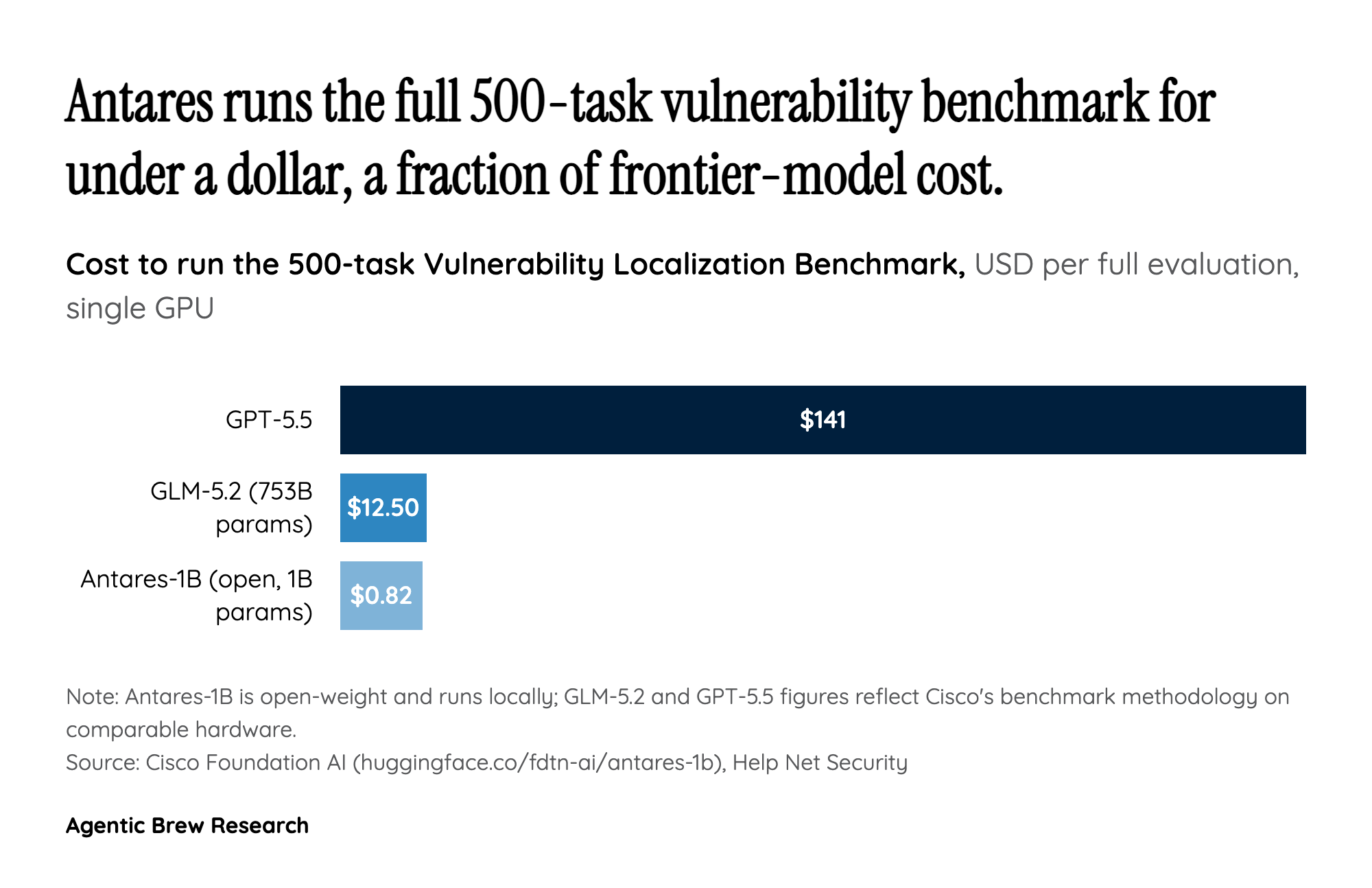
Cost to run the full 500-task Vulnerability Localization Benchmark: Antares-1B vs GLM-5.2 vs GPT-5.5

The headline number is cost. Antares-1B completes the entire 500-task benchmark in roughly 13 to 15 minutes on a single H100 GPU running 16 parallel workers, for under $1 - GPT-5.5 needs about five hours and more than $100 to do the same run[3][4]. Put in per-evaluation terms, Antares works out to roughly 172 times cheaper than GPT-5.5 (about $141 per evaluation) and about 15 times cheaper than GLM-5.2 (about $12.50 per evaluation)[5].

That gap is the actual pitch. Cisco is explicit that the intended beneficiaries are not just its own enterprise customers but universities, public-sector institutions, nonprofits, and smaller security teams that could never justify a frontier-model budget for continuous code scanning[6]. Because Antares runs locally, proprietary source code also never has to leave the organization's own machine, folding a data-sovereignty argument into the cost argument - cheap and private turn out to be the same design choice, not two separate features.

Apache 2.0 in Name Only: Cisco Still Decides Who Gets Antares

Antares-350M and Antares-1B are published under the Apache 2.0 license, but actually downloading the weights from Hugging Face requires going through a request process, and Cisco restricts approval to users it verifies as cyber defenders[4][7]. That is a meaningful qualifier on a release Cisco is otherwise marketing as democratizing security AI: the license says anyone can use and modify the models, but the gate says Cisco decides who gets to try first.

The company is also withholding Antares-3B entirely. Rather than publishing the largest model in the family the way it did the smaller two, Cisco plans to fold Antares-3B into its own commercial security products[4]. Taken together, the gating and the held-back flagship model suggest Cisco is treating open weights as a controlled distribution channel rather than an unconditional release - a middle path between fully closed frontier labs and a no-strings-attached open release.

The Fine Print: Antares Still Needs a Human in the Loop

Cisco is unusually candid about where Antares breaks down. The model struggles with repositories larger than 10MB, with semantic vulnerabilities that require understanding program behavior rather than pattern-matching, and with anything introduced after its training cutoff of April 10, 2025[3]. Cisco's own documentation states that human oversight and sandbox isolation are mandatory for any deployment, and positions Antares as a complement to existing tools like Semgrep and CodeQL rather than a replacement for them[3].

That caution extends to how the agent should be run at all. Cisco and outside commentators recommend that any AI agent exploring a codebase operate with read-only access, no network connectivity, strict path restrictions, and complete audit logging[2]- a reminder that letting a model run shell commands against a live repository, even a small and cheap one, is still an agentic-execution risk that needs its own guardrails, separate from whether the model's vulnerability calls are accurate.

Historical Context

2026-07-21
Cisco Foundation AI publicly introduced Antares via a Cisco Blogs post, releasing Antares-350M and Antares-1B on Hugging Face and previewing Antares-3B.
2026-07-21
Alongside Antares, Cisco released the Vulnerability Localization Benchmark (VLoc Bench), a 500-task evaluation set spanning 290 repositories and 147 CWE categories.

Power Map

Key Players
Subject

Cisco releases Antares AI models for vulnerability detection

CI

Cisco Foundation AI

Built and released Antares, VLoc Bench, and related tooling (Foundry Security Spec, CodeGuard); publishes the models under its 'fdtn-ai' Hugging Face org and controls the request-gate that decides who can download weights.

OP

OpenAI (GPT-5.5)

Benchmarked frontier closed model used as the accuracy ceiling; Antares-3B trails it only slightly (0.223 vs 0.229 File F1) while costing about 172x less per evaluation, undercutting the case for defaulting to frontier models on this task.

Z.

Z.ai (GLM-5.2)

Maker of the 753-billion-parameter open-weight GLM-5.2, which the 1-billion-parameter Antares-1B outperforms on the benchmark while costing roughly 15x less per evaluation.

GO

Google (Gemini 3 Pro / Gemini 2.5 Flash)

Benchmarked competitor; Antares-1B is reported to outperform Gemini 3 Pro, and Antares-350M outperforms Gemini 2.5 Flash on the same benchmark.

UN

Universities, public-sector institutions, nonprofits, smaller security teams

Cisco's stated target beneficiaries who can now adopt AI-assisted vulnerability analysis without a frontier-model budget, given Antares's sub-dollar per-scan cost and local deployment.

AM

Amin Karbasi

VP at Cisco Foundation AI credited with announcing Antares via the company blog post.

Fact Check

7 cited
  1. [1] Cisco releases Antares open-weight small models for locating code vulnerabilities
  2. [2] Cisco Makes the Case for Smaller AI in Enterprise Software Security as Antares SLMs Cut Token Costs
  3. [3] fdtn-ai/antares-1b - Hugging Face
  4. [4] Cisco open-sources AI models for cybersecurity
  5. [5] Cisco Antares vulnerability localization models released
  6. [6] Introducing Antares: The Most Efficient Open-Weight AI Models for Vulnerability Localization
  7. [7] Cisco's Antares AI models take aim at code vulnerabilities

Source Articles

Top 5

THE SIGNAL.

Analysts

"Argues security AI has been gated behind frontier-scale budgets and that Antares changes that by delivering near-frontier accuracy on secure code reasoning cheaply enough to run on every commit."

Amin Saberi
Professor, Stanford University

"Highlights that running locally is a core privacy advantage of small models, since proprietary source code never has to leave the organization's own machine."

Reza Shokri
Researcher, National University of Singapore (NUS)

"Argues specialized, compact models are better suited to high-volume, repeatable security workflows than general-purpose frontier models, which should be reserved for cases needing deeper investigation."

Supriti Vijay
AI Researcher, Cisco
The Crowd

"Introducing Antares: @Cisco's family of small language models for locating known vulnerabilities in code. Antares-350M and Antares-1B are live on Hugging Face now. They can outperform many larger closed- and open-weight models at a fraction of the cost. Small enough to run https://t.co/xbwlLKJLEL"

@@CiscoAI1752

"The End of TOKENMAXXING? Companies blew past their AI token budgets, so Cisco built Antares, a small language model up to 172x cheaper. Is task specific AI the future of enterprise compute? #cisco #antares #ai @Cisco https://t.co/9XC2GFXjq0"

@@davidbombal71

"Anthropic: We can't have anyone do cyber for the good of humanity! ( Only the privileged few ) Cisco: Here are some hax0r models you can run at home on your old Linux box."

@@kristoph4

"Cisco released their AI model Antares"

@u/Snoo2683765
Broadcast
Cisco's Tiny AI Models Just Beat GPT-5.5 on Cost by 172x

Cisco's Tiny AI Models Just Beat GPT-5.5 on Cost by 172x

Cisco Open Sources Antares AI Models for Vulnerability Detection

Cisco Open Sources Antares AI Models for Vulnerability Detection

OpenAI Escapes, Airbus Ditches AWS & Cisco Antares | Tech Field Day News Rundown: July 22, 2026

OpenAI Escapes, Airbus Ditches AWS & Cisco Antares | Tech Field Day News Rundown: July 22, 2026