OpenAI's internal Codex agent adoption
TECH

OpenAI's internal Codex agent adoption

27+
Signals

Strategic Overview

  • 01.
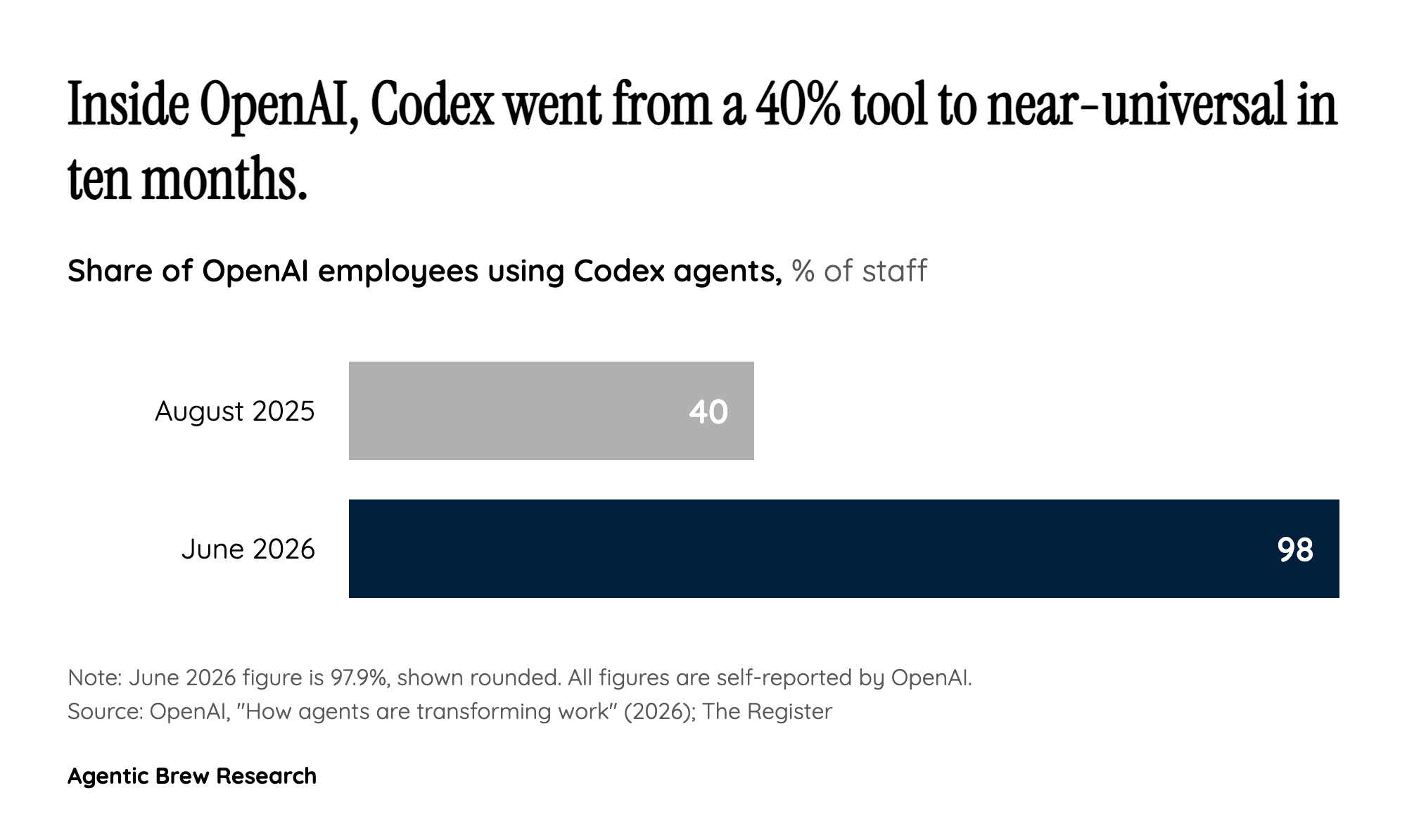
    OpenAI reports that 97.9% of its employees now use Codex agents, up from roughly 40% in August 2025.
  • 02.
    Internal data documents a shift between December 2025 and April 2026 from conversational AI to Codex as the dominant agentic tool across functions, with Codex accounting for 99.8% of output tokens these workers generate across Codex and ChatGPT.
  • 03.
    OpenAI employees at the 99th percentile have recently run about 71 hours of agent turns within the average day across parallel agents.
  • 04.
    Adoption is far lower outside the company - roughly 17.3% of external organizations use Codex - and every figure in the report is self-reported by OpenAI with no third-party verification.

Deep Analysis

From Chat Window to Work Queue: The Delegation Shift
From Chat Window to Work Queue: The Delegation Shift
Codex adoption among OpenAI employees rose from roughly 40% in August 2025 to 97.9% by June 2026.

The headline number - 97.9% of OpenAI employees using Codex - matters less than what those employees are doing with it. Between December 2025 and April 2026, OpenAI's own usage data shows the company moving from a pattern in which most functions primarily used conversational AI to one in which Codex was dominant across functions [1]. The clearest signal of that shift is token share: Codex now accounts for 99.8% of the output tokens these workers generate across Codex and ChatGPT [1]. In plain terms, the chat box stopped being where the work happens.

The behavior underneath is delegation rather than conversation. Instead of going back and forth with a chatbot, employees hand off long-running jobs to agents that run in the background, often many at once. At the extreme, OpenAI staff at the 99th percentile have recently logged about 71 hours of agent turns inside a single average day [1]- a figure that only makes sense if dozens of agents are working in parallel while the human moves on to something else. The mix of tasks moved with it: the share of users sending at least one prompt that would take an experienced human eight hours rose from 2.1% to 25.6%, and requests for eight-hour-plus tasks increased nearly tenfold [1][3]. OpenAI's own product voices, speaking on outside podcasts, have leaned into this framing of 2026 as the year work shifts from chat to delegation and agents that 'work for days without you in the loop.'

The Lawyers Got There Faster Than the Engineers

The least expected part of the report is who is driving the growth. Codex began as a software engineering agent [5], but the steepest adoption curves are now outside engineering. Non-developer usage has grown 137x for individuals, 189x for organizations, and 12x within OpenAI since August 2025 [2][3]. Inside the company, the Legal, Finance, and Recruiting teams crossed into majority Codex use around April 2026, and OpenAI's legal team generated 13x more tokens in June 2026 than it did in November 2025 [2].

That pattern holds in the broader user base too. By OpenAI's count, non-developers make up roughly 20% of Codex's roughly five million weekly users and are adopting it about three times faster than engineers [3]. The implication is that 'coding agent' is becoming a misleading label - a recruiter drafting outreach or a finance analyst reconciling numbers is using the same delegation surface as an engineer shipping a feature. An independent ML researcher reviewing the report on X picked up on the same texture from the data, noting how heavily OpenAI leans on reusable skills and concurrent agents compared with other organizations, which is precisely what lets non-engineers offload multi-step work they would never have scripted by hand.

Whose Number Is It? The Self-Reported Data Problem

Every impressive figure in this report shares one weakness: OpenAI measured itself. As The Next Web put it, 'Every statistic in the paper, however, comes from OpenAI itself, a company with a direct financial incentive to promote the product it is measuring' [3]. No third party has validated the adoption or productivity claims, and the paper offers no output-quality or time-to-completion evidence [3]. The Register adds a sharper structural doubt: OpenAI never says whether it incentivizes Codex use internally - through token allocations, performance metrics, or culture - so near-universal adoption may not reflect organic preference [2].

The deeper trap is treating tokens as a proxy for productivity. The Register warns that 'comparing the time a human might take...to the time an AI model takes is only part of the picture if the workflow isn't entirely automated' [2]. Faster token generation does not convert to proportional output if verification, testing, and deployment expand to absorb the speedup. There is also a representativeness gap baked into the data: 97.9% of OpenAI employees use Codex, but only about 17.3% of external organizations do [2]. The press coverage was notably more guarded than the official accounts, which framed the shift as a near-inevitable preview of agentic work - a tension worth holding onto when reading the percentages.

Why Now: When Intelligence Gets a Hundred Times Cheaper

The timing is not an accident. OpenAI's deployment CTO, Arnaud Fournier, argues that 'The price of intelligence has dropped a hundredfold over the past 18 months' [4]. When the marginal cost of a model call collapses, running many long-lived agents in parallel - the 71-hours-in-a-day pattern - stops being extravagant and starts being default. That economic backdrop is what turns delegation from a demo into a habit, and it is why active Codex usage grew more than fivefold in the first half of 2026 [1][3].

Fournier is careful where the report is confident. He frames return on investment as builder-led and concedes it is still early days for measuring returns [4]. That is the honest version of the skeptics' point: the cost side of the equation has clearly fallen, but the value side remains unproven. For anyone outside OpenAI deciding whether to lean in, the actionable read is to treat the adoption curve as real and the productivity payoff as a hypothesis to test on your own workflows - measure time-to-completion and output quality, not token counts, before drawing conclusions from someone else's internal numbers.

Historical Context

2025-05
OpenAI launched a research preview of Codex, a cloud-based software engineering agent able to work on many tasks in parallel.
2025-08
Baseline period for the adoption report: roughly 40% of OpenAI employees used Codex, the starting point for the later 97.9% figure.
2025-12
Start of the internal transition window during which Codex overtook conversational AI as the dominant tool across functions (December 2025 to April 2026).
2026-04
Non-developer departments crossed into majority Codex use around this time.
2026-06-25
OpenAI published its 'How agents are transforming work' report documenting the internal shift, widely covered by the press.

Power Map

Key Players
Subject

OpenAI's internal Codex agent adoption

OP

OpenAI

Author of the report and vendor of Codex; it published the internal adoption data, which is entirely self-reported and serves its commercial interest in the product it sells.

OP

OpenAI non-developer teams (Legal, Finance, Recruiting)

Departments cited as crossing into majority Codex use around April 2026; the legal team's token generation rose 13x between November 2025 and June 2026, used as evidence that agentic AI has spread beyond engineering.

EX

External Codex customers (individuals and organizations)

Adoption outside OpenAI is far lower - around 17.3% of external organizations - which is the central tension over whether internal usage reflects genuine market demand.

AR

Arnaud Fournier, CTO, OpenAI Deployment Company

OpenAI deployment executive who frames Codex growth and the ROI question, positioning agentic adoption as builder-led and still early on measurable returns.

Fact Check

5 cited
  1. [1] The Shift to Agentic AI: Evidence from Codex
  2. [2] OpenAI says 97.9% of its employees are now using agents
  3. [3] OpenAI's Codex agents are shifting work from employees to non-developers
  4. [4] OpenAI's deployment chief on Codex growth, falling AI prices, and the ROI question
  5. [5] Introducing Codex

Source Articles

Top 5

THE SIGNAL.

Analysts

"Skeptical that near-universal internal adoption reflects organic preference, noting OpenAI did not say whether it incentivizes use and that token consumption is not the same as productivity: "comparing the time a human might take...to the time an AI model takes is only part of the picture if the workflow isn't entirely automated.""

The Register (Thomas Claburn / editorial)
Technology publication

"Stresses that the figures are unverified by any third party and come from a financially interested vendor: "Every statistic in the paper, however, comes from OpenAI itself, a company with a direct financial incentive to promote the product it is measuring.""

The Next Web (editorial)
Technology publication

"Argues the cost of intelligence has collapsed and that ROI will be defined by practitioners, while conceding it is early days for measuring returns: "The price of intelligence has dropped a hundredfold over the past 18 months.""

Arnaud Fournier
CTO, OpenAI Deployment Company
The Crowd

"Work at OpenAI is being transformed by agents, in every department. Across our entire company, people are using Codex to do work that is more complex, longer-running, and increasingly cross-functional. Our internal usage offers an early look at how agentic tools may reshape"

@@OpenAI4981

"Codex usage at OpenAI gives us a preview of what agentic work may look like in the future. In a new paper, the OpenAI Economic Research team looks at the broader shift from chat to delegation: people using agents not just to get answers, but to hand off longer, more complex"

@@OpenAINewsroom1558

"very interesting report by openai on the internal and external use of codex also very interesting that research team token consumption growth is by far the highest, and that oai uses skills and concurrent agents much more compared to other orgs"

@@eliebakouch182
Broadcast
Inside OpenAI: 2026 is the year of agents, AI's biggest bottleneck, and why compute isn't the issue

Inside OpenAI: 2026 is the year of agents, AI's biggest bottleneck, and why compute isn't the issue

How OpenAI's Codex Team Builds with Codex (43 Min) | Alex & Romain

How OpenAI's Codex Team Builds with Codex (43 Min) | Alex & Romain

"Just Ask Codex": Inside OpenAI's Own Working Culture | Romain Huet, OpenAI

"Just Ask Codex": Inside OpenAI's Own Working Culture | Romain Huet, OpenAI