NVIDIA BioNeMo Agent Toolkit for AI-driven drug discovery
TECH

NVIDIA BioNeMo Agent Toolkit for AI-driven drug discovery

29+
Signals

Strategic Overview

  • 01.
    NVIDIA announced the BioNeMo Agent Toolkit on June 23, 2026 at the BIO International Convention, giving AI agents domain-specific tools and skills to gather evidence, run computational experiments, and recommend next steps across life sciences.
  • 02.
    The toolkit is agent-agnostic: NVIDIA supplies tools to agents rather than building agents itself, so it works with any agent or AI platform.
  • 03.
    Core use cases include virtual screening for small-molecule drug candidates, which compresses screening timelines from days to minutes, alongside genomic analysis, protein binder design, and medical imaging.
  • 04.
    Over 50 leading companies, including OpenAI, Anthropic, Eli Lilly, Databricks, and Schrodinger, were already using or adopting the toolkit at launch.

Selling Shovels to the Gold Miners It Competes With

The most revealing thing about the BioNeMo Agent Toolkit is what NVIDIA chose not to build. "We're not even building agents," the company said plainly at BIO 2026; the product is a set of tools handed to agents, and it is agent-agnostic, working with any agent or AI platform [1]. That single design decision is the whole strategy. Rather than competing to build the best AI scientist, NVIDIA is positioning itself as the layer of GPU-accelerated scientific instruments that sits underneath everyone's AI scientist.

The launch roster makes the play obvious. Among the 50-plus companies adopting the toolkit are OpenAI and Anthropic [2]— frontier labs that are, in every other arena, NVIDIA's most ambitious customers and, increasingly, its rivals on the model layer. By staying tool-focused, NVIDIA captures value no matter which lab's agent wins. Whether the breakthrough drug candidate comes from an OpenAI agent, an Eli Lilly internal workflow, or Schrodinger's new discovery agent Bunsen, the docking, screening, and protein-design work runs on NVIDIA tools and, by extension, NVIDIA hardware [1].
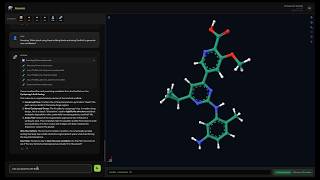
The Business Model Is Idle Time

The Business Model Is Idle Time
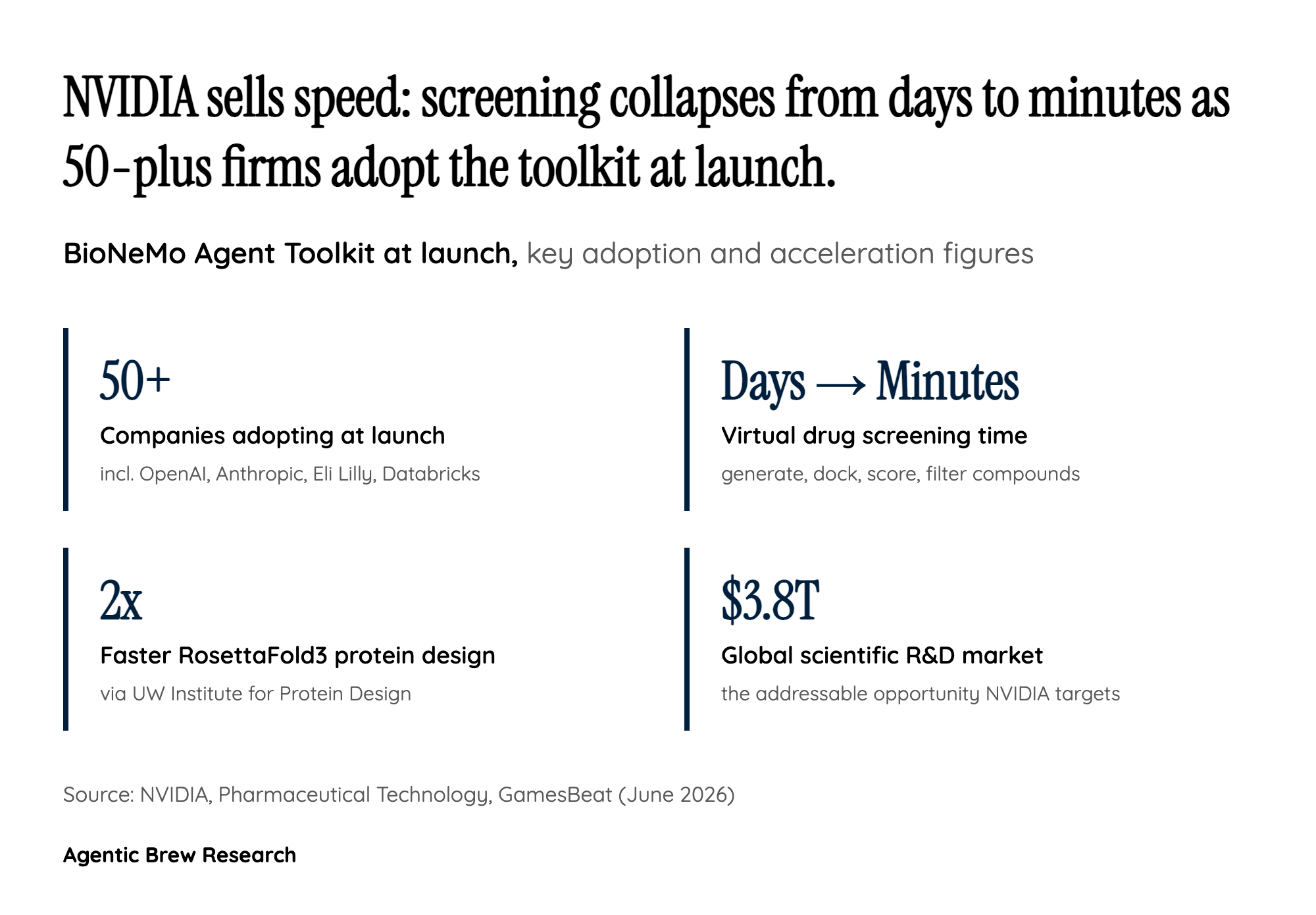
BioNeMo Agent Toolkit at launch: key adoption and acceleration figures.

Underneath the science framing is a precise commercial argument, and NVIDIA's VP of Healthcare Kimberly Powell stated it almost too candidly: "In the world of agents, the longer the agent is waiting ... the more tokens you will be burning. And so we need to have accelerated tools for the agents to work with." [3]Translated, an agent that stalls for hours waiting on a slow molecular simulation is an agent racking up compute cost while producing nothing. Accelerated tools shrink that idle window — which is good for the customer's token bill and, conveniently, expands demand for the GPUs those accelerated tools run on.

This reframes the value proposition. The headline numbers — virtual screening compressed from days to minutes [1], 2x faster RosettaFold3 protein design via the University of Washington partnership [4]— are not just scientist-pleasing speedups. In an agentic workflow they are the difference between an autonomous research loop that is economically viable to run continuously and one that bleeds money every time it hits a slow step. NVIDIA has essentially identified the bottleneck of the agent era (waiting) and sold the cure.

Under the Hood: A Repackaging of a Decade of Libraries

For all the agentic novelty, the toolkit is largely a re-bundling of components NVIDIA already shipped, now exposed as skills an agent can call. It packs Nemotron (open reasoning models), NemoClaw (blueprints for secure private agents), OpenShell (a controlled executable environment), BioNeMo's biology and chemistry foundation, plus genomics via Parabricks and a reinforcement-learning library in NeMo [1]. The framing is "turn any agent into a life science expert with NVIDIA BioNeMo skills." [5]

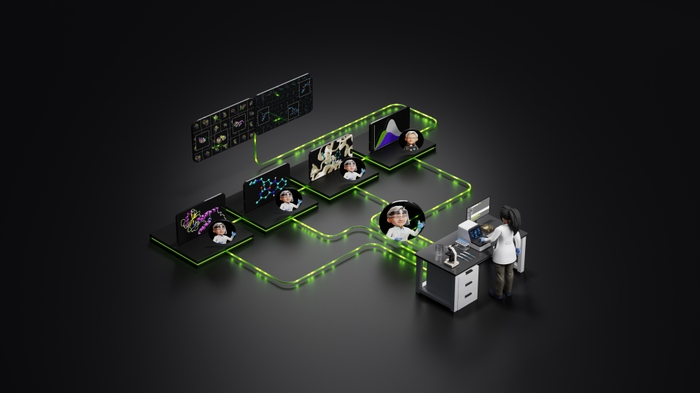
The clearest worked example is small-molecule virtual screening: an agent generates and screens candidate compounds, docks them against a target protein, predicts binding strength, and filters for drug-like properties — a multi-step pipeline that previously required a scientist to manually chain separate tools [1]. What changes is orchestration. The individual capabilities existed; the toolkit lets an autonomous agent sequence them, reason over the intermediate results, and decide the next experiment without a human stitching each step together. That is the leap from "AI that answers questions" to "AI that runs the bench."

The Contrarian Read: The Bottleneck Was Never Compute

Community reaction skewed positive but not uniformly credulous. Launch-day enthusiasm on X centered on NVIDIA's official healthcare channel and partners hosting the BioNeMo microservices, amplifying the open-source, autonomous-science framing. NVIDIA's own video content carried the agentic-era message and the chained protein-design pipeline. The more skeptical voice surfaced in a longer biotech-investor discussion, where a knowledgeable commenter offered a deflationary take: BioNeMo is, in practice, a Docker image bundling prepackaged molecular-biology models that run on NVIDIA hardware, most useful in the discovery and pre-clinical design phase after druggable targets are already chosen.

That critique lands on the part NVIDIA's pitch elides. Faster screening and protein design accelerate the earliest, cheapest stage of drug development — but the real cost and failure risk live downstream in clinical trials, and the binding constraint on the industry is often funding and economics, not a shortage of compute or candidate molecules. Even David Baker's endorsement implicitly concedes the limit, noting tools are "only as powerful as the scientists who can efficiently access" them [4]. The toolkit may make the front of the pipeline dramatically faster without moving the metric that actually gates new medicines: how many candidates survive the clinic.

Historical Context

2023-08
Recursion announced a $50 million investment and partnership with NVIDIA to accelerate foundation models for biology and chemistry, with early-access BioNeMo users including Amgen, AstraZeneca, and Insilico.
2024-03
At GTC 2024 NVIDIA expanded the BioNeMo generative AI drug discovery platform with new foundation models including the DNABERT genomics model, plus AWS and Microsoft Azure collaborations.
2026-01
NVIDIA announced a major expansion of BioNeMo as an open development platform enabling lab-in-the-loop workflows, with partners including Lilly and Thermo Fisher.

Power Map

Key Players
Subject

NVIDIA BioNeMo Agent Toolkit for AI-driven drug discovery

NV

NVIDIA

Developer and vendor of the BioNeMo Agent Toolkit; positions itself as the tool and infrastructure provider rather than an agent builder, making it the underlying layer for life-sciences agents.

OP

OpenAI, Anthropic, Edison Scientific, Lila Sciences, Owkin

Frontier labs and scientific agent builders integrating BioNeMo to move agents from answering questions to completing scientific work.

EL

Eli Lilly, Natera

Pharmaceutical and diagnostics companies using the toolkit to scale repeatable agentic workflows across discovery, translational research, and clinical insight.

DA

Dassault Systemes, Cadence (OpenEye), Schrodinger

Computer-aided drug discovery software providers integrating the toolkit; Dassault is building a companion named Marie and Schrodinger a discovery agent named Bunsen.

UN

University of Washington Institute for Protein Design (IPD)

Research organization collaborating with NVIDIA; the IPD partnership delivers 2x faster RosettaFold3 protein design.

Fact Check

5 cited
  1. [1] NVIDIA Launches BioNeMo Agent Toolkit, Giving AI Agents the Tools to Accelerate Scientific Discovery
  2. [2] NVIDIA announces BioNeMo Agent Toolkit for agentic life sciences
  3. [3] BIO 2026: NVIDIA announces the BioNeMo toolkit for AI agents
  4. [4] NVIDIA Unveils Science Reasoning AI Suite With BioNeMo Agent Toolkit
  5. [5] NVIDIA BioNeMo Agent Toolkit (GitHub)

Source Articles

Top 3

THE SIGNAL.

Analysts

"Frames frontier models as the reasoning brains and BioNeMo as the scientific toolbox: "Frontier models are the brains. BioNeMo is the scientific toolbox. Together, they give AI agents the skills of a PhD research assistant and the speed of a supercomputer.""

Jensen Huang
Founder and CEO, NVIDIA

"Argues life sciences R&D is at an inflection point: "The question is no longer whether AI can help science. The question is, does AI have the right instruments to run science?""

Kimberly Powell
Vice President of Healthcare, NVIDIA

"Highlights the token-economics rationale for accelerated tools: "In the world of agents, the longer the agent is waiting ... the more tokens you will be burning. And so we need to have accelerated tools for the agents to work with.""

Kimberly Powell
Vice President of Healthcare, NVIDIA

"Stresses accessibility as the constraint: "Every tool we've built for protein design is only as powerful as the scientists who can efficiently access it.""

David Baker
Professor of Biochemistry and Director, Institute for Protein Design, University of Washington
The Crowd

"Science is entering a new era - one where AI agents can do scientific work. Today NVIDIA is launching the BioNeMo Agent Toolkit - an open, agent-ready toolkit that gives any AI agent callable tools for protein structure prediction, molecular docking, generative chemistry, genomic analysis and more."

@@NVIDIAHealth1044

"Excited to be a day 0 launch partner for BioNeMo, NVIDIA's new, fully-open agent toolkit for scientific workflows! All 10 BioNeMo NIMs are available in our model library. Learn more in our announcement: baseten.co/blog/nvidia-bi"

@@baseten36

"NVIDIA just launched BioNeMo Agent toolkit.. 100% FREE. Open Source. Available on Github today. It just gave AI agents, the tool to discover drugs. The era of AI doing real science just officially started. NO HUMAN INTERRUPTION NEEDED..."

@@KanikaBK31

"NVIDIA Launches BioNeMo Toolkit to Turn AI Agents Into Life-Science Researchers"

@u/Such-Run-44121
Broadcast
Advancing Scientific Discovery in the Agentic AI Era

Advancing Scientific Discovery in the Agentic AI Era

NVIDIA BioNeMo Protein Binder Design Blueprint

NVIDIA BioNeMo Protein Binder Design Blueprint

Accelerate AI-Powered Drug Discovery With NVIDIA BioNeMo

Accelerate AI-Powered Drug Discovery With NVIDIA BioNeMo