Full-Stack AI Engineer Roadmap
TECH

Full-Stack AI Engineer Roadmap

17+
Signals

Strategic Overview

  • 01.
    A full-stack AI engineer roadmap progresses through phases: Python and developer foundations (Git, CLI, venv), LLM fundamentals and app development (prompt engineering, function calling/MCP, FastAPI/Docker), data/math/ML, and embeddings/RAG/agents using vector DBs, RAGAS/DeepEval, and LangGraph/CrewAI.
  • 02.
    AI engineering in 2026 is defined as integrating foundation models into production systems rather than training models from scratch, emphasizing systems, cost, latency, reliability, and observability over model accuracy alone.
  • 03.
    An agentic AI engineer builds systems where the LLM decides next actions, calls tools, holds state, and recovers from failure, using orchestration (LangGraph), protocols (MCP, A2A), sandboxing (E2B, Modal), and observability (Langfuse, Phoenix, Helicone).
  • 04.
    RAG is described as the single most in-demand production AI engineering pattern, while agents are the fastest-growing area expected to absorb most AI engineering work over the next two to three years.

Why the Order Is the Whole Game

The most useful thing about a full-stack AI engineer roadmap is not its list of tools but its sequence. The recurring path across credible 2026 roadmaps is the same: coding foundations, then LLM APIs, then retrieval and embeddings, then full RAG pipelines, then agents, then production infrastructure [1]. Each layer is a prerequisite for the next, and that dependency is exactly what makes skipping so costly. Embeddings and vector databases are the substrate retrieval runs on; retrieval is the substrate RAG runs on; reliable RAG is the substrate agents call as tools. Start at the top and you are building on layers you do not understand.

This is precisely the failure the developer community keeps naming. The dominant frame across X is corrective rather than aspirational: stop chasing random tutorials and follow a deliberate order. The sharpest version of that critique, from practitioners like Tech with Mak and echoing Avi Chawla's widely shared full-stack thread, describes the common anti-pattern bluntly: people jump straight to agents, skip foundations, ignore MLOps, and then wonder why nothing works. An agent is just a control loop that decides what to do next, calls tools, holds state, and recovers from failure [3]. If the tools it calls are an unreliable retrieval pipeline, or there is no observability to see where a run went wrong, the agent does not fail loudly; it fails subtly, returning plausible-but-wrong output that nobody can debug. The order matters because the hard parts are at the bottom, and they are invisible until something built on top of them breaks.
It's 70% Software Engineering, Not ML Research

It's 70% Software Engineering, Not ML Research
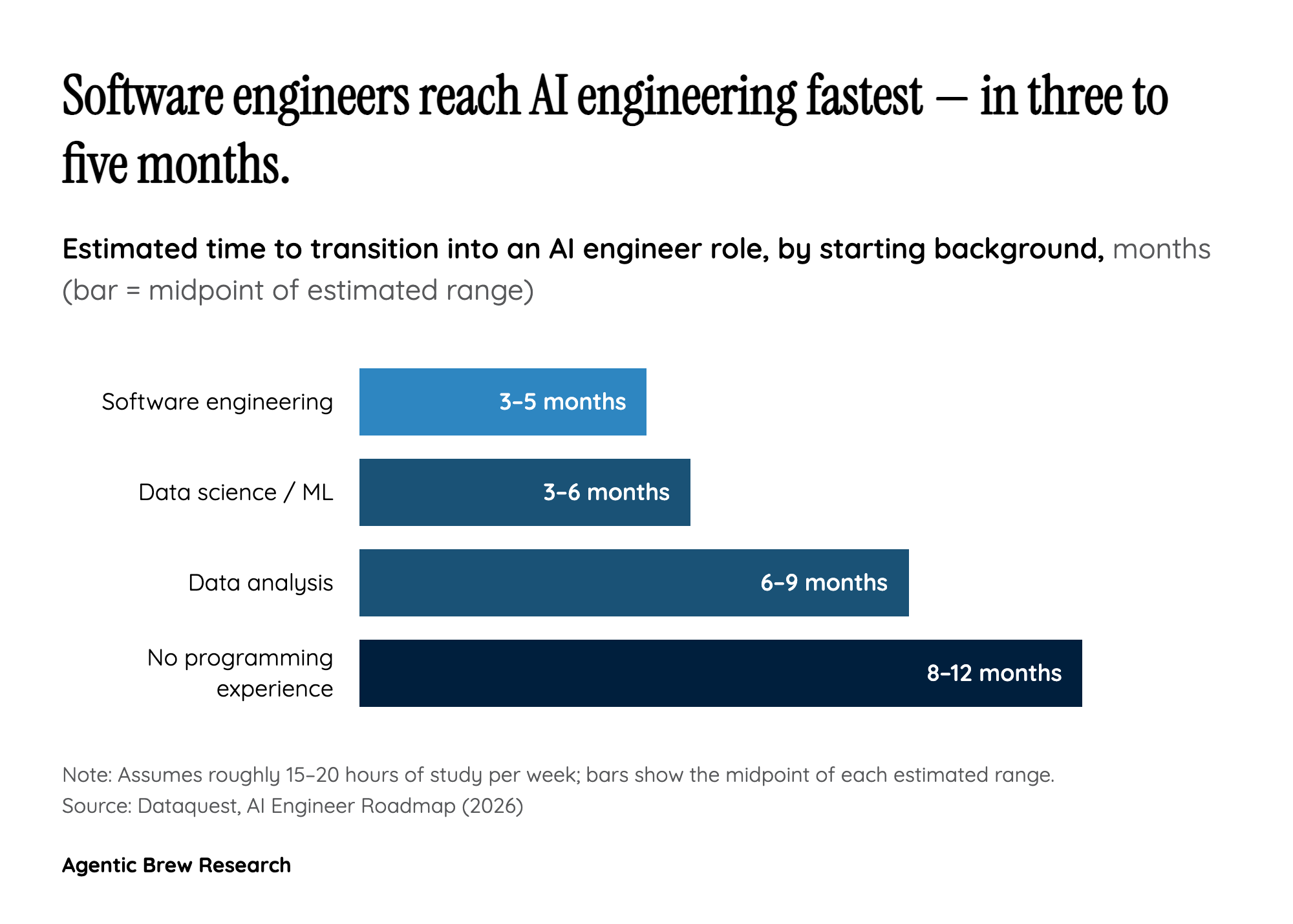
Vertical bar chart of months-to-transition into AI engineering by starting background, showing software engineers reaching the role fastest (about four months) and people with no programming experience taking the longest (eight to twelve months).

The single biggest reframing in these roadmaps is what the job actually is. An AI engineer in 2026 integrates foundation models into production systems rather than training models from scratch, optimizing for systems, cost, latency, reliability, and observability rather than model accuracy alone [2]. ImaginaryCloud puts it plainly: the ability to iterate quickly now matters more than building models from scratch [2]. ZenML draws the line between the new role and traditional ML engineering, noting that what begins as simple API calls quickly escalates into real data and ML problems that demand a layered architecture [4]. Reddit practitioners compress the whole debate into one line that keeps getting upvoted: AI engineering is roughly 70% software development, no PhD required.

That framing has direct career consequences, because it means most of the skills are transferable. Backend, API, cloud, and DevOps experience plus debugging and monitoring habits translate straight into building reliable AI pipelines [2]. The transition timeline reflects this: roughly three to five months from a software engineering background, six to nine months from data analysis, three to six months from data science, and eight to twelve months starting from no programming at all [1]. The demand and pay back it up. AI Engineer median compensation sits around $185K with demand growing 74% year over year, against roughly $165K and 38% growth for ML Engineer [5], and a separate salary survey puts the median near $142K with senior and top-tech bands climbing well past $220K [1]. The role was ranked the fastest-growing job title heading into 2026 [1]. The takeaway is unintuitive but freeing: the closer you already are to shipping software, the shorter your ramp.

The Part Everyone Skips: Evals and Observability

If sequencing is the visible lesson, the hidden one is that the work separating a demo from a shippable system is evaluation and observability infrastructure, and almost nobody plans for it. One Reddit practitioner's advice cuts to it: build the eval suite before you build anything else. The reasoning is that LLM systems are nondeterministic, so without a way to measure quality you cannot tell whether a change helped or hurt. This is why the roadmaps that go deep treat evals, tracing, and reliability as a first-class phase rather than an afterthought, leaning on LLM-as-judge scoring, eval datasets, continuous evaluation, and end-to-end tracing through tools like Langfuse, Phoenix, and Helicone [3].

The operational weight here is real, not decorative. One breakdown of the role allocates roughly 20-25% of the work to evaluation and observability and another 15-20% to standard backend engineering [6], and production systems are expected to ship with dashboards for latency, error rates, distribution drift, and hallucination incidents, plus CI/CD with model rollback [6]. ZenML's argument for a layered architecture is the structural answer to the same problem: without separating the application layer from the ML layer, what looks like a simple integration silently escalates into unmanaged data and ML complexity [4]. This is also where security lives, with guardrails, sandboxing, and prompt-injection defenses sitting in the same production phase [3]. The reason this phase gets skipped is that it produces nothing demo-able; the reason it cannot be skipped is that everything demo-able falls apart in production without it.

The Contrarian Read: Do Roadmaps Even Work?

Not everyone buys the premise. The clearest tension in the community is generational: beginners are genuinely grateful for free, structured paths, while experienced practitioners are openly skeptical that any formulaic roadmap survives contact with the job. The skeptical camp on Reddit makes two pointed arguments. The first is a backfitting critique: a polished retrospective roadmap describes the path someone took after they already succeeded, not a path that would have worked for them prospectively. The second is more philosophical, invoking a be-like-water sentiment associated with Andrej Karpathy: you have arguably opened the wrong door the moment you start searching for a twelve-month roadmap, because the field moves faster than any fixed curriculum can.

There is evidence both sides are partly right. The roadmaps themselves concede the instability, with role ambiguity cited as a live problem because companies are not always sure what to assign AI engineers in such a fast-moving field [1]. Yet the same sources land on a stable core that does not churn: connecting models to real products, building reliable pipelines, and deploying systems that work in production is software engineering, and it stays valuable regardless of which framework wins next [1]. The synthesis the strongest voices converge on is build-first over map-first: the people who get hired show working projects rather than completed courses [1], which on the practitioner side translates into a concrete prescription of two or three deployable end-to-end projects with clean READMEs. The roadmap, read this way, is not a curriculum to complete but a dependency graph that tells you what to learn next when your project demands it.

Historical Context

2026-04
Declares AI engineering is no longer experimental as organizations embed AI into real products and scalable platforms.
2026-06
Frames AI Engineer as the youngest of the three engineering titles and the fastest growing in 2026, emerging after GPT-4 made LLM-powered features economical.
2026-06
Frames the AI Engineer as a new role that emerged during the generative AI rise, primarily integrating GenAI into software products.

Power Map

Key Players
Subject

Full-Stack AI Engineer Roadmap

FU

Full-stack and software engineers

The primary audience transitioning into AI engineering; their backend, API, DevOps, debugging, and monitoring experience transfers directly, shortening the transition to roughly three to five months.

ML

ML engineers

Work at the model layer on training pipelines and drift, but increasingly handle the data infrastructure that RAG and GenAI systems require, and often transition into AI engineering roles.

VE

Venture-backed companies and employers

Treat AI Engineer as a core or first hire at almost every venture-backed company for shipping LLM-powered features, driving demand for the role.

RO

roadmap.sh

A popular open learning-path resource with 300,000+ GitHub stars providing a structured AI Engineer roadmap, AI mentor, and project ideas, shaping how newcomers sequence their learning.

Fact Check

6 cited
  1. [1] AI Engineer Roadmap: How to Become an AI Engineer in 2026
  2. [2] AI Engineer Roadmap: The Full-Stack Transition
  3. [3] The Agentic AI Engineer Roadmap for 2026
  4. [4] AI Engineering vs ML Engineering: Evolving Roles
  5. [5] AI Engineer vs ML Engineer
  6. [6] AI Engineer Skills Roadmap

Source Articles

Top 1

THE SIGNAL.

Analysts

""Don't wait until you feel 'ready.' The practitioners who get hired are the ones who can show working projects." The tools change, but connecting models to real products and deploying reliable systems is software engineering, and it stays valuable."

Dataquest
Data and AI education platform

""The ability to iterate quickly is now more valuable than building models from scratch," and an AI Engineer designs, deploys, and maintains AI-powered systems in production by combining software engineering, machine learning, and infrastructure skills."

ImaginaryCloud
Software and AI engineering consultancy

""What starts as simple API calls to OpenAI quickly evolves into complex data and ML problems," which motivates a layered architecture that separates application and ML concerns."

ZenML
MLOps and AI engineering tooling company
The Crowd

"AI Engineering roadmap covering 1000+ top AI research papers and GitHub repos. Available on GitHub 100% free."

@@Saboo_Shubham_1957

"The right order for learning AI engineering in 2026. What most people do: → Jump to agents → Skip foundations → Ignore MLOps → Wonder why nothing works What this roadmap shows: 1. Foundation (Python, APIs, clean code) 2. Semantic intelligence (embeddings, vector DBs) 3. ..."

@@techNmak1065

"The ultimate Full-stack AI Engineering roadmap to go from 0 to 100. Bookmark this. This is the exact mapped-out path on what it actually takes to go from Beginner → full-stack AI engineer. > Start with coding fundamentals. > Learn Python, Bash, Git, and testing. > Every strong AI engineer starts with fundamentals."

@@_avichawla363

"From Software Developer to AI Engineer: The Exact Roadmap I Followed (Projects + Interviews)"

@u/Secret-Relief-4689435
Broadcast
AI Engineer Roadmap | How I'd Learn AI in 2026

AI Engineer Roadmap | How I'd Learn AI in 2026

How to Become an AI Engineer FAST (2026) | AI Engineering Roadmap

How to Become an AI Engineer FAST (2026) | AI Engineering Roadmap

6-Month Roadmap to Become an AI Engineer | Ex-Google, Microsoft

6-Month Roadmap to Become an AI Engineer | Ex-Google, Microsoft