Moonshot AI launches Kimi K3.1 Pro, a 2.8T-parameter open-weight model
TECH

Moonshot AI launches Kimi K3.1 Pro, a 2.8T-parameter open-weight model

48+
Signals

Strategic Overview

  • 01.
    Moonshot AI launched Kimi K3.1 Pro on October 23-24, 2026, the first model in its new K3.1 series, calling it its most capable 3T-class open-weight model to date with a 1-million-token context window.
  • 02.
    The model is a 2.8T total / 104B active parameter Mixture-of-Experts, multimodal model, released alongside a Highspeed variant that runs 2-3x faster at the same capability level.
  • 03.
    K3.1 Pro and the Highspeed variant are available now on Kimi.ai, Kimi Work, Kimi Code and the Kimi API, with full open model weights promised by November 4, 2026.
  • 04.
    API pricing is set at $2.00 per million input tokens and $10.00 per million output tokens - cheaper than Kimi K3, matching GPT-6.1 Sol, and roughly half the cost of Claude Opus 5.5.

Closing the Gap: What the Benchmarks Actually Say

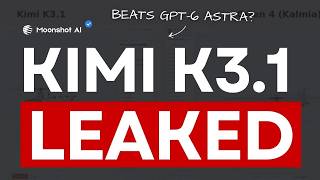
On paper, Kimi K3.1 Pro looks like the most serious open-weight challenge yet to the closed frontier. On Terminal-Bench 4.0, a benchmark that tests coding agents on real terminal-based tasks, it scored 65.7%, clearing GPT-6 Astra's 58.2% and landing within a point of Claude Opus 5.5's 66.4% [1][2]. On the Artificial Analysis Intelligence Index, it placed 4th overall with a score of 55, an 11-point jump from K3's 44, trailing only Claude Opus 5.5, Claude Sonnet 5.5, and Muse Wonder Full [3].

The more interesting detail is where those gains concentrate. The Decoder's analysis found K3.1 Pro's strongest improvements show up specifically in agentic tasks, not as a uniform lift across every capability, which narrows its gap with Claude Opus 5.5 to just 3 points on the Intelligence Index [4]. That pattern holds on agentic-work benchmarks: K3.1 Pro posted 1,846 Elo on GDPval-AA (real-world agentic work tasks), up 312 Elo from K3 and within 20 points of Opus 5.5's 1,866 [5], and it actually surpassed Opus 5.5 on SWE Marathon v1.1 (51.7% versus 46.3%) [4]. Crucially, this isn't a new model built from scratch - it's a post-trained version of K3's existing architecture with a far larger post-training compute budget, which explains why the gains cluster in agentic and tool-use skills rather than raw reasoning [6].

Stripping the Hacking Playbook - But Can Anyone Verify It?

Ahead of releasing K3.1 Pro's weights, Moonshot says it identified and removed cyber-related data from both of the model's training stages, a deliberate attempt to curb misuse once the weights can no longer be revoked. The company reports this dropped its score on an internal exploit test, xdev-bench-hard, from 90.5% in an unfiltered build to 81.0% in the released model [7]. That is a meaningful self-reported reduction, but TheNextWeb is blunt about the caveat: the figures are Moonshot's own and have not been checked independently [8].

The transparency gap goes deeper than a single disputed number. Implicator.ai points out that xdev-bench-hard itself is not public, and Moonshot's blog post never addresses whether fine-tuning after release could restore the capability it just stripped out [9]. That question matters precisely because open weights, once downloaded, are permanent - safety researchers cited by TheNextWeb note that open models can't be recalled, and their safeguards generally lag behind those shipped in closed, API-gated systems [8]. Moonshot is effectively asking the public to trust a safety intervention it can neither inspect nor undo.

Benchmaxxing or Breakthrough? The Gap Between the Score and the Street

Hallucination claims tell two different stories depending on who's measuring. Moonshot's own internal Kimi Hallu Bench Hard shows claim-level hallucination falling sharply, from 23.4% for K3 to 8.3% for K3.1 Pro [7]. Artificial Analysis, using its own AA-Omniscience methodology, measured a smaller but still real improvement - hallucination falling from 53% to 44% as its Omniscience Index rose from 20 to 30 [5][9]. Both show progress, but the gap between an 8.3% internal figure and a 44% third-party figure is large enough to invite skepticism about how either test is constructed.

That skepticism runs through the model's reception across every platform where people are actually testing it. On Reddit, enthusiasm over the raw benchmark numbers was tempered almost immediately by accusations of 'benchmaxxing' - tuning specifically to score well on known test suites - and by a LiveBench update that reportedly places K3.1 Pro below Astra Max and Sonnet Max, directly contradicting the launch framing; separately, early adopters flagged aggressive usage-limit exhaustion on paid subscriptions, a practical friction that undercuts the headline pricing story. On X, independent testers ran their own head-to-head generative comparisons against Gemini 4 Argon and Fable 5.1 using identical prompts, framing the results as uncomfortable for at least one of the three models tested. Separately, a finance-and-crypto-adjacent account summarized the raw spec sheet for its own audience rather than testing the model directly. YouTube commentary leaned into a bigger-picture framing, situating K3.1 Pro's launch inside a wave of near-simultaneous releases from competing labs and reading the timing itself as evidence of an accelerating competitive race between Chinese and US model developers; hands-on reviewers testing it directly were split between treating it as a credible step toward frontier parity and pushing back hard on that framing.

Cheap Tokens, Scarce Compute: Pricing, Geopolitics, and the Talent-Density Story

Moonshot is pricing K3.1 Pro aggressively: $2.00 per million input tokens and $10.00 per million output tokens, a 33% cut from K3, matching GPT-6.1 Sol, and roughly half what Claude Opus 5.5 costs [6]. That pricing pressure is paired with real enterprise distribution - Tencent's WorkBuddy platform integrated both K3.1 Pro and its Highspeed variant, though access is initially rationed to Enterprise Flagship Edition customers and individual subscribers because of resource constraints [12][13]. Tencent's involvement isn't incidental: alongside Alibaba's 36% equity stake, it underscores how deeply the model's commercial reach depends on China's largest tech platforms [11].

That commercial momentum sits awkwardly next to unresolved geopolitical pressure. In July 2026, the White House's Office of Science and Technology Policy accused Moonshot of distilling Anthropic's model and of accessing export-controlled Nvidia GB300 chips through Thailand to train its models, and Treasury Secretary Bessent warned that labs found stealing US IP could face sanctions [10]. Community discussion of K3.1 Pro has leaned into a counter-narrative - that Moonshot's roughly 300 engineers are competing with Google and OpenAI's vastly larger compute budgets through talent density rather than hardware access made scarce by export controls. CNBC's reporting on the preceding K3 release captured the same framing from Wall Street: Morgan Stanley's Gary Yu described it as signaling an all-round catch-up of Chinese LLMs with US leaders [14]. Whichever story is more accurate, Moonshot's low prices and open-weight strategy are now operating directly in the shadow of an active US sanctions threat.

Historical Context

2023
Released the original Kimi chatbot with a 128K-token context window, a first at the time.
2025-07
Launched Kimi K2, an open-weight model that showed strong performance on coding benchmarks.
2026-04
Released Kimi K2.6, with 1T total / 32B active parameters.
2026-06
Shipped Kimi K2.7 Code, later integrated into GitHub Copilot.
2026-07-16
Launched Kimi K3 (2.8T parameters), debuting at No. 3 on the Artificial Analysis leaderboard behind Claude Fable 5 and GPT-5.6 Sol.
2026-07-27
Released Kimi K3's open weights under a custom commercial license.
2026-10-23
Launched Kimi K3.1 Pro, a post-trained upgrade of K3's architecture with a much larger post-training compute budget rather than a new base model.

Power Map

Key Players
Subject

Moonshot AI launches Kimi K3.1 Pro, a 2.8T-parameter open-weight model

MO

Moonshot AI

Beijing-based developer of Kimi K3.1 Pro, founded March 2023 by Tsinghua University classmates Yang Zhilin, Zhou Xinyu, and Wu Yuxin; valued at $35 billion as of July 2026.

AL

Alibaba Group / Tencent

Major investors in Moonshot AI (Alibaba holds a 36% stake); Tencent also integrated Kimi K3.1 Pro and its Highspeed variant directly into its WorkBuddy enterprise platform.

AR

Artificial Analysis

Independent benchmarking firm that ranked K3.1 Pro 4th on its Intelligence Index, behind Claude Opus 5.5, Claude Sonnet 5.5, and Muse Wonder Full, and measured its own hallucination-rate figure using a different methodology than Moonshot's internal tests.

WH

White House Office of Science and Technology Policy / Treasury Department

In July 2026 accused Moonshot of distilling Anthropic's model and acquiring banned Nvidia GB300 chips via Thailand; Treasury Secretary Bessent warned of possible sanctions over alleged IP theft by Chinese AI labs.

Fact Check

14 cited
  1. [1] China's Moonshot AI launches Kimi K3.1 Pro, plans full model weights release by Nov
  2. [2] Moonshot AI Releases Kimi K3.1 Pro: First Model in New K3.1 Series
  3. [3] Kimi K3.1 Pro Places 4th on Artificial Analysis Intelligence Index, Ahead of GPT-6 Astra, Gemini 4 Argon
  4. [4] Chinese AI model Kimi K3.1 Pro is closing in on Anthropic's Claude Opus 5.5
  5. [5] Kimi K3.1 Pro Benchmark Analysis
  6. [6] Kimi K3.1 Pro
  7. [7] Kimi K3.1 Pro
  8. [8] Moonshot strips hacking data from open-weight Kimi K3.1 Pro
  9. [9] Kimi K3.1 Pro's hacking cut relies on an unpublished test
  10. [10] White House accuses Moonshot AI
  11. [11] Moonshot AI
  12. [12] Tencent WorkBuddy integrates Kimi K3.1 Pro
  13. [13] Tencent WorkBuddy adds Kimi K3.1 Pro
  14. [14] Moonshot AI's Kimi K3 model signals China catching up to OpenAI, Anthropic

Source Articles

Top 5

THE SIGNAL.

Analysts

“Called K3.1 Pro's output quality solid and noted it is, for now, the first time a soon-to-be-open-weight model has scored this highly on the Artificial Analysis Index.”

Simon Willison
Independent AI developer and commentator

“Found that K3.1 Pro's strongest gains are concentrated in agentic task performance rather than spread evenly across the board, narrowing the gap with Claude Opus 5.5 to just 3 points on the Intelligence Index.”

The Decoder
AI industry analysis outlet

“Cautioned that open-weight models cannot be recalled once downloaded and that their safety mitigations typically lag behind closed models, framing why Moonshot chose to strip cyber-offense data before release.”

TheNextWeb (citing safety researchers)
Technology news outlet

“Argued that the K3 family signaled an all-round catch-up of Chinese LLMs with US frontier labs and demonstrated that scaling laws still hold for Chinese AI developers.”

Gary Yu
Analyst, Morgan Stanley
The Crowd

“Meet Kimi K3.1 Pro, our most capable 3T-class model.”

@@Kimi_Moonshot25512

“I gave Kimi K3.1 Pro, Gemini 4 Argon, and Fable 5.1 the exact same prompt: “Generate a 10-second video of a plane landing at sunset.” One prompt. Three models. The results might hurt some feelings.”

@@glitch_catAI248

“HUGE: Moonshot AI unveils Kimi K3.1 Pro, a 2.8-TRILLION-parameter model claiming to beat Claude Opus 5.5 and GPT-6 Astra on long-horizon coding tasks. The model features a 1 MILLION-token context window, with 104 billion parameters active per token.”

@@coinbureau128

“Kimi K3.1 Pro benchmarks”

@No-Head-Royal522
Broadcast
Meet Kimi K3.1 Pro

Meet Kimi K3.1 Pro

Kimi K3.1, Qwen 4 and a Gemini 4.5 Argon? Nobody Expected THIS!

Kimi K3.1, Qwen 4 and a Gemini 4.5 Argon? Nobody Expected THIS!

Kimi K3.1 Pro First Impressions: Has Moonshot Caught Up to the Frontier?

Kimi K3.1 Pro First Impressions: Has Moonshot Caught Up to the Frontier?

Moonshot AI launches Kimi K3.1 Pro, a 2.8T-parameter open-weight model — AI News | Agentic Brew