
Enterprise AI Cost Reckoning vs Headcount
TECH

Enterprise AI Cost Reckoning vs Headcount

31+
Signals

Strategic Overview

  • 01.
    Glean CEO Arvind Jain says enterprise technology spend now matches human labor spend for the first time in his memory, with CFOs openly trading off AI token budgets against employee headcount.
  • 02.
    Uber burned through its entire 2026 AI coding tools budget in roughly four months and the COO is now publicly questioning whether the spend is justified.
  • 03.
    Microsoft canceled most internal Claude Code licenses across its Experiences and Devices group, with a June 30 cutoff, after engineer usage drove costs higher than expected and migrated developers to in-house GitHub Copilot CLI.
  • 04.
    Roughly 95% of enterprise AI usage still runs on the most expensive frontier models even for tasks cheaper models could handle, and each new frontier release is roughly twice as expensive per token as the one it replaced.

Deep Analysis

When Tokens Started Competing With Payroll

For the past three years the bullish enterprise-AI pitch had one assumption baked in: agents were a substitute for people, and people were always the more expensive line item. That assumption just snapped. Glean CEO Arvind Jain told reporters this is the first time he can remember that technology cost the same as people [1], and Nvidia's VP of applied deep learning Bryan Catanzaro confirmed it from inside one of the companies most exposed to the buildout, telling Fortune that for his team compute now costs "far beyond" what the employees do [2]. The framing CFOs are now using internally, per CNBC's reporting, is no longer 'AI versus headcount growth' — it is 'this quarter's token line versus that team's payroll' [3].

The trigger isn't a single bill but a structural inversion. Enterprise AI spending grew 108% year-over-year in 2026 to an average $1.2M per organization, and 78% of IT leaders surveyed reported AI charges they never budgeted for, with 80-85% of enterprises missing their AI infrastructure forecasts by more than 25% [4]. When tokens cost as much as people, every AI workflow has to clear the same internal hurdle a new hire would, and most of them currently can't. Finance and product-operator commentary on X is treating the Uber and Microsoft pullbacks as the moment the price-insensitivity thesis broke — not as one-off mismanagement.
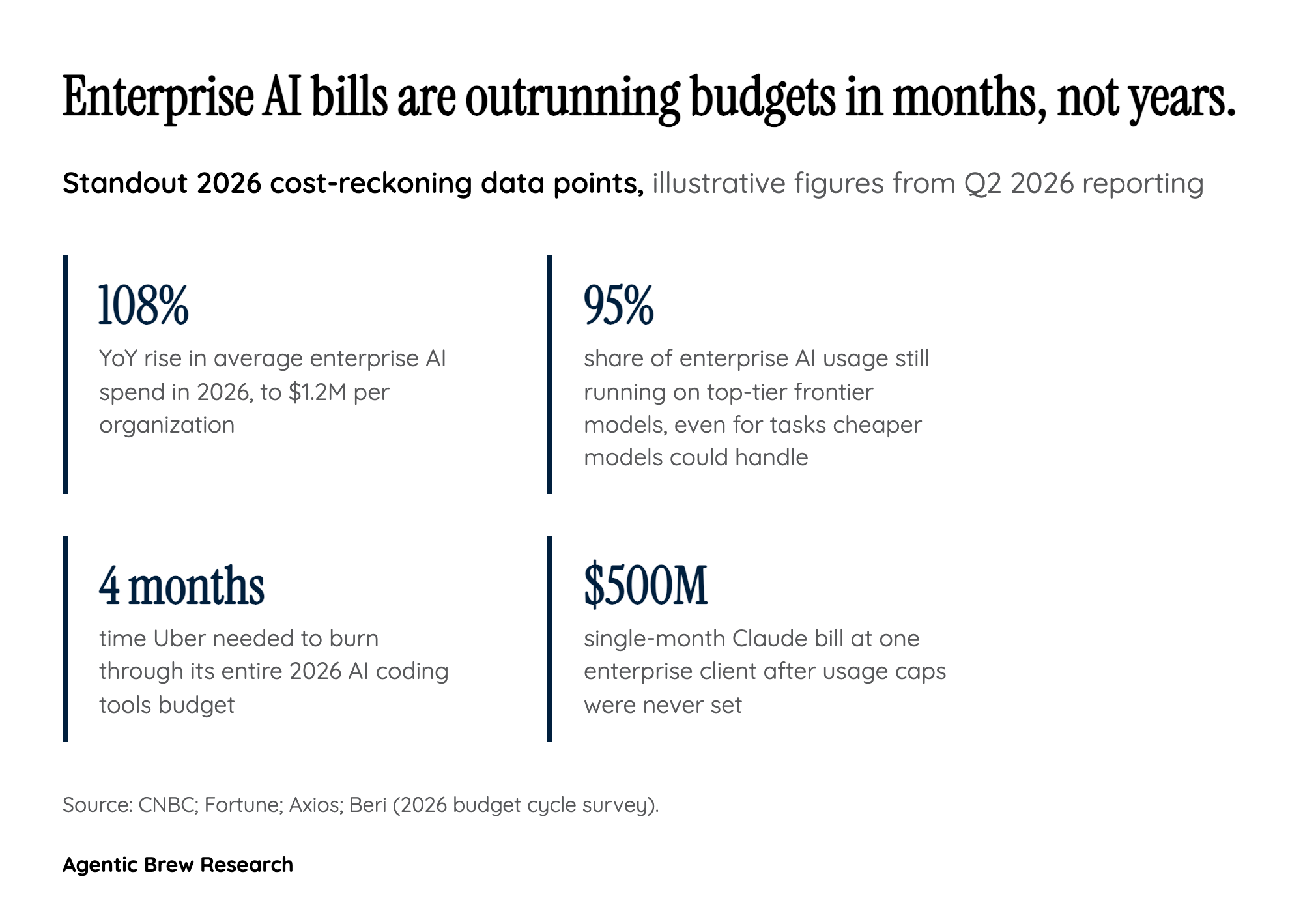

The Doubling-Per-Release Trap That Burned Uber In Four Months

The Doubling-Per-Release Trap That Burned Uber In Four Months
Standout 2026 enterprise AI cost-reckoning data points.

Why is this happening now, after two years of confident enterprise rollouts? Two compounding mechanics. First, each new model release from the frontier labs is roughly twice as expensive per token as the one it replaced, putting bills on what executives themselves now call an unsustainable curve [3]. Second, roughly 95% of enterprise AI usage is still running on the most expensive frontier models even for tasks cheaper alternatives could handle, because internal tooling has no routing layer and engineers default to the strongest available model [3]. Multiply a doubling unit price by usage stuck at the top tier and annual budgets get exhausted in one or two months — which is what enterprise AI leaders are now telling CNBC is happening in the field [3].

Uber is the cleanest case study. The company burned its entire 2026 AI coding tools budget in four months even though roughly 70% of committed code now originates with AI and about 10% is built by autonomous agents [5]. The productivity story is real on paper; the cost story still ate the budget. Microsoft is the same dynamic at a larger scale: internal Microsoft tracking showed AI tool spend exceeding human employee cost, which triggered the cancellation of most Claude Code licenses across the Experiences and Devices group with a June 30 cutoff and a migration to the in-house GitHub Copilot CLI [2][6]. And then there's the extreme tail: Axios reported that one enterprise client spent $500 million on Claude in a single month after failing to set usage limits [7], the kind of accidental bill that turns a CFO into a routing convert overnight.

The Routing Gold Rush: Where Capital Flows When Bills Stop Falling

The clearest tell that the reckoning is real is where venture capital is now flowing — toward companies that promise to cut the AI bill, not grow it. Glean's top line crossed $300M ARR in late May, tripled from $100M in 15 months, with CEO Arvind Jain explicitly telling TechCrunch that what customers value is the bill cut: "One of the things you know our customers really like about Glean is the fact that we can reduce your AI bill significantly" [8]. Glean's pitch is that its context graph reduces token consumption by roughly 30% versus piping raw data straight to a frontier LLM [8]. Factory AI raised $150M at a $1.5B valuation in April on essentially the same thesis applied to coding: route every engineering task to the cheapest model that can still do it [9].

The market for routing isn't theoretical. Public benchmarks now suggest model routers can deliver 30-70% cost reductions across workloads, with up to 98% savings on specific tasks; a basic 70/20/10 Haiku/Sonnet/Opus split can cut API costs by more than half [10][11]. Gartner expects inference unit costs to fall roughly 90% by 2030, but Goldman Sachs is forecasting agentic AI could drive a 24x increase in token consumption over the same window, so the volume offsets the deflation [2]. That math is exactly why the bill-cutters get the valuations: the only way the curve bends is at the routing layer, not at the model-card price tag.

The Substitution Paradox: Vendors Tokenmaxxing While Customers Ration

Underneath the headlines is a quieter contradiction. The same labs whose customers are now rationing usage have been running internal programs explicitly designed to maximize token consumption — programs like Meta's Claudeonomics leaderboard and Amazon's tokenmaxxing push, which incentivized engineers to use more, not less [2]. Microsoft's reversal is the punchline: the company that helped popularize 'tokenmaxxing' internally is now the most visible enterprise pulling licenses because the bill outran the productivity story [2]. Gartner's Will Sommer is warning chief product officers not to take the bait twice, cautioning that they "should not confuse the deflation of commodity tokens with the democratization of frontier reasoning" [2]— sophisticated workloads stay expensive even as the cheap tier gets cheaper. Developer communities are arriving at the same gap from the bottom up, describing a new internal class system in which AI/ML teams get unlimited budgets while product engineers are rationed by model tier.

The second-order risk lands on the frontier vendors themselves. Anthropic, OpenAI, Google, and Meta have been pricing inference below true serving cost to capture share [12], which works as long as enterprise volumes keep compounding. They aren't: with enterprises generating roughly 40% of OpenAI revenue and projected to reach 50% by end-2026 [13], rationing at the top of the customer base directly threatens the growth narrative underwriting current valuations. CloudBees CEO Anuj Kapur is bluntly predicting the resolution: when AI bills outpace plans, workforce cuts are "the only lever" executives can pull, and 84% of UK finance leaders are already explicitly using AI to mitigate labor risk [14][15]. The uncomfortable read is that the headcount-replacement narrative may survive — just on a much smaller, more carefully routed AI footprint than the frontier labs need it to be.

Historical Context

2026-02-23
Reports that 75% of CFOs are raising tech budgets while cutting headcount-growth expectations from 6% to 2% as AI budgets begin eating headcount plans.
2026-04-16
Raises $150M at a $1.5B valuation on a model-routing thesis for enterprise coding work.
2026-05-22
Reports internal Microsoft tracking showing AI tool spend now exceeding the cost of human employees, triggering Claude Code license cancellations.
2026-05-26
Fortune reports Uber's COO publicly questioning AI spend after burning the annual AI coding budget in four months.
2026-05-28
Publishes 'AI sticker shock hits corporate America', documenting an enterprise client that spent $500M in a single month on Claude after failing to set usage limits.
2026-05-28
Crosses $300M ARR (tripled from $100M in 15 months) as enterprises buy its AI-budget-cutting pitch.
2026-05-29
Headlines the 'tokens or humans' trade-off, naming Glean and Factory AI as the routing layer enterprises are turning to.

Power Map

Key Players
Subject

Enterprise AI Cost Reckoning vs Headcount

GL

Glean (Arvind Jain, CEO)

Enterprise AI platform that has repositioned around AI-budget cuts as its main pitch; ARR tripled from $100M to $300M in 15 months by promising roughly 30% fewer tokens than off-the-shelf tools.

FA

Factory AI (Matan Grinberg, CEO)

Routes engineering tasks across every frontier model and picks the cheapest sufficient one; recently raised $150M at a $1.5B valuation on this routing thesis.

UB

Uber (Andrew Macdonald, COO)

Burned its 2026 AI coding budget in four months even though roughly 70% of committed code originates with AI; the COO is now publicly questioning the ROI.

MI

Microsoft

Largest single signal of the reckoning: canceled Claude Code licenses across Windows, 365, Outlook, Teams, and Surface teams and pushed engineers to its cheaper in-house Copilot CLI.

FR

Frontier model vendors (Anthropic, OpenAI, Google, Meta)

Pricing inference below cost to capture share even as customers ration usage and shift volume to cheaper tiers, leaving the growth narrative exposed if rationing spreads.

U.

U.S. Fortune 500 CFOs

Slashed headcount-growth expectations from 6% in 2025 to 2% in 2026 while 75% raise tech budgets, explicitly substituting agents for analyst hires.

Fact Check

15 cited
  1. [1] AI cost trade-off: tokens vs humans reshaping budgets
  2. [2] Microsoft's AI cost problem: tokens, agents, and an unsustainable curve
  3. [3] Tokens or humans? The new corporate trade-off
  4. [4] AI costs surge 108% in 2026 budget cycle
  5. [5] Uber COO questions AI spending after burning yearly budget in four months
  6. [6] Microsoft cancels Claude Code licenses after engineers burn through yearly AI budget
  7. [7] AI sticker shock hits corporate America
  8. [8] Glean's top line crosses $300M as AI budget cutting becomes its major selling point
  9. [9] Factory hits $1.5B valuation to build AI coding for enterprises
  10. [10] What is an AI model router? Optimize cost across LLM providers
  11. [11] 10 AI Cost Optimization Strategies for 2026
  12. [12] Corporate America rations AI as costs soar
  13. [13] The great AI ROI reckoning: what separates the 5% achieving transformational returns from the 95% that don't
  14. [14] Corporate America enters AI reckoning phase
  15. [15] Your AI budget is eating your headcount

Source Articles

Top 3

THE SIGNAL.

Analysts

"Argues AI economics have flipped so that tokens now compete with payroll, and that 95% of usage on frontier models is wasted spend smarter routing could cut sharply: "This is the first time ever that I can remember that technology cost the same as people.""

Arvind Jain
CEO, Glean

"Says AI productivity claims are not yet visible in shipped product, which makes continued spend hard to defend: "If you're not actually able to draw a direct line to how [many] useful features and functionality you're shipping to your users, that trade becomes harder to justify.""

Andrew Macdonald
COO, Uber

"Confirms compute spend has already passed payroll in at least some technical orgs, even at the chipmaker that profits from the buildout: "For my team, the cost of compute is far beyond the costs of the employees.""

Bryan Catanzaro
VP of Applied Deep Learning, Nvidia

"Warns that falling commodity token prices do not mean frontier reasoning is getting cheap: "Chief Product Officers (CPOs) should not confuse the deflation of commodity tokens with the democratization of frontier reasoning.""

Will Sommer
Senior Director Analyst, Gartner

"Predicts workforce cuts as the path of least resistance when AI bills outpace planned budgets, framing layoffs as "the only lever" executives can pull."

Anuj Kapur
CEO, CloudBees
The Crowd

"Corporate America enters its AI reckoning phase as IT bills keep rising and consumer sentiment nosedives. My latest, which includes an account from a CFO fretting over a half a *billion* dollar accidental AI bill: https://t.co/EQhgn0v8DI"

@@MadisonMills223394

"🚨 THE AI COST CRISIS HAS STARTED. Microsoft reportedly told engineers to stop using Claude because AI bills were exploding, while Uber says its entire yearly AI budget was already destroyed by April."

@@cryptorover16871

"🤖 AI turned out to be too expensive to replace humans Microsoft has started limiting employee access to Anthropic models and revoking Claude Code licenses. Uber is also cutting AI spending: the technology is becoming too expensive and failing to justify expectations."

@@nexta_tv542

"Companies on track to spend entire employee budget on AI services"

@u/YeahBuddy500089
Broadcast
Microsoft, Uber Hit: AI Cost Crisis as Compute Spending Surpasses Human Workforce Costs

Microsoft, Uber Hit: AI Cost Crisis as Compute Spending Surpasses Human Workforce Costs

Tokens Or Humans? The New AI Cost Trade-Off Reshaping Corporate Budgets

Tokens Or Humans? The New AI Cost Trade-Off Reshaping Corporate Budgets

Will AI Save Your Business Millions? Or Cost It Millions? (AI Corporate Risk)

Will AI Save Your Business Millions? Or Cost It Millions? (AI Corporate Risk)