Broadcom's Debt Financing for Anthropic AI Chips
TECH

Broadcom's Debt Financing for Anthropic AI Chips

31+
Signals

Strategic Overview

  • 01.
    Broadcom is negotiating with lenders to raise more than $60 billion - potentially up to $100 billion - in debt to finance AI chip production for Anthropic and other AI labs, structured as a $60-70 billion senior-secured tranche plus a roughly $30 billion junior tranche.
  • 02.
    The financing uses a special-purpose vehicle that raises the debt, buys AI chips including Google's TPUs, and leases them to Anthropic, with lease payments repaying the loan - keeping the debt off Anthropic's own balance sheet.
  • 03.
    The new deal builds on a $35 billion AI XPV Platform that Broadcom established with Apollo and Blackstone in June 2026 to fund more than 20 gigawatts of global AI compute deployments.
  • 04.
    Broadcom's 10-Q caps its maximum loss exposure on the first AI XPV transaction at $29 billion, while Bank of America has modeled a hypothetical $370 billion ceiling if the platform scales to its full design by 2029.

Deep Analysis

The Off-Balance-Sheet Machine Broadcom Is Building

Broadcom is back at the negotiating table with lenders, this time for a debt package that could grow to $100 billion - a $60-70 billion senior-secured tranche and roughly $30 billion in junior debt, aimed squarely at funding chips for Anthropic and other AI labs [1]. The mechanics are almost identical to what Broadcom, Apollo and Blackstone built in June: a special-purpose vehicle raises the debt, uses it to buy AI chips - including Google's TPUs, which Broadcom co-designs - and then leases that hardware to Anthropic, with the lease payments flowing back to repay the loan [2]. That earlier vehicle, the $35 billion AI XPV Platform, was pitched by Broadcom CEO Hock Tan as a response to a 'historic inflection point' in AI compute demand, and Apollo's leadership called it proof of conviction in Broadcom's technology and Anthropic's roadmap [3]. What's new is the scale: this isn't a one-off financing, it's Broadcom running the same off-balance-sheet playbook a second time, only twice as large. It also echoes a pattern taking shape across the industry - Meta pioneered a similar lease-back structure in 2025 for a data-center deal with Blue Owl, and Nvidia is reportedly working a much larger, parallel financing push this same month, suggesting off-balance-sheet AI debt is becoming the default way chipmakers fund hyperscaler demand rather than a one-off exception.

Who Actually Eats the Loss If Something Breaks

The headline numbers invite very different readings depending on which one you anchor to. Broadcom's own 10-Q caps its maximum loss exposure on the first AI XPV transaction at $29 billion [4]- a hard, disclosed ceiling. Bank of America's analysts, running their own stress tests, separately modeled a $370 billion hypothetical ceiling if the platform scales to its full 20-gigawatt design by 2029 - explicitly a ceiling on future commitments, not debt already sitting on Broadcom's balance sheet [4]. Retail-investor threads dissecting the fine print have converged on a useful analogy: the senior/junior split resembles mortgage-bond risk tranching, where senior debt gets paid first and junior debt absorbs losses first. But the comparison has a limit the mortgage-bond world never had to worry about - the underlying collateral here is GPU silicon, hardware that depreciates far faster than a house. That mismatch between the loan's tenor and the collateral's shelf life is the real open question: what happens to the junior tranche if a chip generation ages out of relevance before the lease that's supposed to repay it does. Moody's has flagged an adjacent risk - not any single deal, but the pattern of Broadcom stacking several large SPV transactions in a short window, which the ratings agency warned could erode the company's own financial flexibility [5].

Why This Is Happening Right Before Anthropic's IPO

The timing isn't incidental. Keeping tens of billions in chip debt inside an SPV - rather than on Anthropic's own books - matters most right before a public listing, since investors typically punish highly leveraged companies at IPO. And the listing in question is not a small one: Bloomberg reports Anthropic expects its planned IPO to match or exceed SpaceX's record raise of $75 billion (up to $86.2 billion with overallotment), with prediction markets pricing a potential valuation of $1.6-2 trillion and an October target [6]. Every dollar of chip financing that stays inside Broadcom's SPV rather than Anthropic's balance sheet is a dollar that doesn't have to be explained to IPO investors as leverage. It also lines up with how fast the underlying business case is growing - Mizuho estimated back in April that Broadcom stands to earn $21 billion in AI revenue from Anthropic in 2026, rising to $42 billion in 2027 [7], revenue growth that arguably justifies the size of the debt being raised against it, at least on paper.

Two Different Markets, Two Different Verdicts

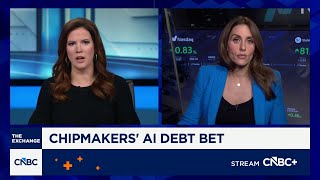
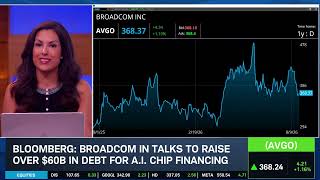
Broadcom's credit market and its equity market told two different stories about the same news. Credit investors moved first and hardest: Broadcom's CDS spreads spiked toward all-time wides as the scale of the new deal became clear [8]. Bank of America followed by downgrading Broadcom's bonds to 'market weight' over concerns about the guarantees embedded in the structure, and Broadcom shares fell as much as 5.9% to close near $393 - about 21% below their 52-week high [4]. That downgrade didn't come from nowhere: Broadcom's debt outlook had already been cut earlier in August, before the larger $60-100 billion figure was even reported [9]. Coverage of the exact deal size has also diverged - some reporting puts it at 'upwards of $70 billion' rather than the $100 billion ceiling now circulating [10]- itself a signal the final structure is still being negotiated. Notably, broadcast coverage of the story showed Broadcom and TSMC shares each ticking up modestly the same morning even as Nvidia and AMD traded down, suggesting equity investors are drawing a distinction between chipmakers extending credit and chipmakers borrowing against future leases. That distinction matters because Hock Tan has previously pushed back on the word 'backstop' altogether, insisting Broadcom simply provides chips and partners with firms that have the balance sheets to fund them - language that arguably undersells just how much of the senior tranche Broadcom itself is guaranteeing.

Historical Context

2026-04-06
Broadcom agreed to expanded custom chip deals with Google and Anthropic; Mizuho analysts estimated Broadcom would earn $21 billion in AI revenue from Anthropic in 2026 and $42 billion in 2027.
2026-06-02
Broadcom's credit backing compressed yields on the senior debt tranches of the $35-36 billion Anthropic financing to roughly 5.75%, via a deficiency guarantee tying credit risk to Broadcom's own balance sheet.
2026-06-09
Apollo led the original $35 billion capital solution for Broadcom's AI XPV Platform in partnership with Blackstone and global banks, designed to enable more than 20 gigawatts of AI compute through 2028.
2026-08-11
Broadcom's debt outlook was cut amid AI financing risk concerns, ahead of the larger $60-100 billion deal talks becoming public.
2026-08-20
Bloomberg first reported Broadcom seeking more than $60 billion (potentially up to $100 billion) in a new AI debt deal for Anthropic; Broadcom shares fell as much as 5.9%, closing near $393, about 21% below its 52-week high.
2026-08-20
Bloomberg reported Anthropic expects its planned IPO to match or exceed SpaceX's record $75 billion (up to $86.2 billion with overallotment) raise, with prediction markets pricing a potential $1.6-2 trillion valuation and an October listing target.

Power Map

Key Players
Subject

Broadcom's Debt Financing for Anthropic AI Chips

BR

Broadcom Inc.

Chip designer that guarantees part of the senior-secured debt tranche and provides residual value guarantees; co-designs Google's TPUs used by Anthropic

AN

Anthropic PBC

AI lab and primary lessee of the financed compute/chip capacity, preparing an IPO expected to match or exceed SpaceX's record raise

AP

Apollo Global Management

Lead arranger of the original $35 billion AI XPV capital solution and a participant in talks for the expanded $60-100 billion deal

BL

Blackstone Inc.

Co-investor via its credit and insurance business, committed $5 billion in equity to the original platform and is in talks to join the expanded deal

GO

Google/Alphabet

Supplies TPUs, co-designed with Broadcom, that are purchased and leased through the SPV structure

Fact Check

10 cited
  1. [1] Broadcom Seeks More Than $60 Billion in Latest AI Debt Deal
  2. [2] Apollo, Blackstone to Lend $35 Billion Against Anthropic AI Chips
  3. [3] Broadcom, Apollo and Blackstone Establish Landmark Strategic Platform to Accelerate More Than 20 Gigawatts of Global AI Deployments
  4. [4] Broadcom's AI Financing Could Reach $370 Billion, But It's Not as Bad as It Sounds
  5. [5] Securing Orders With Guarantees: Broadcom Clinches $35 Billion Chip Deal
  6. [6] Anthropic Expects to Match SpaceX's Record IPO Size or Top It
  7. [7] Broadcom Agrees to Expanded Chip Deals With Google, Anthropic
  8. [8] Broadcom CDS Explodes As It Seeks $100 Billion In Massive Off-Balance-Sheet Debt Deal
  9. [9] Broadcom Debt Outlook Cut on AI Financing Risks
  10. [10] Broadcom Debt Deal Expected to Reach Upwards of $70 Billion, Sources Say

Source Articles

Top 5

THE SIGNAL.

Analysts

Framed the AI XPV Platform as a historic response to surging AI compute demand and signaled more deals of this kind would follow.

Hock Tan, President and CEO, Broadcom
Bullish on AI compute demand

Described AI compute demand as creating an unprecedented opportunity to invest at scale via Blackstone's credit and insurance business.

Jon Gray, President, Blackstone
Bullish on AI infrastructure as an asset class

Positioned AI compute financing as a compelling new asset class characterized by contracted, predictable cash flows.

Jamshid Ehsani, Partner, Apollo
Bullish on AI compute as a new fixed-income asset class

Modeled a worst-case ceiling of $370 billion in financing if the platform scales to its full 20GW design by mid-2029 and downgraded Broadcom's bonds to 'market weight' over guarantee-related concerns, describing the figure as a hypothetical ceiling rather than current balance-sheet debt.

Bank of America analysts
Cautious; downgraded Broadcom's bonds

Warned that the primary risk lies in multiple large off-balance-sheet transactions occurring over a short period, which could pressure Broadcom's financial flexibility.

Moody's Ratings analysts
Cautious on repeated large SPV transactions
The Crowd

Broadcom is in talks with a group of lenders to raise more than $60 billion in debt for an AI chip financing deal that will benefit Anthropic and other companies, according to people with knowledge of the matter

@@business65

SITUATION BREWING: Broadcom is in talks to raise more than $60 billion in debt for an AI-chip financing package that would benefit Anthropic and other companies, per Bloomberg.

@@MTSlive58

500 billion dollars from Nvidia. 60 billion more in debt from Broadcom. The AI compute bill just got a lot harder to hide. Nvidia's fundraising effort with private equity firms and Broadcom's chip financing talks both landed this week. This is what it costs to keep proprietary

@@shawnchauhan19

AI compute financing just tripled in ten weeks - the mechanism behind the reported $100B Broadcom deal

@u/Servola-Journal4
Broadcast
Broadcom Seeking $60B in AI Debt Deal

Broadcom Seeking $60B in AI Debt Deal

AVGO Seeking Up to $100B in Debt Financing Mirrors NVDA AI Infrastructure Push

AVGO Seeking Up to $100B in Debt Financing Mirrors NVDA AI Infrastructure Push

Broadcom's newest debt deal: Here's what to know

Broadcom's newest debt deal: Here's what to know