Meta enters AI cloud business, reshaping neocloud outlook for CoreWeave and Nebius
TECH

Meta enters AI cloud business, reshaping neocloud outlook for CoreWeave and Nebius

30+
Signals

Strategic Overview

  • 01.
    Meta is developing a two-track cloud business, internally called Meta Compute, that would sell hosted access to its own AI models (similar to AWS Bedrock) and raw AI computing capacity (similar to neoclouds CoreWeave and Nebius).
  • 02.
    The news broke via a Bloomberg report that Meta is building a cloud business to sell AI computing power, possibly including the raw capacity that specialist neocloud providers rent out today.
  • 03.
    Markets reacted sharply: CoreWeave fell about 13.9% and Nebius sank about 17% in a single session, while Meta rose as much as 8.6% premarket, as investors weighed Meta shifting from customer to competitor.
  • 04.
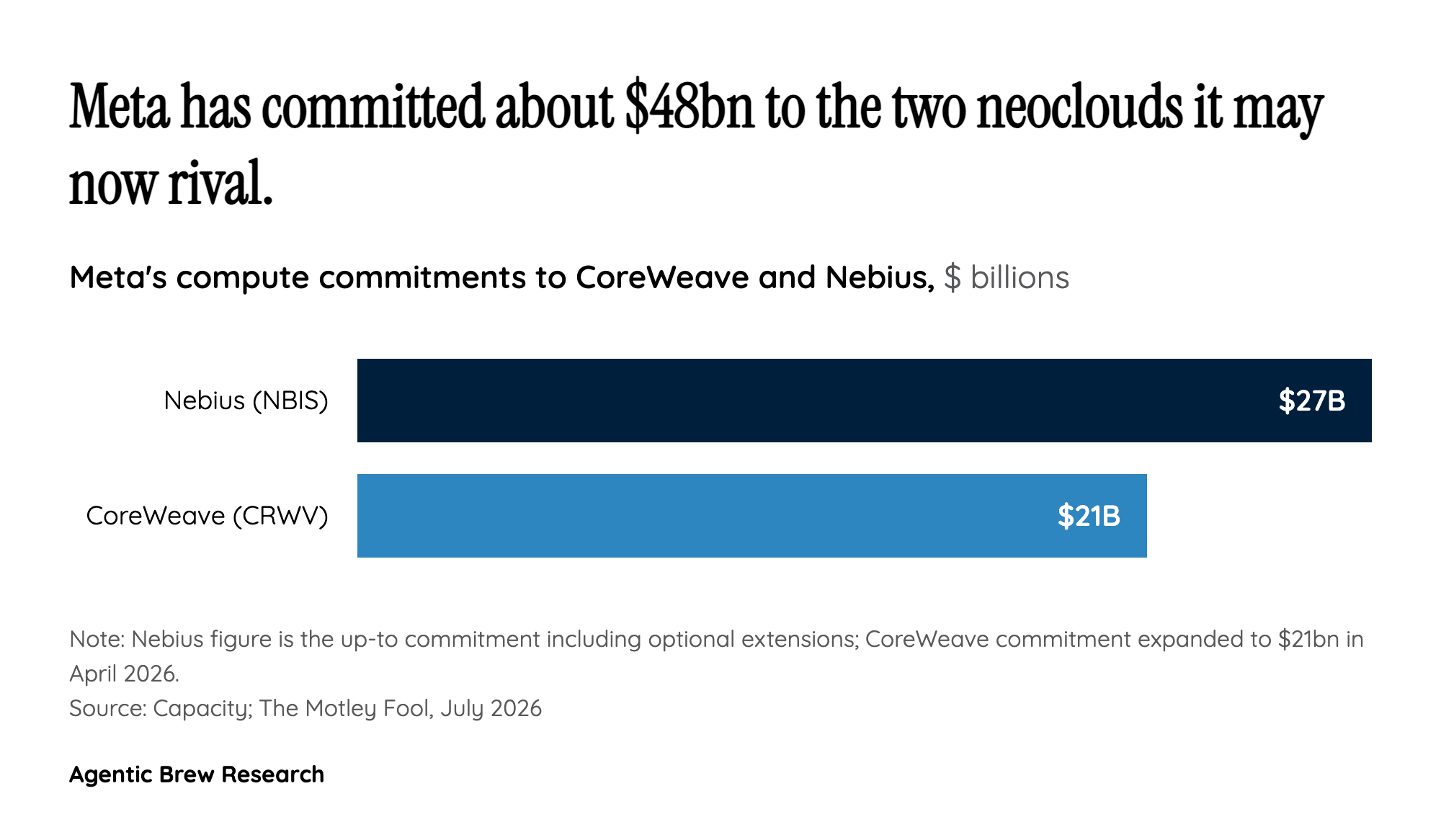
    Meta is both the largest anchor customer of both neoclouds and a potential rival, with combined commitments near $48bn - $21bn to CoreWeave and up to $27bn to Nebius.

Deep Analysis

Two tracks, one threat: only the raw GPU rental competes with neoclouds

The name to internalize is Meta Compute, and it is really two businesses wearing one label. The first track sells hosted access to Meta's own models - including its Muse Spark models - on Meta's infrastructure, an approach explicitly compared to AWS Bedrock [1]. The second track sells raw computing capacity, the bare rental product that specialist neocloud providers rent out today [4]. Only that second track puts Meta head-to-head with CoreWeave and Nebius; the Bedrock-style track competes more with model-hosting layers than with GPU landlords. That distinction matters because the market sold both neoclouds as if Meta had announced a pure rental war, when the reported plan is a portfolio in which raw rental is one option among several. SemiAnalysis maps four distinct use cases behind the fleet - frontier model training in Superintelligence Labs, scaling ad recommendation systems more than tenfold in complexity, hosting private Claude instances via Anthropic, and selling high-margin compute - none of which resemble a commodity rental business [2].

Validate or threaten: the case against a 30%-margin Meta

The bull rebuttal is that Meta will not behave like a discount landlord. SemiAnalysis argues Meta won't be a normal bare-metal IaaS vendor with roughly 30% gross margins because all its options are high value, and that even a couple hundred megawatts can already drive over $10bn of yearly revenue [2]. If a sliver of the fleet is that lucrative, Meta can even afford to pay margin to other neoclouds to accelerate its own buildout, which reframes the move as validation of - not a death sentence for - neocloud demand. That reading fits Capacity's framing of the choice as structural competitor versus bursty-capacity opportunist: training runs pin clusters near 100% utilization for weeks, then leave them at 30-50% between runs, so reselling surplus is a release valve for a fleet that is over-provisioned by design [3]. On that view, Meta selling slack does not mean the pie is shrinking; it means the fleet is so large that even its idle fraction is a business.

Follow the money: the $48bn customer that could become a competitor

Follow the money: the $48bn customer that could become a competitor
Meta's roughly $48bn in neocloud commitments - up to $27bn to Nebius and $21bn to CoreWeave - make it the anchor customer of the very companies it may now rival.

The uncomfortable arithmetic is that Meta is simultaneously the biggest customer and the newest rival. Its combined neocloud commitments sit near $48bn - $21bn to CoreWeave, expanded in April 2026, and up to $27bn to Nebius [3]. The Motley Fool's blunt formulation is that a Meta that builds enough capacity to sell the excess is a Meta that may eventually rent less of it [4], and that is why the exposure cuts differently for each name. CoreWeave carries roughly $25bn of debt with interest consuming nearly half its adjusted EBITDA, so any softening in its anchor tenant lands harder; the Fool leans toward Nebius as the better rebound bet on faster growth, expanding margins, positive operating cash flow, and lower debt reliance [4]. One near-term mitigant blunts the threat: Meta does not have the right to resell capacity leased from CoreWeave, through 2032, to third parties, which caps how quickly leased compute could reach market as a product [3].

The contrarian read: does Meta even have surplus to sell?

The sharpest bear-case rebuttal is that the premise is conditional. Meta expanded its CoreWeave deal in April 2026 precisely because its own buildout couldn't keep pace with demand [3], which is hard to square with a company drowning in sellable slack. Zuckerberg's own framing was hedged: selling excess or standing up an API service was an option only if Meta reached a point where it felt it had overbuilt [1]. On social channels the skepticism ran along two lines - a beta-selloff read arguing the neocloud drop was a market overreaction rather than a structural repricing, since Nvidia's muted reaction is inconsistent with a genuine demand shock, and an execution read invoking Meta's metaverse and Llama stumbles. Yet even bears concede a counterpoint: unlike the metaverse, Meta has run its own infrastructure at scale for years, so the operational competence question is weaker here. The through-line across bull, bear, and contrarian camps is that the day's price action priced a certainty the reporting does not yet support.

Historical Context

2026-01
Meta committed to a roughly $600bn three-year AI infrastructure buildout with $115-135bn for 2026, including the roughly 5GW Hyperion super cluster in Louisiana and the 1GW Prometheus cluster in Ohio.
2026-04
Meta expanded its CoreWeave agreement to $21bn because its own data centre buildout couldn't keep pace with demand.
2026-05
Zuckerberg publicly said selling excess compute or standing up an API service was an option Meta was considering if it overbuilt infrastructure.

Power Map

Key Players
Subject

Meta enters AI cloud business, reshaping neocloud outlook for CoreWeave and Nebius

ME

Meta Platforms (META)

New entrant monetizing excess AI compute and the largest anchor customer of both CoreWeave and Nebius, giving it leverage to potentially insource. Stock rose roughly 9% on the news. Initiative is led by infrastructure chief Santosh Janardhan, Superintelligence Labs leader Daniel Gross, and President Dina Powell McCormick.

CO

CoreWeave (CRWV)

Neocloud whose Meta dependency (a $21bn commitment) makes it vulnerable; shares plunged about 13.9%. Carries roughly $25bn of debt with interest consuming nearly half its adjusted EBITDA.

NE

Nebius Group (NBIS)

Neocloud with a Meta agreement worth up to $27bn; shares sank about 17%. Seen by one analyst as the better rebound bet on faster growth, expanding margins, positive operating cash flow, and lower debt reliance.

AN

Anthropic

In final talks with Meta to provide private instances of Claude on Meta's infrastructure - one of Meta's four high-value compute use cases.

AM

Amazon Web Services (AWS)

Incumbent hyperscale competitor in the AI cloud market Meta would enter; Meta Compute is framed as putting Meta in direct competition with AWS, and its model-hosting track is explicitly compared to AWS Bedrock.

Fact Check

4 cited
  1. [1] Meta Builds Cloud Business to Sell AI Compute
  2. [2] Meta Compute: Everyone Wants To Be A Neocloud
  3. [3] Meta's $48bn cloud question
  4. [4] CoreWeave and Nebius Plunged 14% and 17% in a Single Day. Which Beaten-Down AI Cloud Stock Is the Better Rebound Bet?

Source Articles

Top 5

THE SIGNAL.

Analysts

"Both the overcapacity-bear and neocloud-collapse takes are wrong; Meta's compute procurement will accelerate, not slow, and Meta would be a selective, high-value participant rather than a low-margin bare-metal vendor. It argues Meta won't be a normal bare-metal IaaS vendor with roughly 30% gross margins because all its options are high value, and that even a couple hundred megawatts can already drive over $10bn of yearly revenue."

SemiAnalysis
Semiconductor and AI infrastructure research firm

"Estimates Meta has accumulated 20 gigawatts of global capacity with another 14GW expected online within years, underscoring the scale behind Meta's potential compute-selling ambitions."

Madison Rezaei, Bernstein
Analyst, Bernstein

"Frames the debate as structural competitor versus bursty-capacity opportunist; reselling surplus is a natural release valve for a company that is over-provisioned by design, since training runs draw clusters to near-100% utilization for weeks then leave them at 30-50% between runs."

Capacity
Telecom and infrastructure trade publication

"If Meta builds enough capacity to sell the excess, it may eventually rent less from its suppliers; between the two neoclouds, Nebius is the better buy given CoreWeave's heavy debt load."

The Motley Fool
Investment media
The Crowd

"this is just a beta selloff for $MU and $SNDK -- there is a @vector__news story out that explains plainly why $META is not going to be renting out cloud compute anytime soon. if the market was taking this seriously $NVDA would be -10% to -20%, recommend buying momentum"

@@MartinShkreli2900

"CoreWeave and Nebius are two of the most undervalued stocks in the entire AI infrastructure space (Save this). And the Meta cloud announcement this week just made the case more obvious than ever. When Meta announced it is building a cloud business to sell excess compute at https://t.co/u1YEZRbst6"

@@MilkRoadAI262

"🚨 NEW: Meta is reportedly developing a cloud infrastructure business to sell AI computing power, setting up competition with AWS, Azure, and Google Cloud, per Bloomberg. https://t.co/nctfSCmA9x"

@@Cointelegraph142

"Meta is developing a cloud infrastructure business that will sell access to AI compute and aims to compete with Amazon, Microsoft, and Google. Meta shares are surging over +7% on the news"

@u/RobertBartus203
Broadcast
Meta to Build Cloud Business to Sell Excess AI Compute | Bloomberg Tech 7/01/2026

Meta to Build Cloud Business to Sell Excess AI Compute | Bloomberg Tech 7/01/2026

Are IREN, Nebius, & CoreWeave In BIG Trouble?

Are IREN, Nebius, & CoreWeave In BIG Trouble?

BREAKING: Meta's Compute Cloud: Winners & Losers

BREAKING: Meta's Compute Cloud: Winners & Losers