Top platforms for building AI agents
TECH

Top platforms for building AI agents

31+
Signals

Strategic Overview

  • 01.
    The leading production-ready AI agent frameworks in 2026 include LangGraph, Claude Agent SDK, CrewAI, AutoGen, Semantic Kernel, LlamaIndex, and Pydantic AI, with no single best choice; the right pick depends on where orchestration complexity sits and which framework integrates cleanest with the underlying context layer.
  • 02.
    The AI agents market was valued at USD 7.84B in 2025 and is projected to reach USD 52.62B by 2030 at a 46.3% CAGR, with vertical AI agents (62.7% CAGR) and coding/software agents (52.4% CAGR) growing fastest.
  • 03.
    Despite the hype, fewer than 12% of enterprises have successfully moved agent-based systems into production, and evaluation now consumes 60-80% of development time.
  • 04.
    A parallel no-code tier has emerged where platforms like Dust, Copilot Studio, Relevance AI, and tools such as MetaGPT's MGX let non-engineers build agents through natural language and visual interfaces.

There is no 'best' framework — only the right tool for what you are shipping

The defining shift of 2026 is the collapse of the 'one best framework' question. The strongest production-ready options — LangGraph, Claude Agent SDK, CrewAI, AutoGen, Semantic Kernel, LlamaIndex, and Pydantic AI — each win a different deployment context, and the correct choice depends on where orchestration complexity sits and which framework integrates cleanest with the context layer underneath [1]. Vellum's framing is the clearest articulation of this: pick by what you are actually shipping, not by what is most general [1]. Mapped to deliverables, that means a single-operator assistant, production TypeScript agents on Mastra, custom multi-model workflows on LangChain, role-based teams on CrewAI, and multi-agent research on AutoGen. CrewAI itself encodes this duality in a two-layer architecture of Crews for dynamic role-based collaboration and Flows for deterministic, event-driven orchestration, balancing high-level autonomy against low-level control [2]. The community sentiment on X mirrors the framing precisely: the conversation has moved from 'which framework do I pick' toward the recognition that the framework was never the hard part.

The contrarian truth: the framework is the easy part, reliability is the cliff

Underneath the catalog of platforms sits a sobering reliability problem that no framework solves on its own. Model capability and agent reliability are not the same thing, and treating them as equivalent is precisely why so many deployments fail [3]. The math is brutal: if an agent has an 85% success rate at each of eight steps, the probability of completing the full workflow correctly is 0.85 to the eighth power — roughly 27% [3]. Worse, that degradation is quiet, with agents silently sliding from 94% to 79% accuracy over months because failures are distributed rather than loud [3]. The governance layer has not caught up either: fewer than 10% of organizations report robust governance frameworks for AI deployment [3]. This is why fewer than 12% of enterprises have moved agent systems into production despite the noise [4], and why evaluation now eats 60-80% of development time [5]. The production-first crowd on Reddit has internalized this completely — the operative axis there is debug latency at the 50th failed run, not feature counts at the demo.

Two audiences, two markets: developer frameworks versus no-code builders

The platform landscape has bifurcated into two non-overlapping audiences. On one side sit code-first frameworks for engineers; on the other, a no-code tier where business teams build agents through visual interfaces and natural language — Dust, Copilot Studio, and Relevance AI among them [6]. MetaGPT's MGX pushes this furthest, promising natural-language programming and end-to-end app generation with no code required, using multi-agent collaboration where predefined roles draft specs, architect modules, generate and refactor code, and write tests [7]. Mastra's own origin story captures the pressure driving this split: its community argued agent creation should not be limited to engineers [8]. The social signal exposes how large the no-code audience actually is — the highest-view YouTube tutorials on building agents skew almost entirely toward no-code SaaS stacks like n8n and Zapier rather than classic developer frameworks, and the recurring lesson across them is that platform choice is secondary to identifying the right tasks to automate.

Follow the money: a $52B market splitting into verticals

Follow the money: a $52B market splitting into verticals
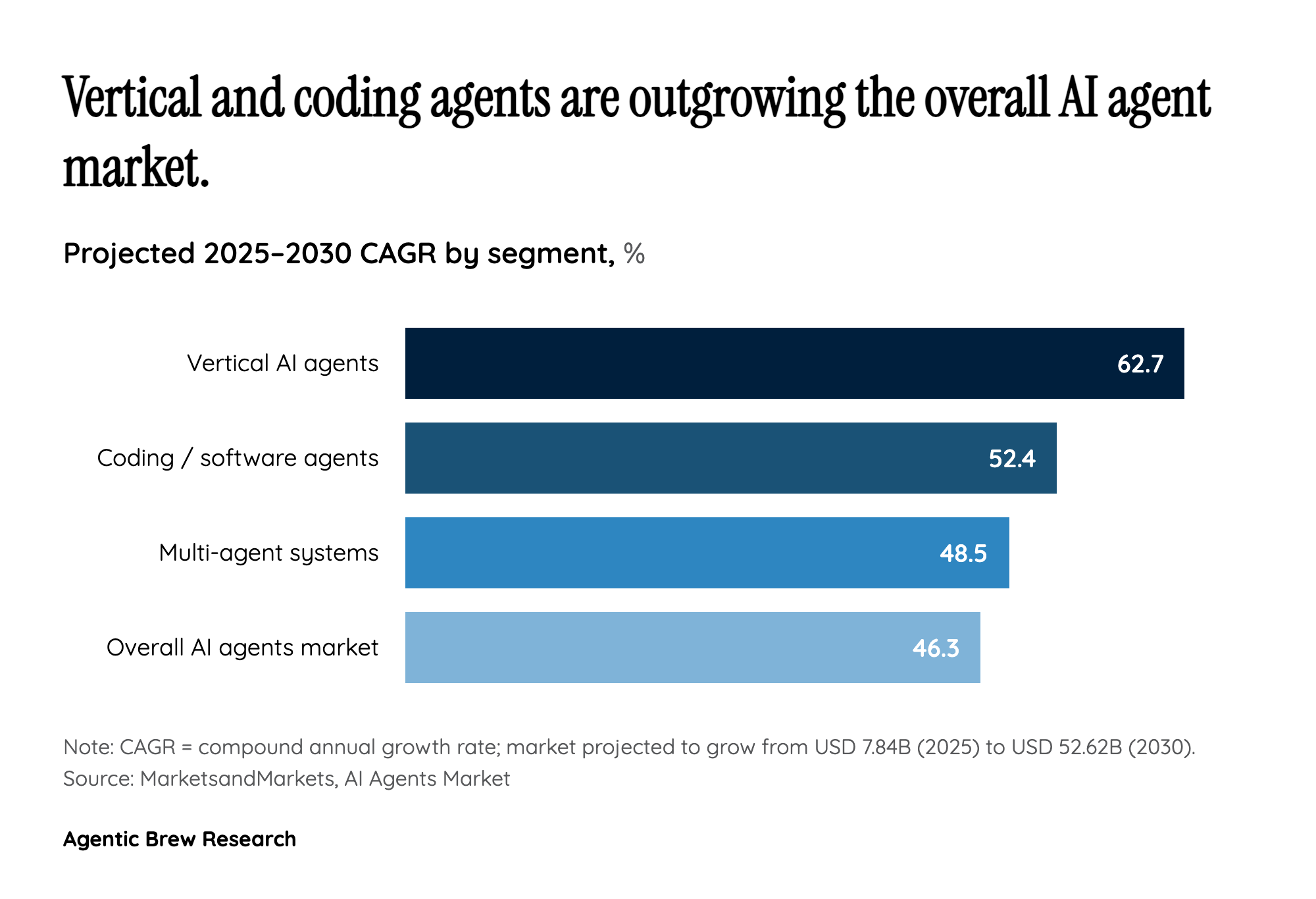
Vertical and coding-agent segments lead the AI agent market in projected 2025-2030 CAGR.

The commercial backdrop explains why the platform count keeps multiplying. The AI agents market was valued at USD 7.84B in 2025 and is projected to hit USD 52.62B by 2030 at a 46.3% CAGR [9], while Gartner expects 40% of enterprise applications to feature task-specific agents by 2026, up from under 5% in 2025 [8]. The fastest-growing slice is not horizontal but vertical — vertical AI agents are growing at 62.7% CAGR, coding/software agents at 52.4%, and multi-agent systems at 48.5% [9]. That dynamic has fractured the market into specialized verticals — compliance, support, deal-making, incident response, developer tooling — each with its own top-three platforms [6]. The lock-in effect compounds it: teams increasingly pick by existing stack — Devin or Claude Code for developers, Agentforce for Salesforce orgs, Copilot Studio for M365, and open-source frameworks where full control matters [10].

Historical Context

2022-01-01
LangChain was released as a general-purpose LLM orchestration toolkit, the same year Google proposed ReAct agents that laid the foundation for modern agent frameworks.
2023-04-01
AutoGPT went viral, becoming the 5th most-starred GitHub repository ever with 100,000+ stars in eight days and igniting the autonomous-agent wave.
2024-01-01
CrewAI launched in early 2024 and LangGraph emerged the same year, marking the shift from experimental scripts to structured multi-agent orchestration.
2024-10-01
Mastra launched as a TypeScript agent framework, going on to reach 22,000+ GitHub stars within 15 months and 300,000+ weekly npm downloads.
2025-01-01
AutoGen shipped its v0.4 release, a complete redesign aimed at improving code quality, robustness, and scalability.
2026-01-01
Mastra reached its 1.0 release, cementing TypeScript as a first-class language for agent development alongside Python.

Power Map

Key Players
Subject

Top platforms for building AI agents

LA

LangChain / LangGraph

Most widely adopted open-source LLM agent framework with 25M+ downloads; LangGraph is used in production by Klarna, Uber, LinkedIn, BlackRock, Cisco, and JPMorgan for branching, durable workflows.

MI

Microsoft AutoGen

Enterprise-focused multi-agent framework born from Microsoft Research; its v0.4 redesign (Jan 2025) overhauled code quality, robustness, and scalability, while Copilot Studio serves M365/Teams agent builders.

CR

CrewAI

Role-based multi-agent framework launched in early 2024 with 50,000+ GitHub stars and nearly 1M monthly downloads, popular for customer service and marketing automation.

MA

Mastra

Agent-first open-source TypeScript framework that hit its 1.0 release in January 2026 and forms part of the infrastructure 'shovels' layer serving agent builders.

SA

Salesforce Agentforce

Enterprise agent platform used by The Adecco Group, OpenTable, and Saks for faster, personalized customer responses; the natural fit for Salesforce-native organizations.

OP

OpenAI / Microsoft

Named star players in the AI agents market; OpenAI is classed as a dominant 'Star' and Microsoft as an 'Emerging Leader' on the strength of market share and product footprint.

Fact Check

11 cited
  1. [1] Top AI Agent Frameworks for Developers
  2. [2] AutoGen vs LangChain vs CrewAI
  3. [3] AI Agent Reliability and Production Failure in 2026
  4. [4] Comparing AI Frameworks 2026: LangChain, LangGraph, AutoGPT
  5. [5] Best AI Agent Framework
  6. [6] Best AI Agent Platforms 2026
  7. [7] MetaGPT Review: Is MGX the No-Code AI Agent Builder?
  8. [8] Agentic AI Frameworks
  9. [9] AI Agents Market
  10. [10] Top AI Agent Frameworks
  11. [11] Mastra AI: The Complete Guide to the TypeScript Agent Framework

Source Articles

Top 3

THE SIGNAL.

Analysts

"Frameworks should be chosen by what you are actually shipping, not by which one is most general; selection follows the deployment context rather than abstract capability."

Vellum
AI dev-tooling vendor (engineering blog)

"Model capability and agent reliability are distinct, and conflating them is why so many deployments fail; per-step success rates compound badly, so an agent that is 85% reliable across eight steps completes the full workflow correctly only about 27% of the time."

Inovabeing
AI reliability analysis blog
The Crowd

"Anthropic's in trouble, again! They spent years building what's now fully open-source. What made Claude feel different from a normal app is that the agent could act inside the interface instead of only talking in a chat box. For instance, Claude Artifacts let an agent render h..."

@@_avichawla1837

"Andrej Karpathy just explained the future of software engineering without directly saying it. The best AI engineers are no longer “prompting.” They’re building systems around the agents. Karpathy’s biggest insight wasn’t: “Claude can code.” It was: LLMs become dramatically more capable when you build the loop around them"

@@DivyanshT91162127

"You can build generative UI for your agents with ADK as the agent backend and AG-UI as the communication layer between agent and the UI. Generative UI goes beyond text and let your agent generate and render UI components directly in the chat."

@@Saboo_Shubham_11

"I compared 8 open-source AI agent frameworks so you don't have to — here's the full breakdown"

@u/docdavkitty14
Broadcast
You're Not Behind (Yet): How to Build AI Agents in 2026 (no coding)

You're Not Behind (Yet): How to Build AI Agents in 2026 (no coding)

Top 7 AI Agent Tools That Actually Work

Top 7 AI Agent Tools That Actually Work

8 AI Agents & Tools I Use to Make $1.6M / Year

8 AI Agents & Tools I Use to Make $1.6M / Year