Midjourney's full-body ultrasonic CT scanner
TECH

Midjourney's full-body ultrasonic CT scanner

34+
Signals

Strategic Overview

  • 01.
    Midjourney unveiled 'The Midjourney Scanner' and a new Midjourney Medical division: a full-body ultrasonic CT device that lowers a person through a ring of ultrasonic transducers in a shallow pool of water and targets a roughly 60-second 3D anatomical map with no radiation or magnets.
  • 02.
    The prototype uses 40 Butterfly Network Ultrasound-on-Chip modules and roughly half a million transducer elements backed by more than two petaflops of compute, under a co-development agreement worth up to $74 million over five years.
  • 03.
    The device is not FDA-cleared; Midjourney plans to begin with non-diagnostic body-composition maps, open a first 'Midjourney Spa' in San Francisco by the end of 2027, and scale toward 50,000 scanners and roughly one billion scans per month by the early 2030s.
  • 04.
    The current prototype takes roughly 20 minutes per scan rather than 60 seconds, has been used on about a dozen people, and uses no AI in its imaging pipeline yet.

Deep Analysis

The AI Company That Built This Without AI

The headline writes itself: Midjourney, famous for conjuring images from text prompts, just unveiled a full-body medical scanner. The twist is that there is no AI inside it yet. At the reveal, founder David Holz was blunt: 'We're not even using any AI in this yet, just really cool hardware and software' [2]. What the scanner actually does is physics. A person descends on a platform through a ring of ultrasonic transducers in a shallow pool of water, the array fires sound through the body from every angle, and software reconstructs the returning echoes into a 3D anatomical map [1].

So why does an image lab care? Because the hard part of ultrasonic computed tomography is not the sound, it is the reconstruction. Turning hundreds of thousands of scattered acoustic measurements into a clean picture of muscle, bone, and organs is a classic inverse problem, mathematically the same shape as turning visual noise into a coherent face. That is precisely the competency Midjourney spent years building, and the company's stated plan is to layer AI-driven reconstruction on later, once enough scans exist to train on [1]. In other words, the 'AI scanner' framing is a bet on the future, not a description of the present: today it is a hardware project wearing an AI brand, and the intelligence is the part that has not shipped.

The Partner Midjourney Barely Mentioned

Strip away the spa imagery and the scanner rests on someone else's silicon. The imaging modules come from Butterfly Network, the ultrasound-on-chip company, under a co-development agreement worth up to $74 million over five years that was filed in November 2025, months before the public reveal [3]. The current prototype packs 40 Butterfly modules and roughly half a million transducer elements [4].

Butterfly was careful in how it endorsed the project. CEO Joseph DeVivo called it 'a potentially meaningful commercial opportunity for Butterfly' and praised the mission to 'democratize access to personal imaging data,' while framing the partnership around prevention rather than vouching for any diagnostic claim [3]. The dependency matters because it relocates the novelty. The genuinely new piece is the reconstruction stack Midjourney is promising to build, not the off-the-shelf chips doing the sensing. The most-shared version of this story, 'Midjourney built medical hardware,' is underneath a quieter one: Midjourney integrated Butterfly's hardware and is betting its software can finish the job.

Why It's a Spa, Not a Hospital

Putting these machines in a 25,000-square-foot wellness spa near Union Square, alongside saunas and cold plunges and opening at the end of 2027, is not just branding [5]. It is a regulatory route. A device that produces diagnostic images needs FDA clearance, a multi-year gauntlet of clinical trials and comparative studies. A service that sells 'body composition maps' as a wellness amenity does not [5]. By launching as a spa experience that explicitly avoids diagnostic claims, Midjourney can start scanning paying customers while it climbs the FDA ladder one approved use at a time.

That sequencing is the entire go-to-market. The stated ambition, on the order of 50,000 scanners and a billion scans a month by the early 2030s [4], only becomes a medical product if the regulatory path clears. Until then the spa is both the storefront and the legal shelter, and the scans it sells are, by design, not something a doctor can act on. The flip side is the prize Midjourney clearly wants: a billion monthly full-body scans would be the largest longitudinal dataset of human anatomy ever assembled, and that, not the scan fee, is the asset an image company would covet.

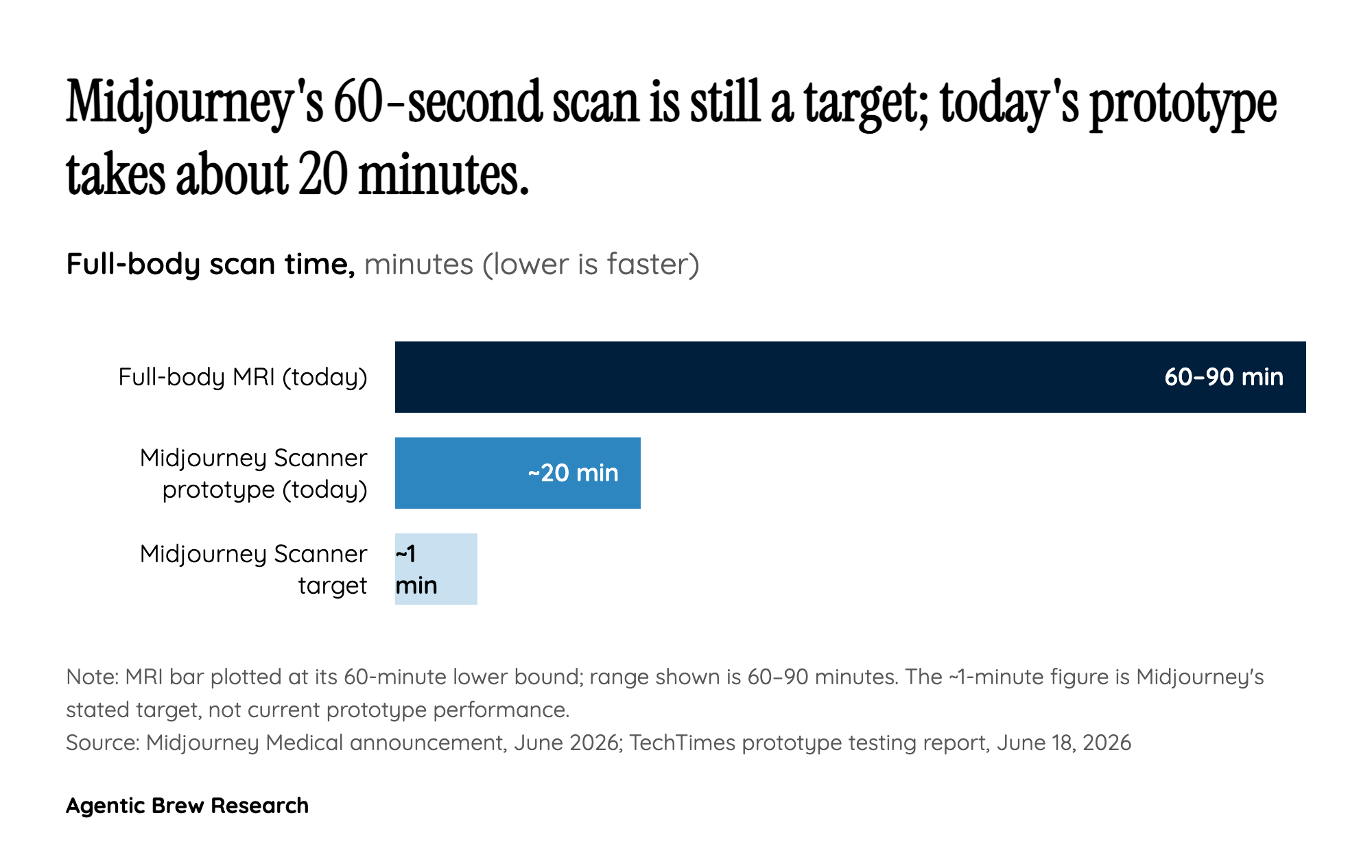
By The Numbers: A 60-Second Claim Meets a 20-Minute Prototype

By The Numbers: A 60-Second Claim Meets a 20-Minute Prototype
Midjourney's stated 60-second target versus its current ~20-minute prototype and a conventional full-body MRI.

The marketing number is 60 seconds, a full-body scan in the time it takes to read this paragraph, pitched at 'nearly a hundred times the speed' of an MRI [1]. The reality today is more modest. The working prototype currently takes roughly 20 minutes per scan and has been used on about a dozen people, with the one-minute figure framed as a target for future hardware generations [6].

The gap cuts both ways. Even at 20 minutes the device would still be several times faster than a 60-to-90-minute full-body MRI, with no radiation and no magnets [5], a real advance if the image quality holds up. But 'a target for future hardware' is doing a lot of work in every breathless retelling, and the leap from a 20-minute prototype tested on twelve people to a planet-scale imaging network is exactly the part that has not been demonstrated.

What the Skeptics Are Saying

The loudest counter-voices are not Luddites; many are radiologists. The recurring objection is that whole-body screening of healthy people surfaces incidentalomas, benign findings that trigger anxiety, follow-up procedures, and cost without improving outcomes [7]. Compounding it, there is no peer-reviewed validation of the scanner's accuracy against MRI or CT, and no independent radiologist has publicly evaluated its image quality [7].

Online, the technical critique sharpened into a specific fear: that Midjourney's image-generation models could be used to upscale sparse scan data, and that generative reconstruction tends to fill in the most probable tissue, which for a healthy-looking body means inventing healthy tissue and potentially papering over real disease. Comparisons to Theranos and to the Therac-25 radiation-overdose disaster circulated widely as shorthand for the discomfort of an image-generation company entering safety-critical medicine. None of this proves the scanner does not work. It explains why the people best positioned to judge medical imaging are asking to see the actual images before they believe the press release.

Historical Context

1975
Early researchers demonstrated transmission ultrasound to image breast tissue, an origin point for ultrasound computed tomography (USCT), a modality that took decades to become computationally practical.
2025-11-17
The two companies entered a co-development agreement worth up to $74 million over five years, months before the public scanner reveal.
2026-06-17
Holz publicly unveiled the Midjourney Scanner and the Midjourney Medical division at a San Francisco event.

Power Map

Key Players
Subject

Midjourney's full-body ultrasonic CT scanner

MI

Midjourney / David Holz

The AI image-generation lab and its founder driving the pivot into medical imaging hardware. Holz unveiled the scanner and set the ambition; Midjourney self-funds the effort and controls the reconstruction stack it plans to build.

BU

Butterfly Network / Joseph DeVivo

Hardware partner supplying the Ultrasound-on-Chip modules under a co-development deal worth up to $74M over five years. Without Butterfly's chips there is no scanner, which gives the company real leverage and a direct commercial stake in the project's success.

U.

U.S. Food and Drug Administration (FDA)

The regulator gating any diagnostic use. By withholding clearance it confines Midjourney to non-diagnostic body-composition maps; each future medical claim depends on incremental FDA approval, making the agency the rate limiter on the entire roadmap.

RA

Radiologists and the clinical community

The gatekeepers of clinical credibility. Their willingness to trust and act on the images determines whether the scanner becomes a medical tool or stays a wellness gadget; many are currently vocal skeptics demanding peer-reviewed validation.

Fact Check

7 cited
  1. [1] Midjourney Medical
  2. [2] Midjourney unveils a full-body ultrasound scanner and Midjourney Medical
  3. [3] Butterfly Network Provides Commentary on Midjourney Medical's Full-Body Ultrasound Scanner Announcement
  4. [4] Midjourney unveils planned ultrasound scanner with help from Butterfly
  5. [5] Midjourney Enters Medical Imaging With 60-Second Full-Body Scan
  6. [6] Midjourney Full-Body Ultrasound Scanner Targets MRI Speed; Prototype Runs 20 Minutes
  7. [7] Midjourney Medical Controversy: Expert Reactions

Source Articles

Top 5

THE SIGNAL.

Analysts

"Framed the partnership as a preventive-care play and 'a potentially meaningful commercial opportunity for Butterfly,' supporting Midjourney's mission to democratize personal imaging while pointedly not vouching for diagnostic claims."

Joseph DeVivo
President, CEO and Chairman, Butterfly Network

"Called the reveal something he 'genuinely did not see coming' and a potential leap for preventive medicine if validated, while flagging that it is a Gen-1 prototype tested on only about a dozen people and not yet FDA-cleared."

Afshine Emrani, MD FACC
Cardiologist

"Warn that whole-body screening of healthy people risks incidentalomas that trigger unnecessary follow-up and anxiety, that no peer-reviewed validation against MRI or CT exists, and that the data-governance and HIPAA status of the scans is undisclosed."

Radiologists and privacy researchers (as reported by ExplainX)
Clinical and data-governance critics
The Crowd

"I'm a cardiologist. Something just happened today that I genuinely did not see coming — and it could change the future of preventive medicine more than anything I've written about on this platform. Midjourney — the AI company that became famous for generating images from text"

@@afshineemrani7350

"Midjourney Full Body Medical Scanner. Everything you need to know. Read on."

@@BrianRoemmele876

"Midjourney's massive pivot into the personal health and medical industries. Its first hardware project, a scanner that reads your body in 60 seconds, with 'full-body ultrasound machine'. The plan is to put people in water, lower them through a sensor ring, send ultrasound"

@@rohanpaul_ai635

"Midjourney, The Image Generation Company, Just Built the Sequel to the MRI"

@user1300
Broadcast
Midjourney's New Scanner Could Change Everything

Midjourney's New Scanner Could Change Everything

The World's First Full-Body Ultrasound CT Scanner? Midjourney Just Revealed It

The World's First Full-Body Ultrasound CT Scanner? Midjourney Just Revealed It

BREAKING: Midjourney Pivots to Medicine - Its AI Body Scanner Is Taking On the MRI Industry

BREAKING: Midjourney Pivots to Medicine - Its AI Body Scanner Is Taking On the MRI Industry