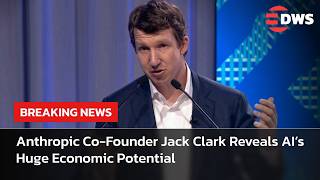
One number, three scenarios: how the headline figure lost its context
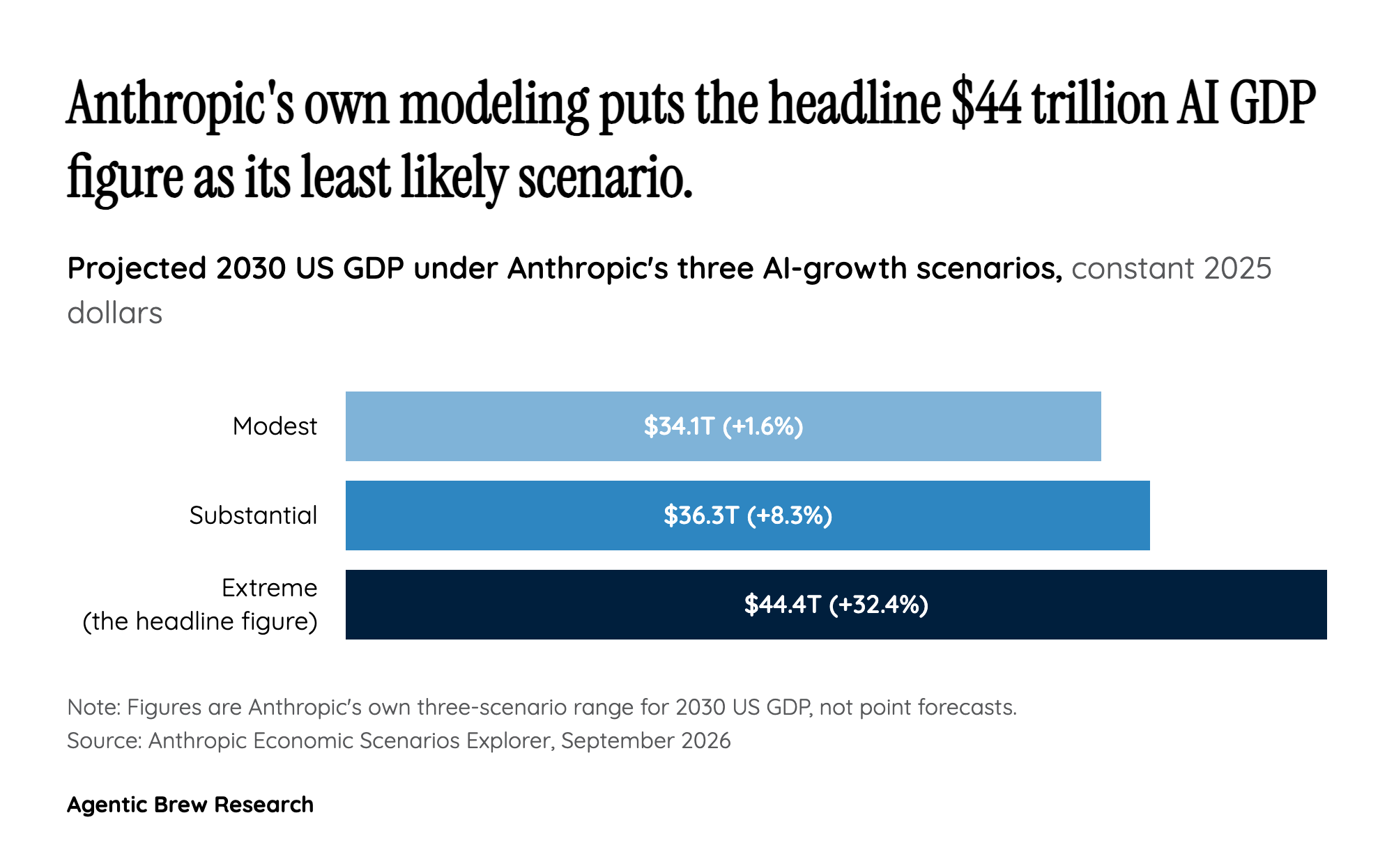
The $44 trillion figure that dominated coverage is not Anthropic's forecast - it is the top end of a three-scenario model the company published in September 2026. The Modest case puts 2030 US GDP at $34.1 trillion, just 1.6% above baseline; the Substantial case puts it at $36.3 trillion, up 8.3%; and only the Extreme case reaches $44.4 trillion, a 32.4% jump above baseline, all measured in constant 2025 dollars [1]. Clark himself flagged the awkwardness of leading with the outer edge of the range, telling the Bangkok audience the figure 'sounds very outlandish, I know' before presenting it anyway [4].
That framing choice matters because it collapsed a probabilistic range into a single headline number almost everywhere the story traveled. Finance-oriented accounts on social media treated 'AI could push US GDP to $44 trillion' as breaking macro news, repeating Clark's own hedge about the figure sounding outlandish without surfacing the Modest or Substantial alternatives at all. The effect is a classic selective-salience problem: the most dramatic scenario becomes the only scenario the public remembers, even though Anthropic's own modeling treats it as the least likely of the three paths.
A top comment on the r/Economics discussion of the forecast made a similar point with different numbers: it described the $44 trillion figure as Anthropic's own 'best case, most optimistic' scenario, measured against a baseline of $33.5 trillion and an expected outcome of $36 trillion, and noted that 44% of that growth is modeled as accruing to capital - a detail that nuances any framing of the forecast as primarily a story about worker productivity gains.