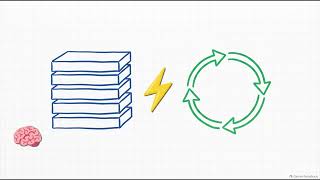
Recurrent Looped Transformer (RLT) architecture
TECH

Recurrent Looped Transformer (RLT) architecture

36+
Signals

Strategic Overview

  • 01.
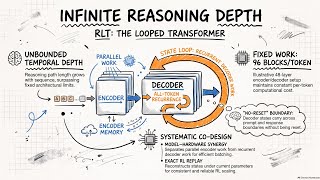
    RLT pairs a causal encoder that builds a global key-value memory with a recurrent decoder that carries its final hidden state and layerwise sliding-window attention cache across every prompt and response token. The reference configuration stacks 48 encoder layers with 48 decoder layers, for 96 logical blocks executed per token.
  • 02.
    Because the decoder loops, a token at position t sits at the end of a recurrent path of length t times the decoder depth, which the author calls unbounded temporal depth - not unbounded compute per token, since per-token cost stays fixed.
  • 03.
    The same state-transition rule is reused across pretraining, supervised fine-tuning, sampling, and reinforcement-learning replay and rollouts, with no reset at the prompt-to-response boundary, unlike ordinary decoder-only transformers that switch between separate prefill and decode paths.
  • 04.
    The technical report, titled 'Recurrent Looped Transformer: Latent Reasoning with Infinite Temporal Depth,' was published September 12, 2026 by Princeton researcher Yifan Zhang, hosted on alphaXiv and the author's own project page rather than arXiv proper.
  • 05.
    Code, paper, and project page were released under the Apache License 2.0.
  • 06.
    The paper reports no large-scale reasoning-quality, efficiency, or RL-scaling results; it defines the architecture, execution schedules, and an RL replay contract only, describing performance gains as research goals rather than measured findings.
  • 07.
    The only empirical evidence in the repo is a small synthetic state-tracking test (about 79,000 parameters, 3 seeds), explicitly labeled preliminary: RLT beat a standard Transformer on a parity task at 4x training length, but roughly matched-to-underperformed it on a five-state-transitions task at the same length.
  • 08.
    Separately reported independent testing found a plain GRU outperforming RLT on the same 79K-parameter state-tracking setup at 4x training length, and two unofficial open-source reimplementations (lucidrains' pip-installable rlt-pytorch and a second port by developer awdemos) appeared within days of release.

The mechanism: recurrence bolted onto a transformer

RLT splits into two halves. A causal encoder reads the full sequence once and builds a global key-value (KV) memory - the cached attention keys and values a model normally computes once per prompt so it doesn't redo that work at every generation step. A recurrent decoder then processes tokens one at a time, but instead of starting fresh each step it carries forward its own hidden state and a layerwise sliding-window attention cache (a fixed-size rolling window of recent context, rather than attending to everything ever seen) across every prompt and response token. The reference build stacks 48 encoder layers on top of 48 decoder layers, so a single token triggers 96 logical blocks of computation [1]. Coverage of the report frames this as merging two lineages that normally stay separate: the parallelizable, one-shot-context style of transformers, and the step-by-step, state-carrying style of RNNs [2].
"Infinite reasoning depth" versus what the numbers show

The headline claim is that reasoning depth grows with sequence length at fixed per-token cost - a token at position t effectively sits behind a recurrent chain t times as long as the decoder's own depth, which the author describes as unbounded temporal depth rather than unbounded compute [3]. But the only measurements offered are on a roughly 79,000-parameter synthetic model. On a parity task extended to four times the training length, RLT scored 60.8% against about 48% for a plain Transformer baseline - a real gap, but far short of the near-perfect accuracy such toy tasks are meant to demonstrate. On a five-state-transitions task at the same 4x length, RLT scored 20.7% against roughly 21% for the baseline, meaning the architecture's supposed depth advantage evaporated entirely on a different task type [1]. Separately reported independent testing found a plain GRU (a much simpler, decades-old recurrent unit) beating RLT outright on the same state-tracking setup [4], undercutting the case that the added architectural complexity buys anything concrete yet.

One state-transition rule for training, sampling, and RL - at a cost

The design's other pitch is unification: pretraining, supervised fine-tuning, sampling, and RL rollouts all reuse the identical state-transition rule, with no reset at the prompt-to-response boundary the way ordinary decoder-only transformers reset between prefill and decode [2]. That is architecturally elegant, but it is also unproven at any scale beyond the synthetic experiment, and the report itself frames the promised reasoning and hardware-efficiency gains as goals for future work rather than results already achieved [2].

Viral hype, rapid reimplementation, skeptical reception

The author's own announcement framed RLT in maximalist terms, and it drew the highest engagement of any post about it - a stark contrast with the response once people looked at the underlying report. Two unofficial open-source ports appeared within days: lucidrains published a pip-installable implementation covering training, sliding-window decoding, and optional truncated backpropagation through time [5][6], and a second independent port followed shortly after [7]. Reception elsewhere was considerably cooler: technical commenters focused less on whether recurrent-transformer hybrids are plausible and more on monitorability - the concern that looping pushes part of a model's reasoning into unreadable numerical latent states rather than inspectable text [8], echoing broader skepticism that a paper attracting fast reimplementation still shipped with no benchmark results at all.

Historical Context

2018
Earlier work combining weight-sharing across layers with Adaptive Computation Time for input-dependent halting - the original 'looped transformer' concept RLT is compared against, differing by organizing recurrence across sequence positions rather than repeated depth iterations.
2026-07
Zhang's own earlier paper proposing a scaling rule for looped transformers that decouples depth from parameter count, a direct predecessor of RLT's design lineage.
2026-09-12
RLT technical report, project page, code, and Apache-2.0-licensed weights and paper released.
2026-09-13
Mainstream tech-press coverage of RLT appears, noting the report is a design specification with no empirical validation at scale.

Power Map

Key Players
Subject

Recurrent Looped Transformer (RLT) architecture

YI

Yifan Zhang

Princeton PhD candidate and author of RLT; also authored the earlier related paper DeepLoop on depth scaling for looped transformers

LU

lucidrains

Independent open-source developer who published an unofficial PyTorch implementation of RLT within days of release

MA

MarkTechPost

Tech publication that covered the RLT technical report

AL

AlphaSignal

AI news outlet that covered RLT's architecture and the GRU-versus-RLT test result

EX

explainx.ai (Yash Thakker)

Published a critical analysis comparing RLT to Universal Transformers and ACT, flagging interpretability and evidentiary gaps

Fact Check

8 cited
  1. [1] Recurrent Looped Transformer (GitHub repository)
  2. [2] Recurrent Looped Transformer: Infinite Reasoning Depth? - explainx.ai
  3. [3] Yifan Zhang's RLT Grows Transformer Depth With Every Token Generated - AlphaSignal
  4. [4] A Princeton Researcher Proposes Recurrent Looped Transformer (RLT) - MarkTechPost
  5. [5] lucidrains/RLT - unofficial PyTorch implementation
  6. [6] RLT-pytorch on PyPI
  7. [7] awdemos/recurrent-looped-transformer - independent implementation
  8. [8] Recurrent Looped Transformer discussion - Hacker News

Source Articles

Top 4

THE SIGNAL.

Analysts

Flags that no benchmark results, trained checkpoints, or falsifiable performance claims were published, and raises interpretability concerns since latent reasoning under this scheme is never externalized as text. Concludes the viral framing outran the actual research contribution.

explainx.ai (Yash Thakker)
Critical / skeptical analysis

The most substantive pushback was not about whether looped/recurrent transformer variants are plausible in principle, but about monitorability and termination - looping shifts part of the model's reasoning into unreadable numerical latent states rather than readable chain-of-thought text.

Hacker News technical commenters (aggregated, unnamed)
Mixed - architecture seen as plausible but under-evidenced
The Crowd

We are at the dawn of Superintelligence. Introducing the Recurrent Looped Transformer (RLT), We now have Transformers with Infinite Reasoning depth. From now on, we should pace progress at the Open Frontier of Superintelligence, Until Safe Superintelligence is achieved.

@@yifanzhang_7302

I put together a mega write-up on GPT-6 Astra & looped transformers. How looped transformers / recurrent depth works, cost-tradeoffs, whether it hides reasoning traces, with lots of figures and a tour of recent looped transformer research.

@@rasbt2290

"Recurrent Looped Transformer" This paper makes the decoder recurrent across every prompt and response token, while a causal encoder provides reusable global KV memory. Longer sequences then create deeper latent computation paths without adding more physical layers, while...

@@askalphaxiv1790

A Princeton Researcher Proposes Recurrent Looped Transformer (RLT) that Carries Decoder State across Every Token, Fixing 96 Blocks per Token with Unbounded Temporal Depth

@u/ai-lover72
Broadcast
Recurrent Looped Transformer Explained: New Benchmarks Put "Infinite Reasoning Depth" to the Test

Recurrent Looped Transformer Explained: New Benchmarks Put "Infinite Reasoning Depth" to the Test

Recurrent Looped Transformer: Infinite Depth Through Hardware Co-Design

Recurrent Looped Transformer: Infinite Depth Through Hardware Co-Design

Recurrent Looped Transformer

Recurrent Looped Transformer