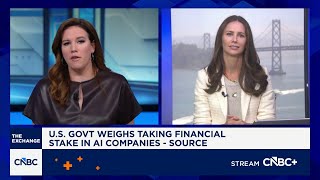
Trump administration weighs government equity stakes in US AI companies
TECH

Trump administration weighs government equity stakes in US AI companies

38+
Signals

Strategic Overview

  • 01.
    Senior U.S. officials have held preliminary talks with major AI companies about the federal government acquiring shares in their firms, with White House meetings involving AI executives reported for the week ahead.
  • 02.
    Trump told reporters aboard Air Force One that pieces of AI companies could be handed to the public, framing the arrangement as making the American public a 'partner' with the companies.
  • 03.
    The leading proposal centers on OpenAI donating equity to seed a 'Public Wealth Fund' that gives every citizen a stake in AI-driven growth, with returns potentially distributed directly to the public.
  • 04.
    No legal framework currently exists for transferring private AI-company equity to the federal government, and the differing corporate structures of OpenAI, Anthropic, and xAI complicate any uniform approach.

Deep Analysis

A donated stake with no door to walk through

The mechanics are where the idea wobbles. Rather than taxpayers buying into OpenAI at its $850B-plus valuation, the company would donate equity to seed a 'Public Wealth Fund,' whose proceeds could flow directly to citizens, including those who own no stocks at all [1]. That structure is clever because it sidesteps a cash outlay from a government already swimming in debt. But the cleverness ends at the implementation. As The Next Web's reporting bluntly frames it, the most fundamental obstacle is mechanical: there is no legal framework for moving private AI-company equity onto the federal balance sheet [3]. Compounding that, OpenAI, Anthropic, and xAI are wired differently at the corporate level, so a template that works for one could be useless for the next [3]. A 'partnership with the American public' is an appealing slogan; it is not yet a transaction anyone can describe.


The Intel playbook reaches for AI

This is not coming out of nowhere. Trump has taken partial government ownership of U.S. firms more aggressively than any recent president, with direct investments in at least 10 companies during his second term, including Intel, Lithium Americas, and Trilogy Metals [1][4]. The clearest precedent is MP Materials, where the Defense Department put up a $400M preferred-equity stake, committed to as much as $350M more, and added a $150M loan to stand up a domestic rare-earth magnet supply chain [5]. Those deals were sold on national-security and supply-chain logic, and Trump has called the Intel arrangement a 'direct windfall for American taxpayers' [1]. AI is the natural next target for that worldview: strategically vital, dominated by a few firms, and minting paper wealth at a scale no policymaker wants to watch from the sidelines. The equity-stake habit, in other words, has a runway.

Three visions of public ownership, none agreeing on how much

What looks like one debate is really three competing proposals. Trump's version is the vaguest and softest: a donated stake, a 'partnership,' a promise to 'look into it' [2]. Bernie Sanders sits at the opposite pole, floating a 50% government equity stake in the largest AI firms via an AI Sovereign Wealth Fund Act, levied as a one-time 50% stock tax paid in shares [1][3]. And then there is the opposition from inside Trump's own coalition: former AI czar David Sacks, who argues that deeper government ownership would 'accelerate the corporate-government fusion we're already sliding toward' and warns against nationalization and bailouts [2]. The striking thing is the ideological scramble. A Republican president is entertaining what critics call nationalization, a democratic socialist senator wants to go further still, and a libertarian-leaning ally is the one yelling stop. The usual political map does not apply here.

The trust gap between 'partner' and 'bailout'

The framing battle may matter more than the policy. The administration sells this as ordinary Americans sharing in AI's upside; the audience is not buying the pitch at face value. Public Knowledge's Nat Purser names the cleanest structural problem: the government would be 'a shareholder and a regulator at the same time, which creates substantial conflicts of interest' [1]. That critique landed even harder in the financial communities, where the dominant read was that this is a thinly disguised bailout or market pump for AI firms, profits accruing to insiders while taxpayers absorb the downside, with sharp skepticism that any 'public stake' would carry voting power or real economic interest. A smaller camp connected it to Sanders' sovereign-wealth logic, reasoning that if AI is going to take their jobs they may as well own a slice of it. Across business television the story was treated as a market-moving event, with traders tying the AI-stake chatter to broader tech volatility. When the same proposal reads as 'partnership' to its authors and 'self-dealing' to its audience, the gap itself becomes the political risk.

Historical Context

2025-01-01
Altman first pitched the public-stake / Public Wealth Fund idea to the Trump administration in early 2025, and has revived the conversation in recent weeks.
2025-07-01
The Department of Defense took a $400M Series A preferred equity stake in MP Materials, plus up to $350M more and a $150M loan, to build a U.S. rare-earth magnet supply chain.
2025-12-01
By late 2025 the administration had made direct investments in at least 10 companies, including Intel, MP Materials, Lithium Americas, and Trilogy Metals.
2026-04-01
OpenAI outlined the 'Public Wealth Fund' concept in an April policy proposal, the document now anchoring the administration's discussions.
2026-06-05
Trump told reporters his team would look into the U.S. taking stakes in AI companies, with White House meetings involving AI executives reported for the following week.

Power Map

Key Players
Subject

Trump administration weighs government equity stakes in US AI companies

DO

Donald Trump

President publicly endorsing the idea; said his team would 'look into' the U.S. taking stakes and framed it as making the public a 'partner' with AI firms, citing the Intel deal as a windfall for taxpayers.

SA

Sam Altman / OpenAI

OpenAI CEO who originated the proposal; the company, valued at $850B+, would donate equity to seed the Public Wealth Fund per its April policy paper. Altman first pitched the idea in early 2025.

SE

Sen. Bernie Sanders

Pushing a far more aggressive alternative: a 50% government equity stake in major AI firms, structured as a one-time 50% stock tax paid in shares via an AI Sovereign Wealth Fund Act.

DA

David Sacks

Former White House AI czar and Trump ally who warns government ownership would accelerate corporate-government fusion; opposes AI nationalization and bailouts.

AN

Anthropic / xAI

Named alongside OpenAI as potential targets of public-stake proposals; their differing corporate structures complicate any uniform equity transfer.

Fact Check

5 cited
  1. [1] Trump Wants The U.S. To Own A Stake In OpenAI
  2. [2] The Trump administration might take an equity stake in OpenAI
  3. [3] Trump wants the American public to own a piece of OpenAI. Nobody knows how that would work
  4. [4] Donald Trump Administration Purchased Stakes in Intel, MP Materials, Lithium Americas, and More
  5. [5] MP Materials Department of Defense Transaction Agreement

Source Articles

Top 5

THE SIGNAL.

Analysts

"Warns that the government acting simultaneously as shareholder and regulator creates substantial conflicts of interest."

Nat Purser
Public Knowledge

"Argues that nationalizing AI would accelerate a dangerous fusion of corporate and government power."

David Sacks
Former White House AI czar
The Crowd

"BREAKING: President Trump says the Trump Administration might buy equity stakes in US AI companies and that he will host a meeting with AI executives as soon as next week, per Reuters."

@@KobeissiLetter11511

"Trump says he's interested in the government taking equity stakes in the giant AI companies like OpenAI or Anthropic: "There's something very interesting about it, where it almost becomes a partnership with the American public. The American people can benefit from the success of"

@@atrupar318

"Trump says his team will “look into” the U.S. taking equity stakes in AI companies."

@@PolymarketMoney434

"Trump admin proposes public stakes in AI companies"

@u/greenchaos738
Broadcast
Trump Asked Point Blank: Is The Government Considering Taking Stakes In AI Companies?

Trump Asked Point Blank: Is The Government Considering Taking Stakes In AI Companies?

Bloomberg This Weekend | Major Indexes Tumble, Trump Eyes Government Stake in AI

Bloomberg This Weekend | Major Indexes Tumble, Trump Eyes Government Stake in AI

U.S. government reportedly weighing financial stake in AI companies

U.S. government reportedly weighing financial stake in AI companies