Post-Training Alone, No New Base Model
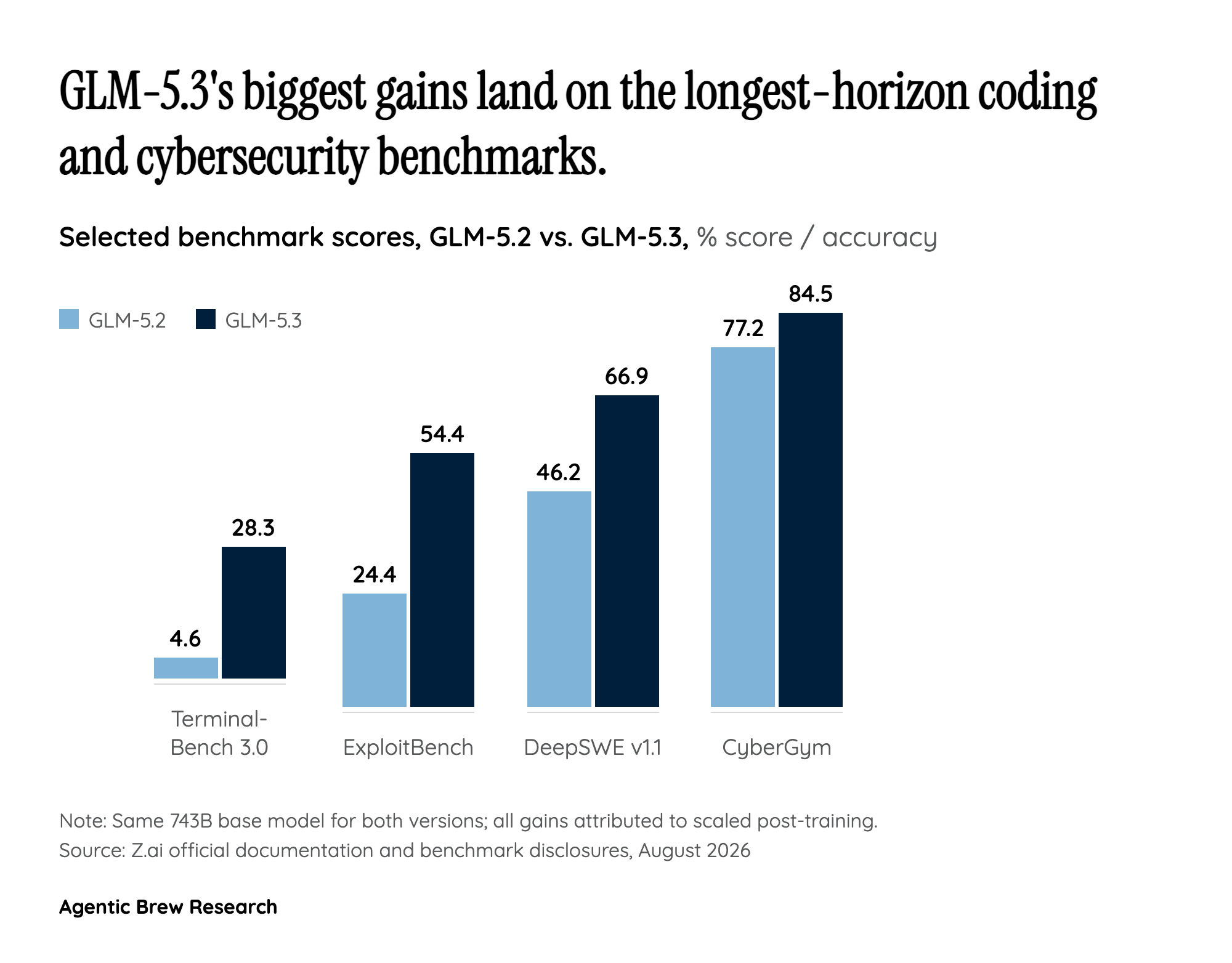
GLM-5.3 runs on the identical 743-billion-parameter mixture-of-experts base that powered GLM-5.2 [1]- Z.ai did not pretrain a new model at all. Instead, every capability jump came from scaling up post-training: more task environments, more environment types, and longer training runs layered onto the existing base. The clearest signal is Terminal-Bench 3.0, a benchmark for long-horizon coding tasks, where the score moved from 4.6 under GLM-5.2 to 28.3 under GLM-5.3 [2], the single largest gain reported across any coding benchmark. Z.ai built its post-training stack on two open-source technologies, slime and SAO, using sandboxes designed to mimic real developer workstations [3]. Nathan Lambert of Interconnects.ai summarized the approach bluntly: scaling post-training was all Z.ai did for this release [4]. That a frontier-scale jump in agentic coding ability can come purely from post-training compute, with the base weights frozen, is a notable data point for how far reinforcement-learning-style training on realistic task environments can stretch an existing model.