NVIDIA RTX Spark Superchip for Windows AI PCs
TECH

NVIDIA RTX Spark Superchip for Windows AI PCs

60+
Signals

Strategic Overview

  • 01.
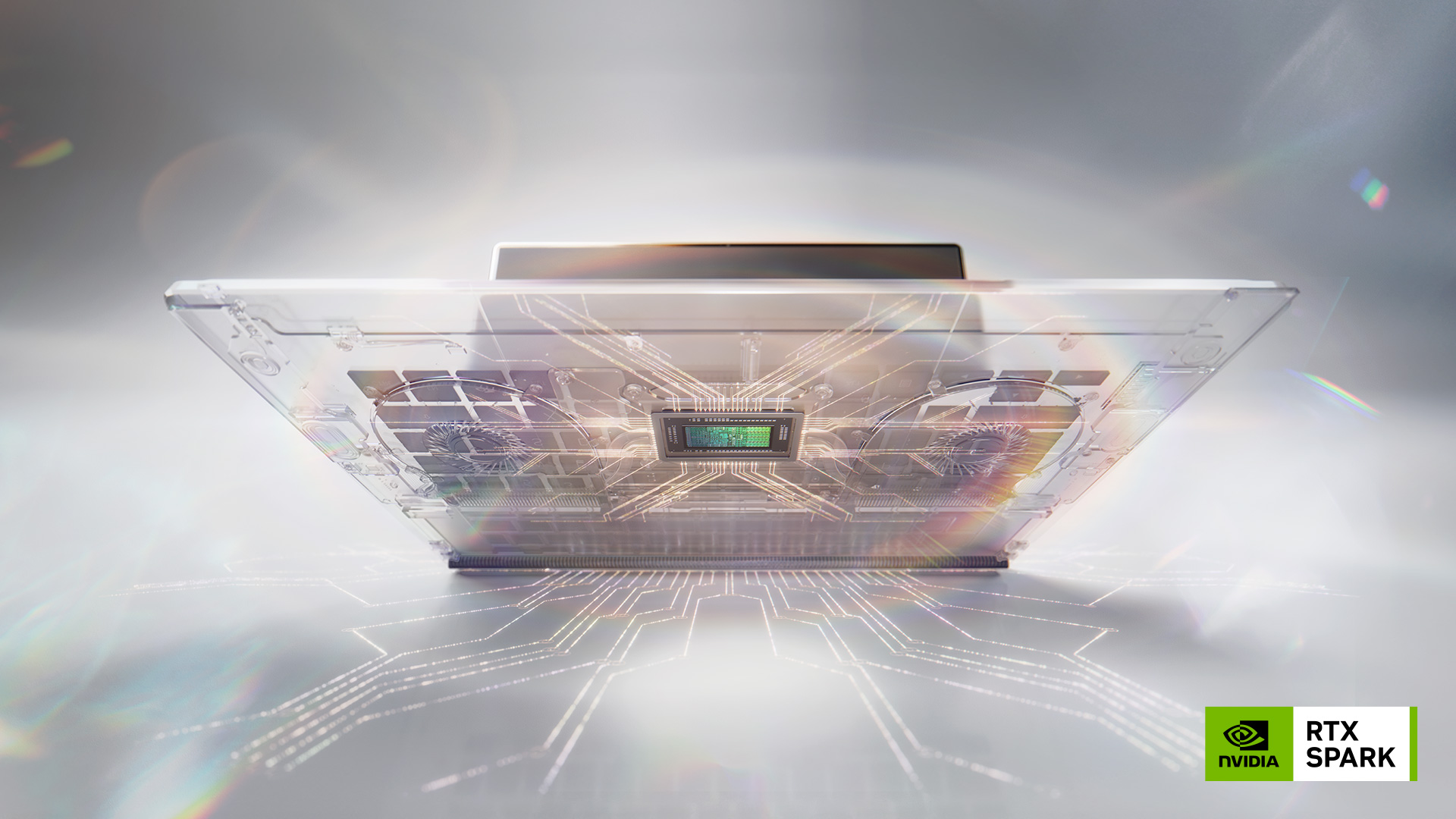
    At Computex 2026, NVIDIA unveiled the RTX Spark Superchip — a 20-core Arm Grace CPU fused with a Blackwell RTX GPU (6,144 CUDA cores, 5th-gen Tensor Cores) and up to 128GB of unified LPDDR5X memory, delivering up to 1 petaflop of FP4 AI performance.
  • 02.
    NVIDIA says RTX Spark systems can run 120-billion-parameter LLMs locally with up to 1 million tokens of context, render 90GB+ 3D scenes, edit 12K 4:2:2 video, generate 4K AI video, and play AAA games at 1440p over 100 FPS with DLSS and ray tracing.
  • 03.
    The chip is co-designed with MediaTek, fabricated on TSMC's 3nm process with 70 billion transistors, and is essentially the same silicon as NVIDIA's existing data-center GB10 superchip — only the OS changes (Windows on Arm instead of DGX OS).
  • 04.
    First RTX Spark systems ship fall 2026 across 30+ laptops and 10+ desktops from Microsoft Surface, ASUS, Dell, HP, Lenovo, and MSI — with the Surface Laptop Ultra serving as Microsoft's flagship debut device.

Deep Analysis

It's the Same Chip You've Been Buying as DGX Spark

The cleanest single sentence about RTX Spark came from The Register: 'the N1X and GB10 are essentially the same chip' [6]. The silicon NVIDIA quietly shipped last October as the DGX Spark — a personal AI workstation aimed at researchers — has been rebadged, re-skinned in Windows on Arm rather than DGX OS, and dropped into a fleet of premium laptops and desktops [5]. The CPU half came from a co-design with MediaTek, the GPU is the same 6,144-CUDA-core Blackwell die, and the unified-memory ceiling tops out at the same 128GB [1]. What changed is the wrapper: an OEM coalition, a Microsoft Surface flagship, and a consumer story.

That's a smart product move, but it deserves a skeptical asterisk that Reddit's r/nvidia megathread picked up on immediately — the mod-confirmed framing across the platform was simply 'DGX Spark runs Linux, RTX Spark runs Windows on ARM,' and that pithiness captures the tension. NVIDIA gets to amortize a single piece of silicon across the workstation, prosumer, and AI-laptop markets while preserving the option to price-segment via memory tiers (a lower-tier RTX Spark variant reportedly delivers ~400 TFLOPS FP4, roughly 40% of the top SKU) [5]. Consumers, meanwhile, should ask whether they're really getting a 'new beginning for personal computers' or a thoughtfully repackaged workstation chip — and whether the pricing will reflect the latter. The top r/pcmasterrace thread was openly cynical on exactly this point; the absence of any pricing during the keynote was the loudest complaint.
Where the Real Margin War Will Be Fought

The market reaction told the cleaner story than any keynote slide: Intel dropped 6%, AMD dropped 5%, NVIDIA rose 4%, and Microsoft picked up 3% on announcement day [7][8]. That's not the pattern you see when investors expect a slow-developing technical curiosity. It's the pattern you see when they think a high-margin pool is about to be drained. Cryptobriefing said it most plainly: 'the risk isn't that Nvidia captures the entire PC market overnight. It's that Nvidia captures the highest-margin segment: AI-optimized premium laptops and desktops where buyers are willing to pay more for cutting-edge capabilities' [8].

That segment matters more than the unit-share numbers suggest. Premium AI laptops are where Apple has been printing money with M-series MacBook Pros, where Intel had hoped to land Lunar Lake Copilot+ designs, and where AMD's Ryzen AI Max (Strix Halo) was supposed to anchor the Windows side [5]. ServeTheHome's reading — that RTX Spark's specs 'land squarely against AMD Ryzen AI Max and Apple M5' — is the operative one for anyone modeling segment ASPs [5]. NVIDIA doesn't need to dent the budget-laptop market to be disruptive here; it needs to peel off the buyers who would have paid $2,500+ for a MacBook Pro 16 or a high-end ROG, and it has the brand permission to do exactly that in the AI-developer and creator niches. The 30+ laptops and 10+ desktops launching this fall, anchored by Surface Laptop Ultra, are pointed at that exact buyer [3].

The Memory Bandwidth Asterisk LocalLLaMA Won't Let Go Of

NVIDIA's headline pitch — '120-billion-parameter LLMs locally with up to 1 million tokens of context' — is technically true and rhetorically slippery [1]. The r/LocalLLaMA thread, which is the most expert audience the chip has yet faced, fixated on the spec NVIDIA put in the fine print: roughly 273 GB/s of LPDDR5X memory bandwidth, with a stated platform ceiling of 'up to 300 GB/s' [3]. That number is the dividing line between marketing and engineering reality. On a dense 70B model — the workhorse local-inference target for serious users — that bandwidth means each generated token requires reading the full model from memory, and the community estimate that 'Llama 70B runs like a dog ~5 tok/s' is the kind of figure that does not survive contact with a benchmark blog.

Where the chip actually shines is the workload NVIDIA's slides emphasize but the marketing rarely names: mixture-of-experts (MoE) inference and very long context. A 120B MoE only activates a fraction of its parameters per token, so 128GB of capacity matters far more than raw bandwidth — RTX Spark can hold the full model resident while only paying the bandwidth cost for the active experts. Long-context attention is similarly capacity-bound rather than bandwidth-bound. The honest framing, captured in r/LocalLLaMA's contrarian-bullish takes — 'Now that's what I think could be called a real AI-enabled laptop, not like those Copilot+ laptops that can't actually do anything more than run benchmaxxed Phi Silica' — is that RTX Spark is the first laptop credibly built for frontier-shape models (MoE, long-context, agentic) rather than the dense 7B/13B comfort zone of the Copilot+ era. NVIDIA's marketing would be more durable if it said that out loud.

Microsoft's Second Swing at Windows on Arm

Windows on Arm has been a slow-burning embarrassment for Microsoft since the Snapdragon X launch in mid-2024, when Qualcomm and Microsoft jointly promised a Copilot+ revolution that the market politely declined [7]. RTX Spark is Microsoft's second swing, and the substantive differences are worth naming: a vastly more capable GPU pulled directly into Windows' driver and DirectX surface area, a CPU partner (MediaTek) with serious mobile-Arm pedigree, and a flagship hardware story — Surface Laptop Ultra with a 15-inch mini-LED PixelSense Ultra display, 2,000 nits peak HDR, and the same 128GB unified memory ceiling — that Microsoft is willing to put its own brand on top of [2][9]. Satya Nadella's 'unmetered intelligence to every home and every desk with Windows' framing is, for once, backed by silicon that can plausibly carry the claim [1].

The gating risk is identical to the one that hobbled Snapdragon X: x86 emulation via Microsoft's Prism translation layer. Reddit's r/nvidia thread confirmed that NVIDIA is 'working with MS, game devs, and anti-cheat providers,' which is the right list but also a long list — anti-cheat in particular has been the place where Windows on Arm has historically died. The roadmap, however, is materially different this time. NVIDIA disclosed a multi-generation Spark family at Computex — Blackwell first, then Vera Rubin Spark on LPDDR6, then Rosa Feynman Spark — signaling that the consumer push is a multi-year commitment rather than a one-off launch [4]. If Prism matures and the anti-cheat vendors fall in line, RTX Spark gives Windows the first credible answer to Apple Silicon's unified-memory pitch since Apple Silicon defined the unified-memory laptop category. That's the bet. Everything else is implementation.

Historical Context

2015-01-01
NVIDIA's last consumer CPU effort was the Tegra X1 (Nvidia Shield TV) — more than a decade before RTX Spark's consumer return.
2023-10-01
Reuters first reported NVIDIA was developing Arm-based CPUs capable of running Windows, foreshadowing what became the RTX Spark program.
2024-06-01
Microsoft and Qualcomm jointly promoted Windows-on-Arm Snapdragon X PCs for over a year prior to RTX Spark with limited market traction.
2025-10-01
NVIDIA shipped the DGX Spark personal AI supercomputer using the GB10 Grace-Blackwell silicon — the same chip now rebadged as RTX Spark for consumer Windows PCs.
2026-05-31
Jensen Huang formally unveiled RTX Spark in Taipei alongside Microsoft's Surface Laptop Ultra reveal and a 3-generation Spark roadmap (Blackwell, Vera Rubin, Rosa Feynman).

Power Map

Key Players
Subject

NVIDIA RTX Spark Superchip for Windows AI PCs

NV

NVIDIA

Chip designer and platform owner; Jensen Huang unveiled RTX Spark at the Computex 2026 keynote and outlined a 3-generation Spark roadmap (Blackwell -> Vera Rubin -> Rosa Feynman).

MI

Microsoft

OS partner shipping Windows on Arm for RTX Spark and launching the Surface Laptop Ultra as flagship hardware after a multi-year co-development effort.

ME

MediaTek

Co-designed the 20-core Arm Grace CPU portion of the RTX Spark superchip, giving NVIDIA a credible client-CPU partner.

OE

OEM coalition (ASUS, Dell, HP, Lenovo, MSI)

Initial launch partners shipping 30+ RTX Spark laptops and 10+ desktops in fall 2026, with Acer and GIGABYTE following.

IN

Intel & AMD

Incumbent x86 PC chip vendors directly targeted; both saw stock declines (Intel -6%, AMD -5%) on announcement day as investors priced in margin compression at the high end.

AP

Apple

Primary single-chip competitor; Apple Silicon M5 is the unified-memory, AI-on-device benchmark that RTX Spark explicitly targets.

AD

Adobe

Software partner building AI-native creative experiences optimized for RTX Spark's unified-memory architecture.

Fact Check

9 cited
  1. [1] NVIDIA and Microsoft Reinvent Windows PCs for AI Agents With Powerful, Efficient NVIDIA RTX Spark
  2. [2] Introducing Surface Laptop Ultra, made for world makers
  3. [3] NVIDIA unveils RTX Spark superchip at Computex 2026
  4. [4] NVIDIA unveils DGX Spark roadmap for laptops and desktop PCs at Computex 2026
  5. [5] NVIDIA Introduces RTX Spark an Arm SoC for Windows PCs
  6. [6] Nvidia recasts GB10 superchip in bid for high-end PC market
  7. [7] Nvidia debuts RTX Spark processor for Windows laptops, taking aim at Intel, AMD
  8. [8] Nvidia's RTX Spark superchip sends Intel and AMD shares tumbling
  9. [9] Microsoft Surface Laptop Ultra announced at Computex 2026

Source Articles

Top 5

THE SIGNAL.

Analysts

"Frames RTX Spark as reinventing the PC for the agentic AI era — a shift from launching apps to stating intent."

Jensen Huang
CEO, NVIDIA

"Positions RTX Spark as Microsoft's vehicle for delivering 'unmetered intelligence to every home and every desk with Windows.'"

Satya Nadella
CEO, Microsoft

"Asserts agents are the future of personal computing and that RTX Spark is purpose-built for creators, gamers, and AI developers."

Jeff Fisher
SVP of Personal Computing, NVIDIA

"Positions the Surface Laptop Ultra as the most powerful Surface laptop ever built — Microsoft's hero showcase for the new chip."

Brett Ostrum
Corporate VP, Surface, Microsoft

"Adobe is co-building AI-native creative tools optimized for RTX Spark's local-inference performance envelope."

Shantanu Narayen
CEO, Adobe

"Characterizes RTX Spark as a rebadge of NVIDIA's existing GB10 silicon for the consumer Windows market — 'Forget Wintel, we're living in a Winvidia world now.'"

The Register editorial
Industry analysis, The Register

"Argues the real Intel/AMD risk isn't total PC share but the high-margin premium AI laptop segment where buyers will pay up for cutting-edge capability."

Cryptobriefing editorial
Market analysis

"Notes RTX Spark's specs land squarely against AMD's Ryzen AI Max (Strix Halo) and Apple's M5 in the premium Windows segment."

ServeTheHome editorial
Enterprise hardware analysis
The Crowd

"NVIDIA has announced RTX Spark, a new chip for Windows PCs that combines the CPU, RTX graphics, AI hardware, and memory into a single package. The company says RTX Spark can run modern games at 1440p and over 100 FPS in thin and lightweight laptops. >It is an ARM-based chip"

@@Pirat_Nation5596

"NVIDIA RTX Spark: a 1-petaflop superchip, the full CUDA and RTX ecosystem, and Windows-native agents. A new beginning for personal computers."

@@nvidia2964

"This is the @NVIDIARTXSpark Superchip. A new beginning for personal computers. Designed for creators, AI developers, and gamers, RTX Spark brings over 30 years of NVIDIA innovation to slim Windows laptops and small, ultra-efficient desktop PCs."

@@NVIDIAGeForce1093

"NVIDIA just announced the RTX Spark CPU, developed with Microsoft, at Computex."

@u/pedro193900
Broadcast
Nvidia's New Laptops - RTX Spark

Nvidia's New Laptops - RTX Spark

NVIDIA RTX Spark Reinvents Windows PCs for the Age of Personal AI

NVIDIA RTX Spark Reinvents Windows PCs for the Age of Personal AI

Nvidia's Computex 2026 Keynote in Less Than 12 Minutes

Nvidia's Computex 2026 Keynote in Less Than 12 Minutes